
Red Gallery – Northern Cardinal

Photo Gallery


© HJ Ruiz – Avian101
Share this:

Photography of Birds – Set # 111
Set # 111
White-crowned Sparrow
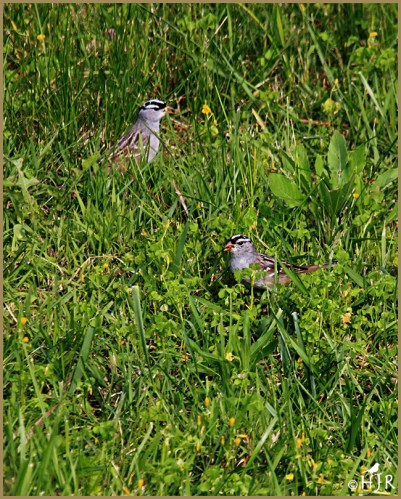
White-crowned Sparrow
These birds forage on the ground or in low vegetation, but sometimes make short flights to catch flying insects. They mainly eat seeds, other plant parts and insects. In winter, they often forage in flocks.
White-crowned sparrows nest either low in bushes or on the ground under shrubs and lay three to five brown-marked gray or greenish-blue eggs.
The white-crowned sparrow is known for its natural alertness mechanism, which allows it to stay awake for up to two weeks during migration.
White-throated Sparrow
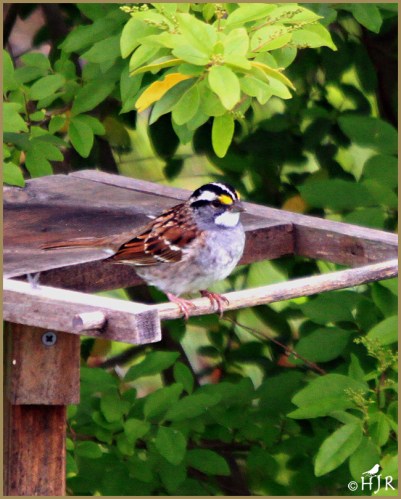
White-throated Sparrow
White-throated sparrows produce song laterally through the left side of their syrinx, and control of their syrinx involves both their central and peripheral nervous systems. After damage to motor control of the left side of the syrinx, individuals were still able to produce sound but their song pattern was distorted, indicating the left side chiefly controls their production of song. There are at least two distinct songs sung by this species. One consists of an initial note, followed by three or so repeated notes at an interval of about a major third above. The second song consists of an initial note, a second a whole step lower, and a third note, repeated two or three times, about a minor third below that.
© HJ Ruiz – Avian101
Share this:

Photography of Birds – Set # 110
Set # 110
Northern Mockingbird
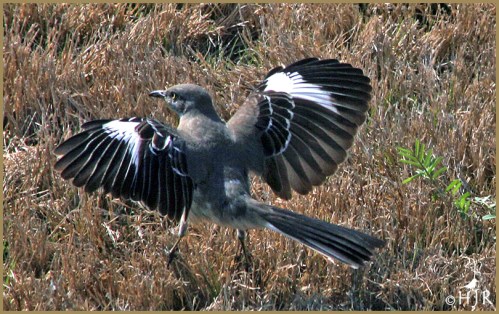
Northern Mockingbird
Both the male and female are involved in the nest building. The male does most of the work, while the female perches on the shrub or tree where the nest is being built to watch for predators. The nest is built approximately three to ten feet above the ground. The outer part of the nest is composed of twigs, while the inner part is lined with grasses, dead leaves, moss, or artificial fibers. The eggs are a light blue or greenish color and speckled with dots. The female lays three to five eggs, and she incubates them for nearly two weeks. Once the eggs are hatched, both the male and female will feed the chicks.
Eastern Kingbird
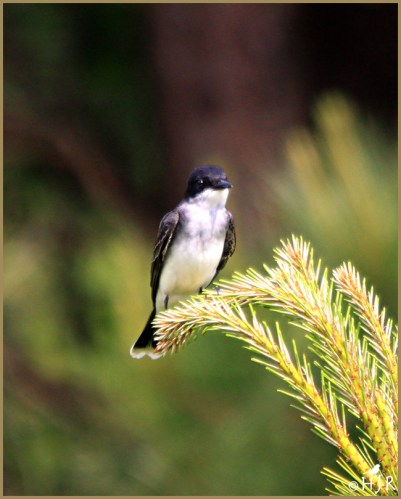
Eastern Kingbird
Some eastern kingbirds place their nests in the open, while others hide their nests well. Eastern kingbirds in southern British Columbia may nest in open fields, in shrubs over open water, high up in trees, and even in the tops of small stumps. Both male and female participate in nest defense, but females may stay on well-hidden nests longer than females with open nests, who may leave nests earlier to chase away predators. Those pairs nesting in the open may be able to see predators coming earlier and rely on aggressive behavior to protect their young.
HJ Ruiz – Avian101
Share this:

Framed Memories – # 9
Photo Gallery
-

- House Finch
-
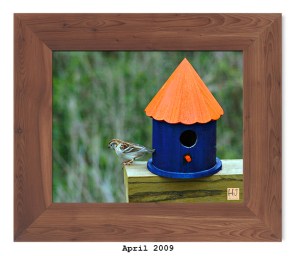
- Chipping Sparrow
© HJ Ruiz – Avian101
Share this:


Read Past Reviews

Book # 69

Quote from the Author
“A good chuckle is healthy, it helps you break the monotony of a serious life.” ~ H.J. Ruiz
 H.J. Ruiz - Avian101
You must be logged in to post a comment.