Red Gallery – Northern Cardinal
Photo Gallery


© HJ Ruiz – Avian101
Share this:

Photography of Birds – Set # 116
Set # 116
Brown Thrasher

Brown Thrasher
Brown Thrashers spend most of their time on ground level or near it. When seen, it is commonly the males that are singing from unadorned branches. The brown thrasher has been noted for having an aggressive behavior, and is a staunch defender of its nest. However, the name does not come from attacking perceived threats, but is believed to have come from the thrashing sound the bird makes when digging through ground debris. It is also thought that the name comes from the thrashing sound that is made while it is smashing large insects to kill and eventually eat.
Eastern Phoebe

Eastern Phoebe
This species appears remarkably big-headed, especially if it puffs up the small crest. Its plumage is gray-brown above. It has a white throat, dirty gray breast and buffish underparts which become whiter during the breeding season. Two indistinct buff bars are present on each wing. Its lack of an eye ring and wingbars, and its all dark bill distinguish it from other North American tyrant flycatchers, and it pumps its tail up and down like other phoebes when perching on a branch. The eastern phoebe’s call is a sharp chip, and the song, from which it gets its name, is fee-bee.
© HJ Ruiz – Avian101
Share this:

Photography of Birds – Set # 115
Set # 115
Blue-Gray Gnatcatcher
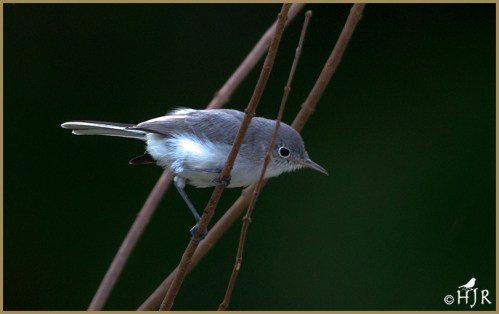
Blue-Gray Gnatcatcher
The blue-gray gnatcatcher’s breeding habitat includes open deciduous woods and shrublands in southern Ontario, the eastern and southwestern United States, and Mexico. Though gnatcatcher species are common and increasing in number while expanding to the northeast, it is the only one to breed in Eastern North America. Both parents build a cone-like nest on a horizontal tree branch, and share feeding the young. The incubation period is 13 days for both sexes, and two broods may be raised in a season.
Gray Catbird
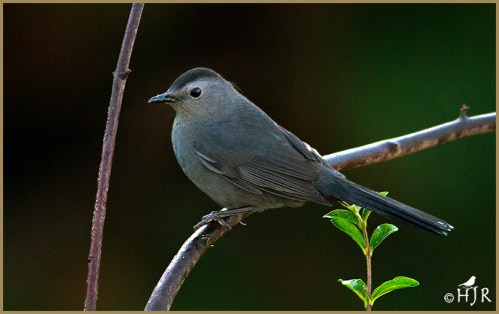
Gray Catbird
The gray catbird tends to avoid dense, unbroken woodlands, and does not inhabit coniferous, pine woodland. Catbirds prefer a dense vegetative substrate, especially if thorny vegetation is present. Scrublands, woodland edges, overgrown farmland and abandoned orchards are generally among the preferred locations of the catbird. In Bermuda, its preferred habitats are scrub and myrtle swamp. During the winter season, the catbird has an affinity for berry-rich thickets, especially within proximity of water sources.
© HJ Ruiz – Avian101
Share this:

Framed Memories – # 10
Photo Gallery
-
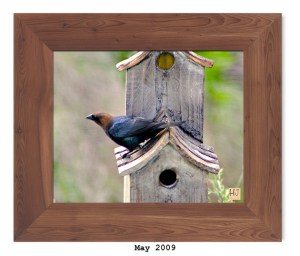
- Brown-headed Cowbird (M)
-
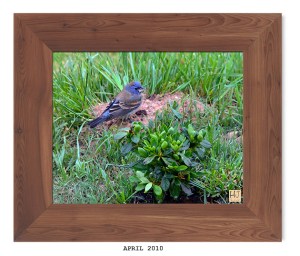
- Blue Grosbeak (M)
© HJ Ruiz – Avian101
Share this:

Read Past Reviews

Book # 69
Quote from the Author
“A good chuckle is healthy, it helps you break the monotony of a serious life.” ~ H.J. Ruiz
 H.J. Ruiz - Avian101
You must be logged in to post a comment.