
Photography of Birds – Set # 131
Set # 131
Eastern Bluebird
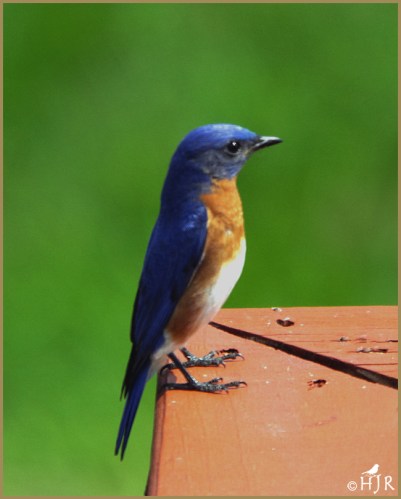
Eastern Bluebird (M)
About two thirds of an adult bluebird’s diet consists of insects and other invertebrates. The remainder is made up of wild fruits or berries. The bluebird’s preferred insect prey include grasshoppers, crickets, katydids, and beetles. Other prey include earthworms, spiders, millipedes, centipedes, sow bugs, and snails.
Common Grackle
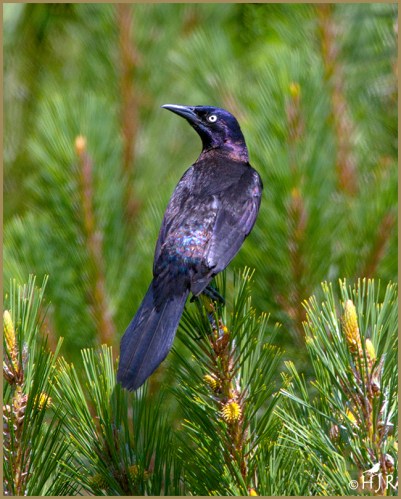
Common Grackle
In the breeding season, males tip their heads back and fluff up feathers to display and keep other males away. This same behavior is used as a defensive posture to attempt to intimidate predators. Male common grackles are less aggressive toward one another, and more cooperative and social, than the larger boat-tailed grackle species.
© HJ Ruiz – Avian101
Share this:

Photography of Birds – Set # 130
Set # 130
Cooper’s Hawk
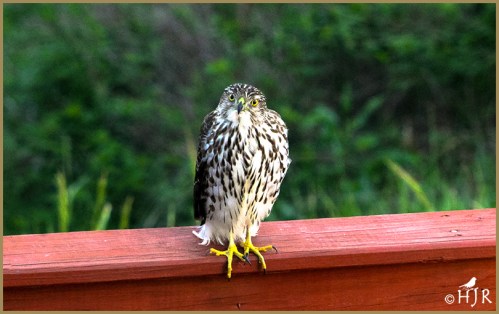
Cooper’s Hawk
Cooper’s hawks are fairly variable in size. There is usually minimal to no overlap in dimensions between the sexes, with females being considerably larger than males. On average, she may be about 20% larger linearly and around 40% heavier (though can be up to 125% more massive). More westerly Cooper’s hawks (roughly west of the Rocky mountains) show slightly less pronounced sexual dimorphism than hawks of the species elsewhere. Sexual dimorphism in Cooper’s hawks is most reliably measured by wing size, talon size, then body mass. Although there is some margin of error, within a given region dimensions of the two sexes never overlap in these regards (but may overlap marginally in tarsal and tail lengths). In general terms, Accipiter species are among the most sexually dimorphic in size of all raptorial birds.
Red-shouldered Hawk
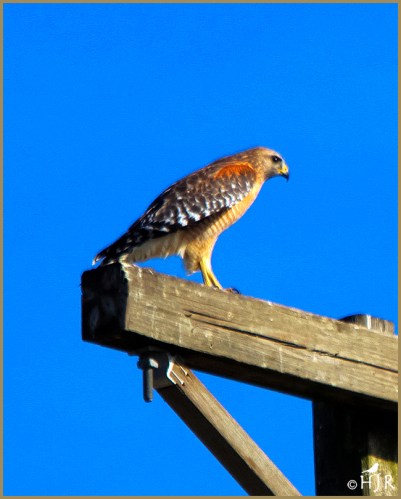
Red-shouldered Hawk
An eastern population ranges west through southern Canada from southern New Brunswick and Ontario to the eastern edge of the U.S. Great Plains, south to Florida, the Gulf Coast, and eastern Mexico. Only northernmost populations are migratory. A western population breeds west of the Sierra Nevada from northern California to northern Baja California, and has recently expanded into Oregon and Arizona, and east of the Sierra Mountains in California.
© HJ Ruiz – Avian101
Share this:

Framed Memories – # 13
Photo Gallery
-
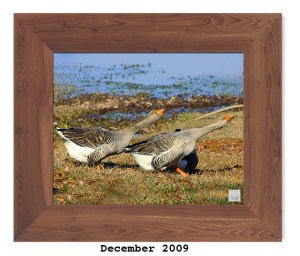
- Graylag Geese
-

- Northern Cardinal (M)
© HJ Ruiz – Avian101
Share this:

Photography of Birds – Set # 129
Set # 129
Common Moorhen

Common Moorhen
The birds are territorial during breeding season. The nest is a basket built on the ground in dense vegetation. Laying starts in spring, between mid-March and mid-May in Northern hemisphere temperate regions. About 8 eggs are usually laid per female early in the season; a brood later in the year usually has only 5–8 or fewer eggs. Nests may be re-used by different females. Incubation lasts about three weeks. Both parents incubate and feed the young.
Ring-billed Gull
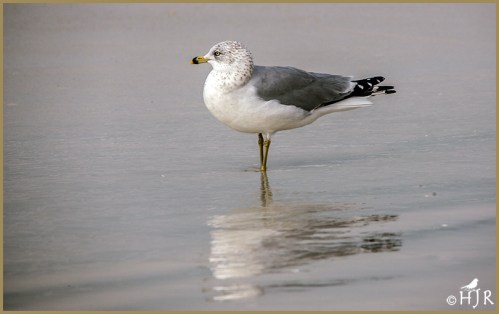
Ring-billed Gull
Ring-billed gulls forage in flight or pick up objects while swimming, walking or wading. They also steal food from other birds and frequently scavenge. They are omnivorous; their diet may include insects, fish, grain, eggs, earthworms and rodents. These birds are opportunistic and have adapted well to taking food when discarded or even left unattended by people. It is regarded as a pest by many beach-goers because of its willingness to steal unguarded food on crowded beaches.
© HJ Ruiz – Avian101
Share this:

Read Past Reviews

Book # 69

Quote from the Author
“A good chuckle is healthy, it helps you break the monotony of a serious life.” ~ H.J. Ruiz
 H.J. Ruiz - Avian101
You must be logged in to post a comment.