Photography of Birds – Set # 134
Set # 134
Snowy Egrets
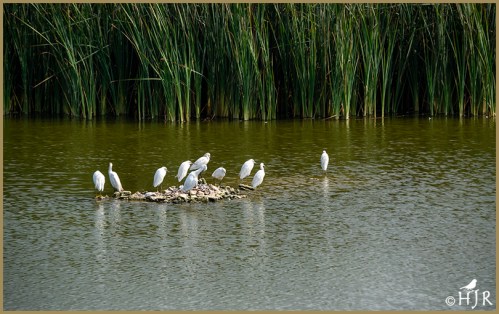
Snowy Egrets
Fossils of the snowy egret have been reported from the Talara tar seeps of Peru and in Bradenton in Manatee County and Haile XIB in Alachua County in Florida, United States. The deposits were dated to the Late Pleistocene.
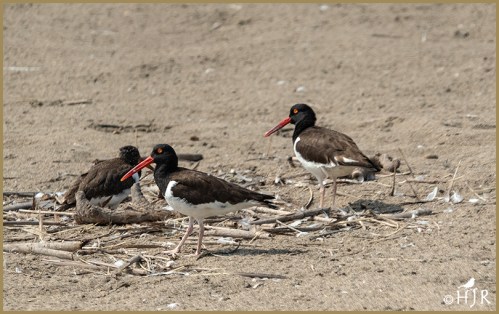
American Oystercatchers (Fam.)
During the breeding season, the American oystercatcher can be found in coastal habitats including sand or shell beaches, dunes, salt marshes, marsh islands, mudflats, and dredge spoil islands made of sand or gravel. During migration and winter, they are found feeding in mud or salt flats that are exposed by the tide. They are also found on shellfish beaches at this time.
© HJ Ruiz – Avian101
Share this:

Photography of Birds – Set # 133
Set # 133
Peruvian Booby
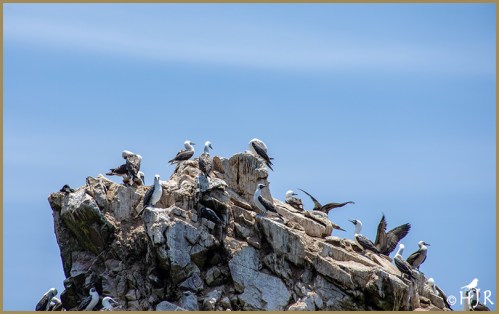
Peruvian Booby
The Peruvian booby has brown upperparts, and white underparts, as well as a white head. There is noticeable white mottling on the upper side of the wings. Their wing-coverts are tipped white, creating a scale-like pattern. They have a long, pointed, grey bill. Their feet are webbed and also grey; as opposed to the characteristic coloring of the blue-footed and red-footed boobies. Female boobies tend to be larger than their male counterparts: their bodies an average of 19% heavier, and their wings 4% larger.
Rufous-collared Sparrow
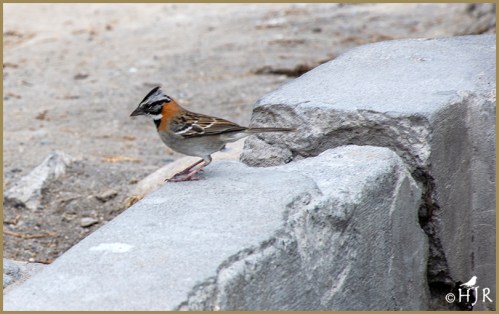
Rufous-collared Sparrow
The rufous-collared sparrow feeds on the ground on seeds, fallen grain, insects and spiders. It will sometimes join mixed-species feeding flocks and has been observed to pick termites from spider webs. It is usually seen in pairs which hold small territories, or in small flocks. Tame and approachable, it is common throughout its large range and not considered threatened by the IUCN.
© HJ Ruiz – Avian101.
Share this:

Photography of Birds – Set # 132
Set # 132
Sanderlings
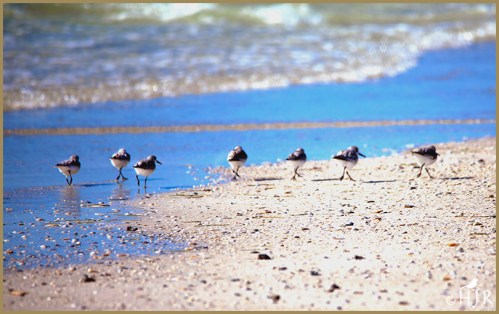
Sanderlings
Sanderlings feed on invertebrate prey buried in the sand in the upper intertidal zone. In North America, this diet largely consists isopods and the mole crab. When the tide is out, these crustaceans live in burrows some way beneath the surface. When the tide comes in, they move into the upper layers of sand and feed on the plankton and detritus that washes over them with each wave. They then burrow rapidly down again as the water retreats. They leave no marks on the surface, so the sanderlings hunt for them by plunging their beaks into the sand at random, consuming whatever they find.
Reddish Egret
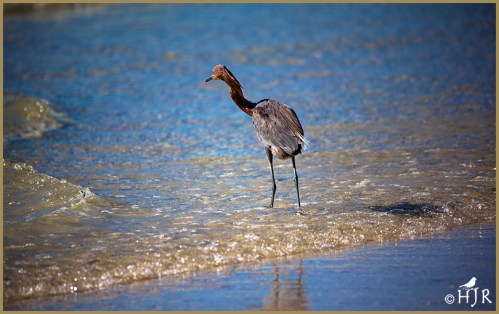
Reddish Egret
Reddish egrets’ breeding habitat is tropical swamps. It nests in colonies, often with other herons, usually on platforms of sticks in trees or shrubs. These colonies are usually located on coastal islands. These birds have raucous courtship displays. They generally involve shaking of the head during the greeting ceremony, followed by chases and circle flights. They also involve raising of the neck, back and crest feathers, accompanied by bill clacking, similar to the tricolored heron.
© HJ Ruiz – Avian101
Share this:

Red Gallery – Northern Cardinal

Photo Gallery


Happy Anniversary with WordPress.com! You registered on WordPress.com 11 years ago.
© HJ Ruiz – Avian101
Share this:

Read Past Reviews

Book # 69
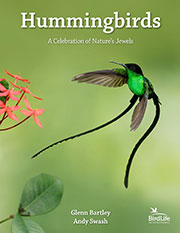
Quote from the Author
“A good chuckle is healthy, it helps you break the monotony of a serious life.” ~ H.J. Ruiz
 H.J. Ruiz - Avian101
You must be logged in to post a comment.