
Framed Memories – # 15
Photo Gallery
-
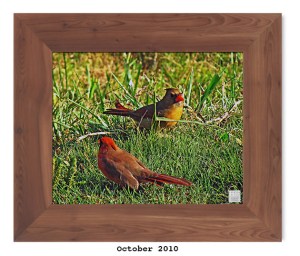
- Northern Cardinals
-
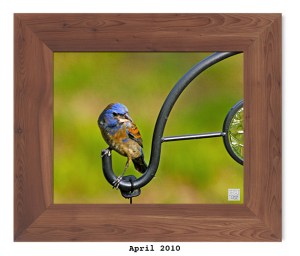
- Blue Grosbeak
© HJ Ruiz – Avian101
Share this:

Photography of Birds – Set # 139
Set # 139
Red-winged Blackbird (M)
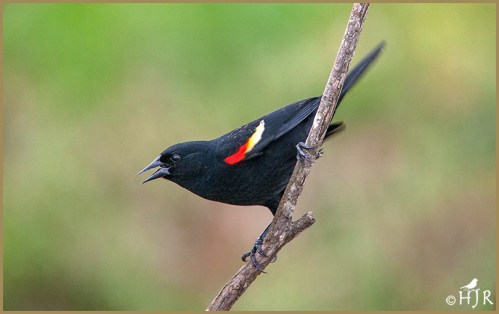
Red-winged Blackbird (M)
Red-winged Blackbird (F)
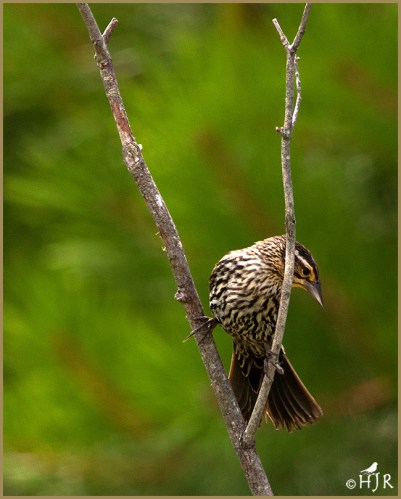
Red-winged Blackbird (F)
The red-winged blackbird is sexually dimorphic; the male is all black with a red shoulder and yellow wing bar, while the female is a nondescript dark brown. Seeds and insects make up the bulk of the red-winged blackbird’s diet.
© HJ Ruiz – Avian101
Share this:

Photography of Birds – Set # 138
Set # 138
Song Sparrow
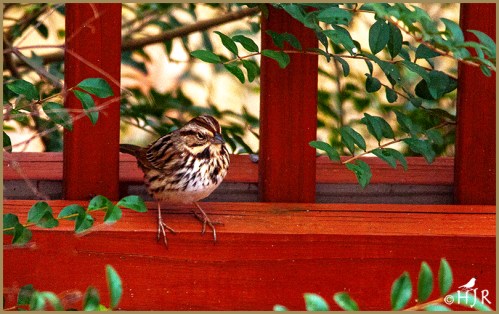
Song Sparrow
Common predators to the song sparrow include cats, hawks, and owls, however snakes, dogs, and the American kestrel are treated ambiguously, suggesting that they are less of a threat. The song sparrow recognizes enemies by both instinctual and learned patterns (including cultural learning), and adjusts its future behavior based on both its own experiences in encounters, and from watching other birds interact with the enemies. Comparisons of experiments on hand-raised birds to observation of birds in the wild suggest that the fear of owls and hawks is instinctual, but fear of cats is learned.
Lincoln’s Sparrow
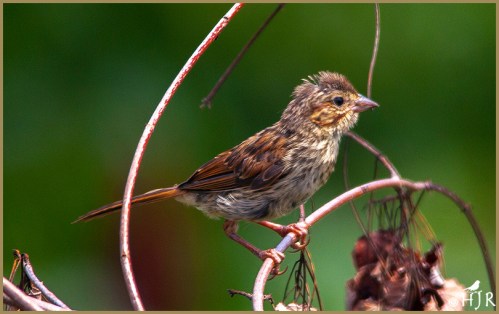
Lincoln’s Sparrow
This bird was named by Audubon after his friend, Thomas Lincoln, of Dennysville, Maine. Lincoln shot the bird on a trip with Audubon to Nova Scotia in 1834, and Audubon named it “Tom’s Finch” in his honor.
© HJ Ruiz – Avian101
Share this:

Photography of Birds – Set # 137
Set # 137
Indigo Bunting

Indigo Bunting
The indigo bunting forages for food on the ground or in trees or shrubs. In winter, it often feeds in flocks with other indigo buntings, but is a solitary feeder during the breeding season. During the breeding season, the species eats insects, seeds and berries, including caterpillars, grasshoppers, spiders, beetles, and grass seeds. The seeds of grasses are the mainstay of its diet during the winter, although buds, and insects are eaten when available. The young are fed mainly insects at first, to provide them with protein. The indigo bunting does not drink frequently, generally obtaining sufficient water from its diet.
Blue Grosbeak (Juv.)

Blue Grosbeak (Juv.)
This is a migratory bird, with nesting grounds across most of the southern half of the United States and much of northern Mexico, migrating south to Central America and in very small numbers to northern South America; the southernmost record comes from eastern Ecuador. It eats mostly insects, but it will also eat snails, spiders, seeds, grains, and wild fruits. The blue grosbeak forages on the ground and in shrubs and trees.
© HJ Ruiz – Avian101
Share this:

Read Past Reviews

Book # 69
Quote from the Author
“A good chuckle is healthy, it helps you break the monotony of a serious life.” ~ H.J. Ruiz
 H.J. Ruiz - Avian101
You must be logged in to post a comment.