
Photography of Birds – Set # 142
Set # 142
Ruby-throated Hummingbird

Ruby-throated Hummingbird (M)

Ruby-throated Hummingbird (M)
These photos were shot within a fraction of a second, this birds can do that with their throat feathers.
Hummingbirds have many skeletal and flight muscle adaptations which allow great agility in flight. Muscles make up 25–30% of their body weight, and they have long, blade-like wings that, unlike the wings of other birds, connect to the body only from the shoulder joint. This adaptation allows the wing to rotate almost 180°, enabling the bird to fly not only forward but backward, and to hover in mid-air, flight capabilities that are similar to insects and unique among birds.
A hummingbird’s ability to hover is due to its small mass, high wingbeat frequency and relatively large margin of mass-specific power available for flight. Hummingbirds achieve ability to support their weight and hover from wing beats creating lift on the downstroke of a wing flap and also on the upstroke in a ratio of 75%:25%, respectively, similarly to an insect. Hummingbirds and insects gain lift during hovering partially through inversion of their cambered wings during an upstroke. During hovering, hummingbird wings beat up to 80 times per second.
Based on my own observations, I’ve seen them chase each other at high speed and then brake in the air down to zero. On one occasion I was shooting pictures of one of them, it saw me and flew rapidly toward me, it stopped right in front of the camera then turned back to the nectar feeder. I thought it was going to crash into me.
© HJ Ruiz – Avian101
Share this:

Red Gallery – Northern Cardinal

Photo Gallery


© HJ Ruiz – Avian101
Share this:

Photography of Birds – Set # 141
Set # 141
Brown-headed Nuthatch
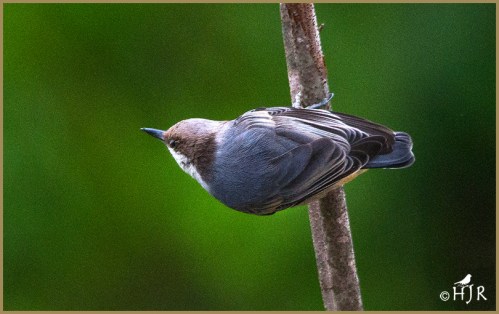
Brown-headed Nuthatch
The bird, like other nuthatches, possesses a sharp black nail-like beak, which it uses to pound open seeds. It is a frequent visitor to feeding stations and is highly fond of sunflower seeds and suet cakes.
Carolina Chickadee
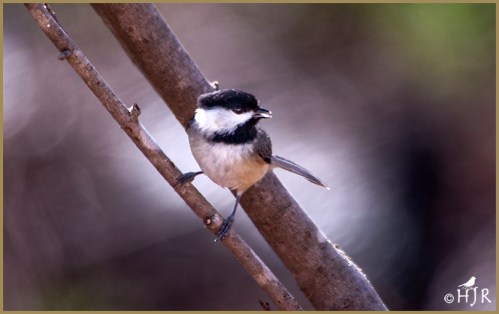
Carolina Chickadee
Their breeding habitat is mixed or deciduous woods in the United States from New Jersey west to southern Kansas and south to Florida and Texas; there is a gap in the range at high altitudes in the Appalachian Mountains where they are replaced by their otherwise more northern relative, the black-capped chickadee. They nest in a hole in a tree; the pair excavates the nest, using a natural cavity or sometimes an old woodpecker nest. They may interbreed with black-capped chickadees where the ranges overlap, which can make identification difficult.They are permanent residents, not usually moving south even in severe winter weather.
© HJ Ruiz – Avian101
Share this:

Photography of Birds – Set # 140
Set # 140
American Goldfinch (M)
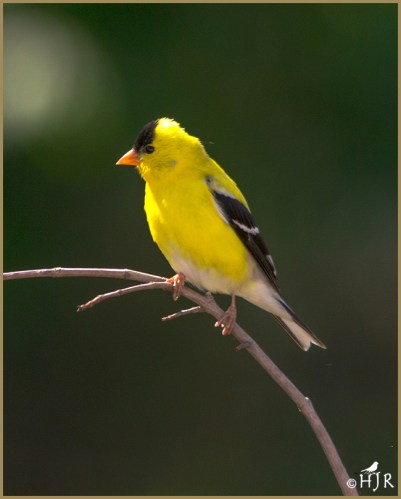
American Goldfinch (M)
American Goldfinch (F)

American Goldfinch (F)
The American goldfinch is gregarious during the non-breeding season, when it is often found in large flocks, usually with other finches. The social hierarchy, measured by how many aggressive encounters are won by each individual, tends towards the male being dominant in the non-breeding season. During the breeding season, this finch lives in loose colonies. While the nest is being constructed, the male will act aggressively toward other males who intrude into his territory, driving them away, and the female reacts in the same way toward other females. This aggressiveness subsides once the eggs have been laid. The social hierarchy in the breeding season generally has the female dominant over the male. Dominance may change based on the value of a resource; a study published in 1987 found that starved subordinate birds were sometimes dominant in competitions over feeder access.
© HJ Ruiz – Avian101
Share this:

Read Past Reviews

Book # 69
Quote from the Author
“A good chuckle is healthy, it helps you break the monotony of a serious life.” ~ H.J. Ruiz
 H.J. Ruiz - Avian101
You must be logged in to post a comment.