Photography of Birds – Set # 145
Set # 145
Chipping Sparrow

Chipping Sparrow
The male chipping sparrow start arriving at the breeding grounds from March (in more southern areas, such as Texas)) to mid-May (in southern Alberta and northern Ontario). The female arrives one to two weeks later, and the male starts singing soon after to find and court a mate. After pair formation, nesting begins (within about two weeks of the female’s arrival). Overall, the breeding season is from March till about August.
Field Sparrow

Field Sparrow
The field sparrow is distributed across eastern Canada and the eastern United States, with northern populations migrating southwards to southern United States and Mexico in the fall. The typical habitat of this bird is bushy country with shrubs and grassland. The nest is a cup-shaped construction built on the ground and hidden beneath a bush or clump of grass. The birds forage on the ground or in low vegetation, feeding mainly on seeds and insects. The population is thought to be in slow decline, but it is a common species with a wide range, and the International Union for Conservation of Nature has assessed its conservation status as being of “least concern“.
© HJ Ruiz – Avian101
Share this:

Framed Memories – # 16
Photo Gallery
-
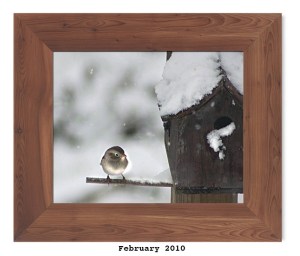
- Field Sparrow
-
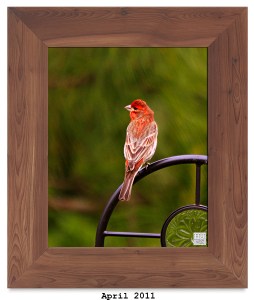
- House Finch (M)
© HJ Ruiz – Avian101
Share this:

Photography of Birds – Set # 144
Set # 144
Lincoln’s Sparrow
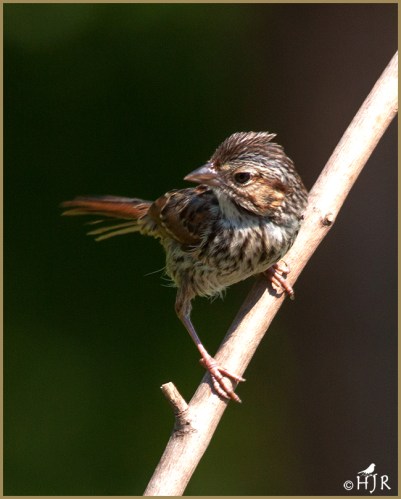
Lincoln’s Sparrow
Adults have dark-streaked olive-brown upperparts with a light brown breast with fine streaks, a white belly, and a white throat. They have a brown cap with a grey stripe in the middle, olive-brown wings, and a narrow tail. Their face is grey with brown cheeks, a brown line through the eye, and an eye ring. They are somewhat similar in appearance to the song sparrow.
Song Sparrow
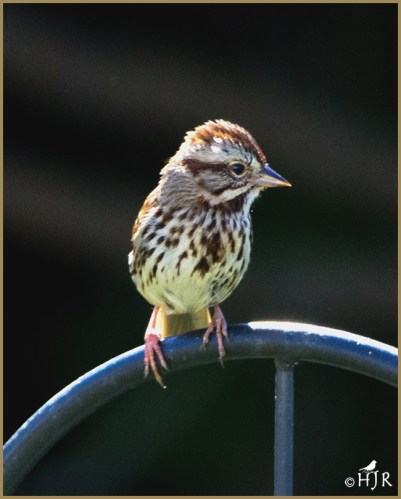
Song Sparrow
The sparrow species derives its name from its colorful repertoire of songs. Enthusiasts report that one of the songs heard often in suburban locations closely resembles the opening four notes of Ludwig van Beethoven’s Symphony No. 5. The male uses a fairly complex song to declare ownership of its territory and attract females.
Singing itself consists of a combination of repeated notes, quickly passing isolated notes, and trills. The songs are very crisp, clear, and precise, making them easily distinguishable by human ears. A particular song is determined not only by pitch and rhythm but also by the timbre of the trills. Although one bird will know many songs—as many as 20 different tunes with as many as 1000 improvised variations on the basic theme, unlike thrushes, the song sparrow usually repeats the same song many times before switching to a different song.
© HJ Ruiz – Avian101
Share this:

Photography of Birds – Set # 143
Set # 143
Blue Grosbeak (M)
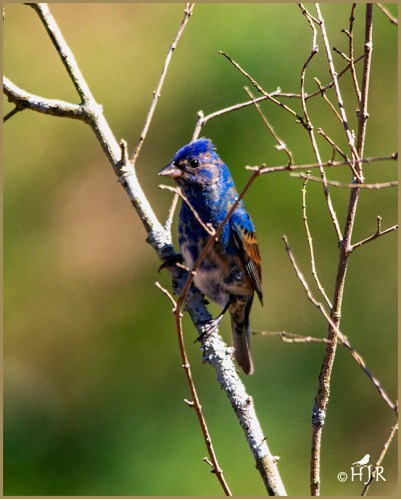
Blue Grosbeak (M)
The male blue grosbeak is deep blue, with both black and brown on its wings. The female is mostly brown. Both sexes are distinguished by their large, deep bill and double wing bars. These features, as well as the grosbeak’s relatively larger size, distinguish this species from the indigo bunting. Length can range from 14 to 19 cm (5.5 to 7.5 in) and wingspan is from 26 to 29 cm (10 to 11 in). Body mass is typically from 26 to 31.5 g (0.92 to 1.11 oz).
Indigo Bunting (M)
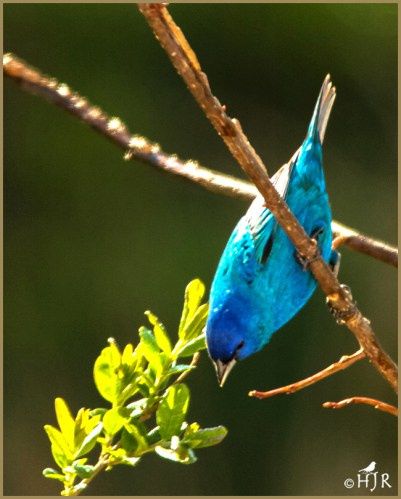
Indigo Bunting (M)
The habitat of the indigo bunting is brushy forest edges, open deciduous woods, second growth woodland, and farmland.The breeding range stretches from southern Canada to Maine, south to northern Florida and eastern Texas, and westward to southern Nevada. The winter range begins in southern Florida and central Mexico and stretches south through the West Indies and Central America to northern South America. It has occurred as a vagrant in Antigua and Barbuda, Barbados, Denmark, Ecuador, Germany, Iceland, Ireland, Netherlands, the Netherlands Antilles, Saint Pierre and Miquelon, Serbia and the United Kingdom.
© HJ Ruiz – Avian101
Share this:

Read Past Reviews

Book # 69

Quote from the Author
“A good chuckle is healthy, it helps you break the monotony of a serious life.” ~ H.J. Ruiz
 H.J. Ruiz - Avian101
You must be logged in to post a comment.