Photography of Birds – Set # 148
Set # 148
Pine Warbler (M)
-

- Male
-
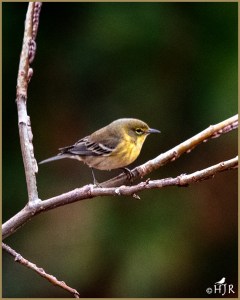
- Female
They forage slowly on tree trunks and branches by poking their bill into pine cones. These birds also find food by searching for it on the ground. These birds mainly eat insects, seeds and berries.
Their nests are deep, open cups, which are placed near the end of a tree branch. Pine warblers prefer to nest in pine trees, hence their names. Three to five blotched white eggs are laid.
© HJ Ruiz – Avian101
Share this:

Photography of Birds – Set # 147
Set # 147
White-breasted Nuthatch

White-breasted Nuthatch
The female has, on average, a narrower black back band, slightly duller upperparts and buffer underparts than the male. Her cap may be gray, but many females have black caps and cannot be reliably distinguished from the male in the field. In the northeastern United States, at least 10% of females have black caps, but the proportion rises to 40–80% in the Rocky Mountains, Mexico and the southeastern U.S. Juveniles are similar to the adult, but duller plumaged.
Brown-headed Nuthatch

Brown-headed Nuthatch
The Brown-headed Nuthatch is a small songbird found in pine forests throughout the Southeastern United States. Genetic analyses indicated low differentiation between northern and southern populations in Florida. A population on the Bahamas showed moderate to high differentiation compared with Florida populations. The bird, like other nuthatches, possesses a sharp black nail-like beak, which it uses to pound open seeds. It is a frequent visitor to feeding stations and is highly fond of sunflower seeds and suet cakes.
© HJ Ruiz – Avian101
Share this:

Red Gallery – Northern Cardinal

Photo Gallery


© HJ Ruiz – Avian101
Share this:

Photography of Birds – Set # 146
Set # 146
American Goldfinch
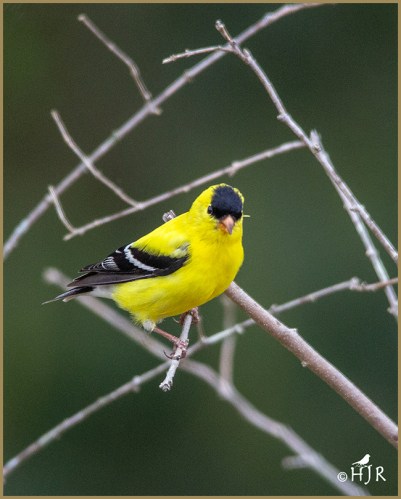
American Goldfinch (M)
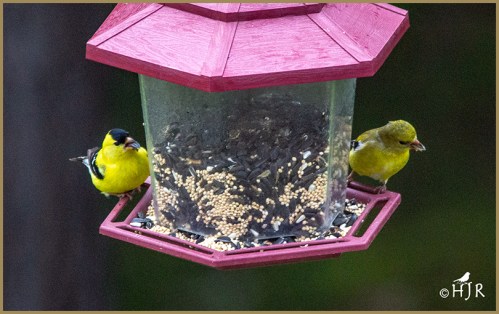
American Goldfinch (Male & Female)
The American goldfinch begins its breeding season later in the year than any other finch and later than any other native North American bird, besides occasionally the sedge wren. This may be related to the abundance of seeds in the late summer months, as seeds represent the majority of their diet.
The courtship rituals of the American goldfinch include aerial maneuvers and singing by males, who begin courtship in late July. The flight displays begin as the male pursues the female, who flies in zigzagging evasive patterns. The male is able to signal his quality and fitness, both in the short term (current body condition) and long term (genes), through ornamentation (bill color and plumage). If a female accepts the male as a mate, the pair will fly in wide circles, as the male warbles throughout the flight.
© HJ Ruiz – Avian101
Share this:

Read Past Reviews

Book # 69
Quote from the Author
“A good chuckle is healthy, it helps you break the monotony of a serious life.” ~ H.J. Ruiz
 H.J. Ruiz - Avian101
You must be logged in to post a comment.