
Photography of Birds – Set # 151
Set # 151
European Starling
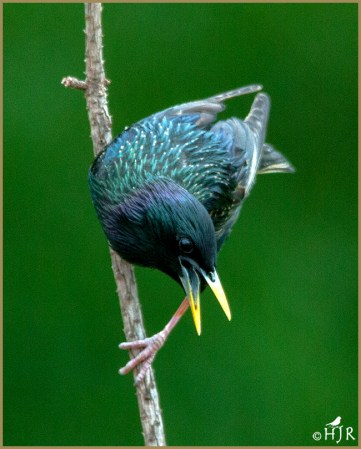
European Starling
The common starling was first described by Carl Linnaeus in his Systema Naturae in 1758 under its current binomial name. Sturnus and vulgaris are derived from the Latin for “starling” and “common” respectively. The Old English staer, later stare, and the Latin sturnus are both derived from an unknown Indo-European root dating back to the second millennium BC. “Starling” was first recorded in the 11th century, when it referred to the juvenile of the species, but by the 16th century it had already largely supplanted “stare” to refer to birds of all ages. The older name is referenced in William Butler Yeats’ poem “The Stare’s Nest by My Window”. The International Ornithological Congress’ preferred English vernacular name is common starling.
Common Grackle
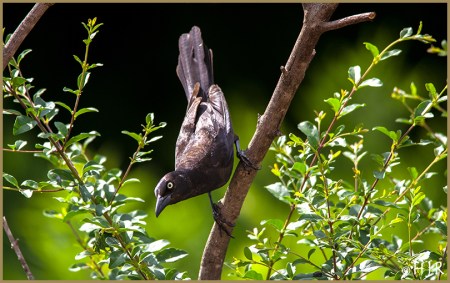
Common Grackle
Grackles have a unique adaptation in the keel within their bill which allows them to crack and cut hard nuts or kernels. The keel projects downward from the horny palate and is sharper and more abrupt anterior. It extends below the level of the tomium and is used in a sawing motion to score open acorns or dried kernels. Large adductor muscle within their jaw compared to other icteridae also makes this adaptation even more useful for opening hard seeds and acorns.
Along with some other species of grackles, the common grackle is known to practice “anting”, rubbing insects on its feathers possibly to apply liquids such as formic acid secreted by the insects.
© HJ Ruiz – Avian101
Share this:

Photography of Birds – Set # 150
Set # 150
Purple Finch (F)
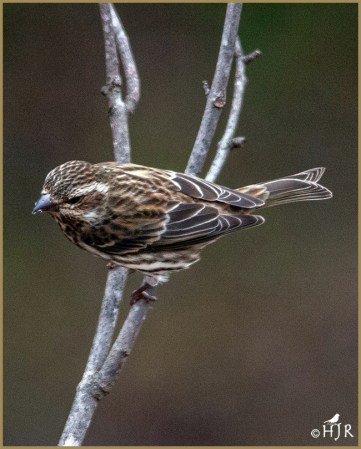
Purple Finch (F)
The Purple Finch population has declined sharply in the East due to the House Finch. Most of the time, when these two species collide, the house finch outcompetes the purple finch. This bird has also been displaced from some habitat by the introduced house sparrow.
House Finch (F)
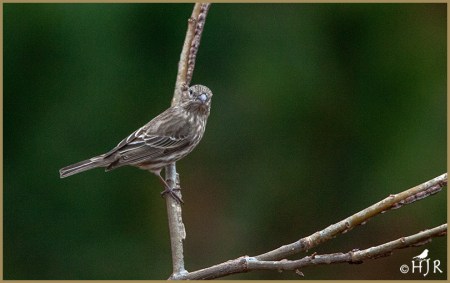
House Finch (F)
Originally only a resident of Mexico and the southwestern United States, they were introduced to eastern North America in the 1940s. The birds were sold illegally in New York City as “Hollywood Finches”, a marketing artifice. To avoid prosecution under the Migratory Bird Treaty Act of 1918, vendors and owners released the birds. They have since become naturalized; in largely deforested land across the eastern U.S., they have displaced the native purple finch and even the non-native house sparrow. In 1870, or before, they were introduced to Hawaii and are now abundant on all its major islands.
There are estimated to be anywhere from 267 million to 1.7 billion individuals across North America.
© HJ Ruiz – Avian101
Share this:

Framed Memories – # 17
Photo Gallery
-
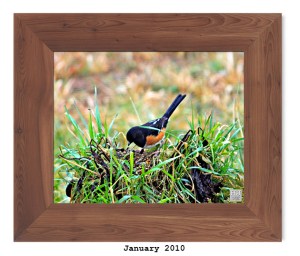
- Eastern Towhee (M)
-
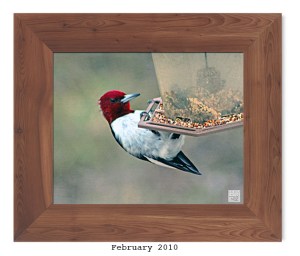
- Red-headed Woodpecker
© HJ Ruiz – Avian101
Share this:

Photography of Birds – Set # 149
Set # 149
Red-breasted Nuthatch
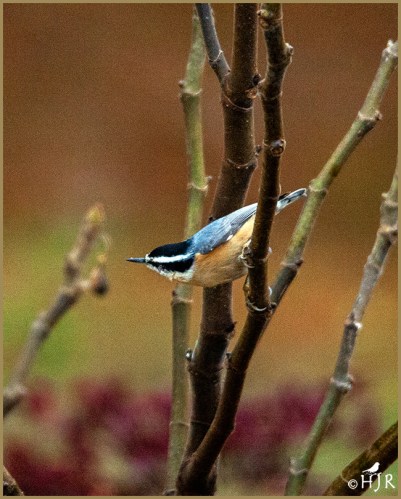
Red-breasted Nuthatch
Though it is primarily a full-time resident of northern and subalpine conifer forests, the red-breasted nuthatch regularly migrates irruptive, with both the number migrating and the wintering locations varying from year to year. They sometimes reach northern Mexico, where they are rare winter visitors to Nuevo León, Baja California Norte and south along the Pacific slope as far as Sinaloa. In the eastern United States, its range is expanding southwards.
Brown-headed Nuthatch

Brown-headed Nuthatch
Despite the other species’ common name, the brown-headed nuthatch is about the same size as the pygmy nuthatch and the two species are the world’s smallest nuthatches. In the brown-headed nuthatch, the total length is 9–11 cm (3.5–4.3 in), wingspan is 16–18 cm (6.3–7.1 in) and body mass is 10–12 g (0.35–0.42 oz)
© HJ Ruiz – Avian101
Share this:

Read Past Reviews

Book # 69
Quote from the Author
“A good chuckle is healthy, it helps you break the monotony of a serious life.” ~ H.J. Ruiz
 H.J. Ruiz - Avian101
You must be logged in to post a comment.