Photography of Birds – Set # 156
Set # 156
Blue Jay

Blue Jay
The blue jay mainly feeds on nuts and seeds such as acorns, soft fruits, arthropods, and occasionally small vertebrates. It typically gleans food from trees, shrubs, and the ground, though it sometimes hawks insects from the air. Blue Jays can be very aggressive towards other birds; they sometimes raid nests and have even been observed decapitating other birds. Like squirrels, blue jays are known to hide nuts for later consumption.
House Finch (M)
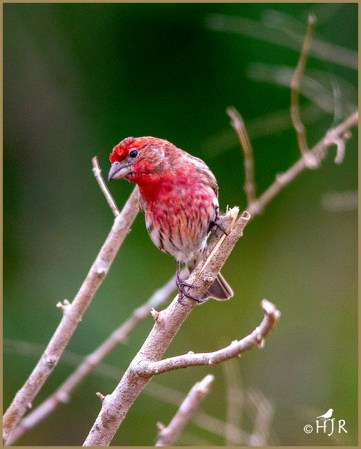
House Finch (M)
During courtship, the male will touch bills with the female. He may then present the female with choice bits of food, and if she mimics the behavior of a hungry chick, he may actually feed her. The male also feeds the female during breeding and incubation of the eggs, and raising of the young, and the male is the primary feeder of the fledgelings (who can be differentiated from the females by the pin feathers remaining on their heads). Females are typically attracted to the males with the deepest pigment of red to their head, more so than the occasional orange or yellowish-headed males that sometimes occur.
© HJ Ruiz – Avian101
Share this:

Photography of Birds – Set # 155
Set # 155
White-throated Sparrow
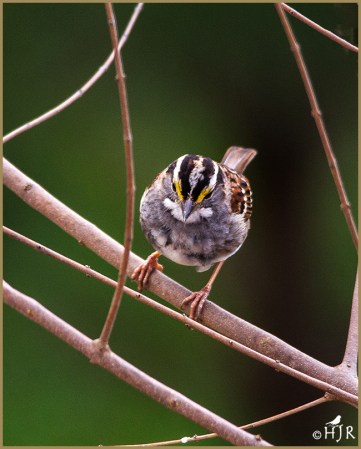
White-throated Sparrow
In winter, this species migrates to the southern and eastern United States. They are differential migrants with females migrating farther, increasing the proportion of females at lower latitudes in the Atlantic flyway. Females are smaller so they would not perform as optimally at colder, higher latitudes, and females avoid competition with the dominant males of the winter hierarchies by migrating farther. There is also no benefit for females to be among the first to return after winter, so migrating farther allows the males to return and establish territory a few weeks before their arrival. It stays year round in the Atlantic provinces of Canada.
Yellow-rumped Warbler
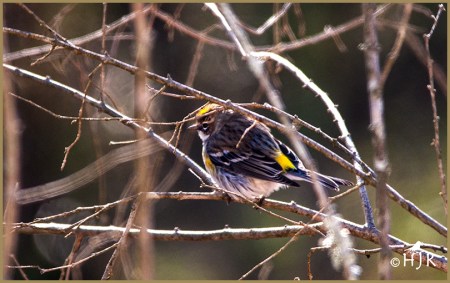
Yellow-rumped Warbler
The Yellow-rumped Warbler breeds from eastern North America west to the Pacific, and southward from there into Western Mexico. “Goldman’s” yellow-rumped warbler is a non-migratory endemic within the highlands of Guatemala and the black-fronted warbler is also a non-migratory Mexican endemic. The myrtle and Audubon’s forms are migratory, traveling to the southern U.S., Mexico, Central America, and the Caribbean for winters. Among warblers Audubon’s is by far the most widespread in North America in winter, and in the northern and central parts of the continent, it is among the last to leave in the fall and among the first to return and is an occasional vagrant to the British Isles and Iceland.
© HJ Ruiz – Avian101
Share this:

Framed Memories # 18
Photo Gallery
-
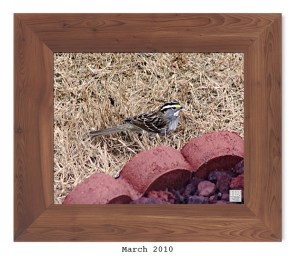
- White-throated Sparrow
-

- Song Sparrow
© HJ Ruiz – Avian101
Share this:

Photography of Birds – Set # 154
Set # 154
Northern Mockingbird
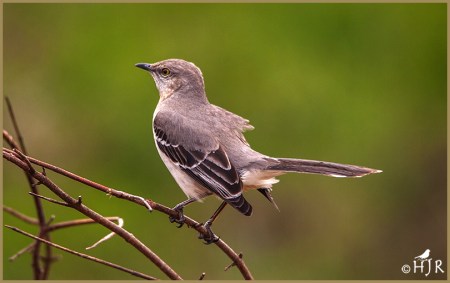
Northern Mockingbird
The Northern mockingbird’s habitat varies by location, but it prefers open areas with sparse vegetation. In the eastern regions, suburban and urban areas such as parks and gardens are frequent residential areas. It has an affinity for mowed lawns with shrubs within proximity for shade and nesting. In western regions, desert scrub and chaparral are among its preferred habitats. When foraging for food, it prefers short grass. This bird does not nest in densely forested areas, and generally resides in the same habitats year round.
Mourning Dove
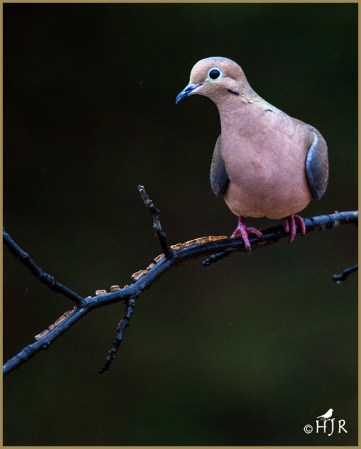
Mourning Dove
The plumage is generally light gray-brown and lighter and pinkish below. The wings have black spotting, and the outer tail feathers are white, contrasting with the black inners. Below the eye is a distinctive crescent-shaped area of dark feathers. The eyes are dark, with light skin surrounding them. The adult male has bright purple-pink patches on the neck sides, with light pink coloring reaching the breast. The crown of the adult male is a distinctly bluish-grey color. Females are similar in appearance, but with more brown coloring overall and a little smaller than the male. The iridescent feather patches on the neck above the shoulders are nearly absent, but can be quite vivid on males. Juvenile birds have a scaly appearance, and are generally darker.
© HJ Ruiz – Avian101
Share this:

Read Past Reviews

Book # 69
Quote from the Author
“A good chuckle is healthy, it helps you break the monotony of a serious life.” ~ H.J. Ruiz
 H.J. Ruiz - Avian101
You must be logged in to post a comment.