Photography of Birds – Set # 181
Set # 181
European Starlings
-

- Adults
-

- Juvenile
The common starling has about 12 subspecies breeding in open habitats across its native range in temperate Europe and across the Palearctic to western Mongolia, and it has been introduced to Australia, New Zealand, Canada, the United States, Mexico, Argentina, South Africa and Fiji. This bird is resident in western and southern Europe and southwestern Asia, while northeastern populations migrate south and west in the winter within the breeding range and also further south to Iberia and North Africa. The common starling builds an untidy nest in a natural or artificial cavity in which four or five glossy, pale blue eggs are laid.
© HJ Ruiz – Avian101
Share this:

Photography of Birds – Set # 180
Set # 180
Mourning Doves
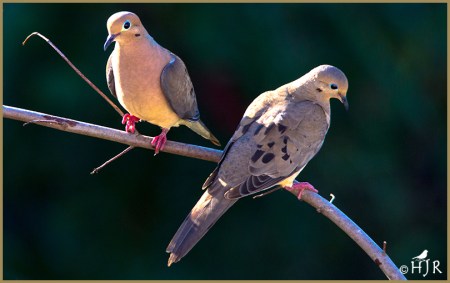
Mourning Doves
The Mourning Dove (Zenaida macroura) is a member of the dove family, Columbidae. It is one of the most abundant and widespread of all North American birds. It is also a leading gamebird, with more than 20 million birds (up to 70 million in some years) shot annually in the U.S., both for sport and for meat. Its ability to sustain its population under such pressure is due to its prolific breeding; in warm areas, one pair may raise up to six broods of two young each in a single year. The wings make an unusual whistling sound upon take-off and landing, a form of sound. The bird is a strong flier, capable of speeds up to 88 km/h (55 mph). It is the national bird of the British Virgin Islands.
Pine Siskins
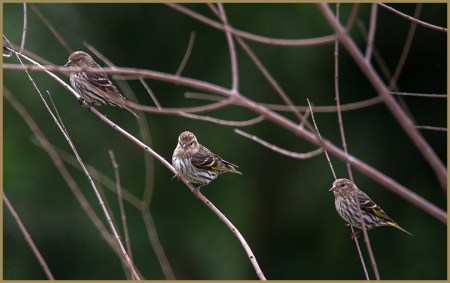
Pine Siskins
Their breeding range spreads across almost the entirety of Canada, Alaska and, to a more variable degree, across the western mountains and northern parts of the United States. As their name indicates, the species occurs mostly as a breeder in open conifer forests. Northern pine forests supports the majority of the species breeding population. However, stands of ornamental conifers or deciduous trees may support nesting birds in partially developed parks, cemeteries, and suburban woodlands. While they favor feeding in open forest canopies where cone seeds are abundant, they’ll forage in habitats as diverse as deciduous forests and thickets, meadows, grasslands, weedy fields, roadsides, chaparral, and backyard gardens and lawns. They flock to backyard feeders offering small seeds. Mineral deposits can lure them to otherwise unattractive habitats like winter road beds that are salted to melt snow and ice. The nest is well-hidden on a horizontal branch of a tree, often a conifer.
© HJ Ruiz – Avian101
Share this:

Framed Memories # 23
Photo Gallery
-
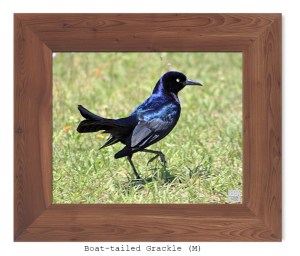
- Boat-tailed Grackle (M)
-

- Field Sparrows
© HJ Ruiz – Avian101
Share this:

Photography of Birds – Set # 179
Set # 179
Snowy Egret
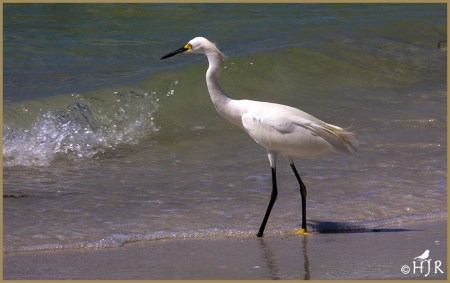
Snowy Egret
The Snowy Egret (Egretta thula) is a small white heron. The genus name comes from the Provençal French for the little egret aigrette, a diminutive of aigron, “heron”. The species name thula is the Araucano for the black-necked swan, applied to this species in error by Chilean naturalist Juan Ignacio Molina in 1782.
The snowy egret is the American counterpart to the very similar Old World little egret, which has become established in the Bahamas. At one time, the plumes of the snowy egret were in great demand as decorations for women’s hats. They were hunted for these plumes and this reduced the population of the species to dangerously low levels. Now protected in the United States by law, under the Migratory Bird Treaty Act, this bird’s population has rebounded.
Tricolored Heron

Tricolored Heron
The Tricolored Heron (Egretta tricolor), is a small species of heron native to coastal parts of the Americas; in the Atlantic region, it ranges from the northeastern United States, south along the coast, through the Gulf of Mexico and the Caribbean, to northern South America as far south as Brazil. In the Pacific region, it ranges from Peru to California, but it is only a non-breeding visitor to the far north.
© HJ Ruiz – Avian101
Share this:

Read Past Reviews

Book # 69

Quote from the Author
“A good chuckle is healthy, it helps you break the monotony of a serious life.” ~ H.J. Ruiz
 H.J. Ruiz - Avian101
You must be logged in to post a comment.