Photography of Birds – Set # 198
Set # 198
Black -necked Stilt
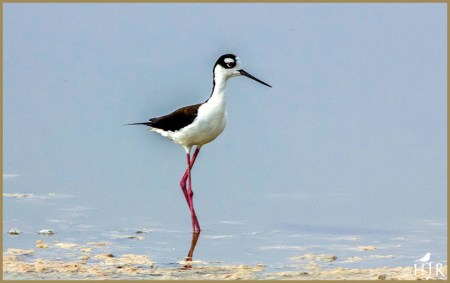
Black -necked Stilt
The Black-necked Stilt (Himantopus mexicanus) is a locally abundant shorebird of American wetlands and coastlines. It is found from the coastal areas of California through much of the interior western United States and along the Gulf of Mexico as far east as Florida, then south through Central America and the Caribbean to Ecuador and the Galápagos Islands. The northernmost populations, particularly those from inland, are migratory, wintering from the extreme south of the United States to southern Mexico, rarely as far south as Costa Rica; on the Baja California peninsula it is only found regularly in winter.
Greater Yellowlegs
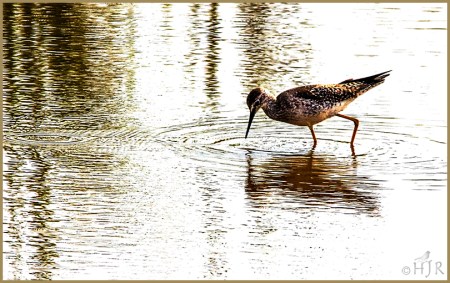
Greater Yellowlegs
These birds forage in shallow water, sometimes using their bills to stir up the water. They mainly eat insects and small fish, as well as crustaceans and marine worms. It often walks in sand or mud and leaves clear tracks; it can be possible to gather information about this species using its tracks.
© HJ Ruiz – Avian101
Share this:

Photography of Birds – Set # 197
Set # 197
Yellow-rumped Warbler
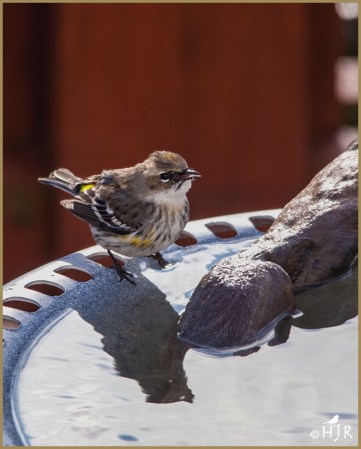
Yellow-rumped Warbler
The Yellow-rumped Warbler (Setophaga coronata) is a regular North American bird species that can be commonly observed all across the continent. Its extensive distribution range connects both the Pacific and Atlantic coasts of the U.S. as well as Canada and Central America, with the population concentrating in the continent’s northern parts during the breeding season and migrating southwards to southern North and Central America in Winter. The species generally prefers coniferous forests or mixed coniferous-deciduous forests as its breeding habitat, while during the winter it can be found inhibiting more open areas such as shrublands that offer food resources. The diet of the Yellow-rumped Warbler is based primarily on insects, though the species does eat fruits like juniper berries as well, especially in winter.
Pine Warbler
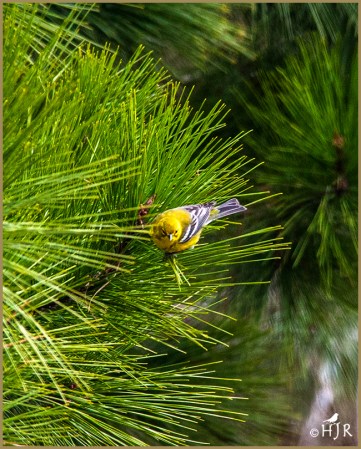
Pine Warbler
Their breeding habitats are open pine woods in eastern North America. These birds are permanent residents in southern Florida. Some of them, however, migrate to northeastern Mexico and islands in the Caribbean. The first record for South America was a vagrant wintering female seen at Vista Nieve, Colombia, on 20 November 2002; this bird was foraging as part of a mixed-species feeding flock that also included wintering Blackburnian and Tennessee warblers.
© HJ Ruiz – Avian101
Share this:

Red Art Gallery – Northern Cardinal # 7
Red Art Gallery
-
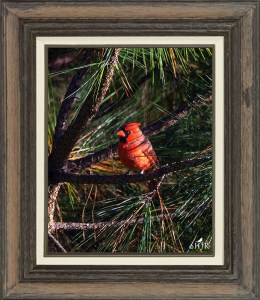
- Male
-
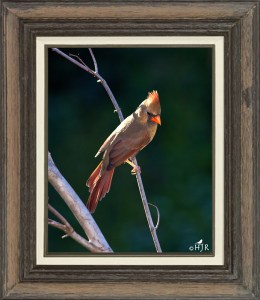
- Female
© HJ Ruiz – Avian101
Share this:

Photography of Birds – Set # 196
Set # 196
Red-bellied Woodpecker
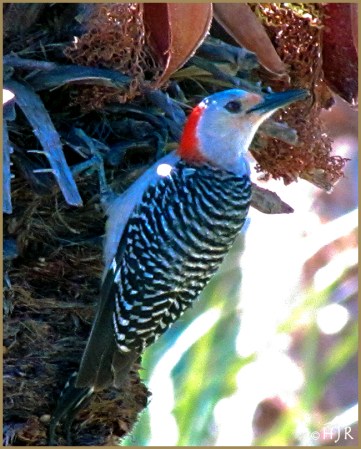
Red-bellied Woodpecker
Adult Red-bellied Woodpeckes are mainly light gray on the face and underparts; they have black and white barred patterns on their back, wings and tail. Adult males have a red cap going from the bill to the nape; females have a red patch on the nape and another above the bill. The reddish tinge on the belly that gives the bird its name is difficult to see in field identification. They are 22.85 to 26.7 cm (9.00 to 10.51 in) long, have a wingspan of 38 to 46 cm (15 to 18 in), and weigh from 2.0-3.2 oz (56-91 g).
Northern Flicker
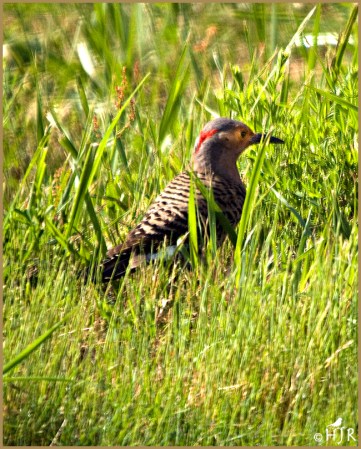
Northern Flicker
The English naturalist Mark Catesby described and illustrated the Northern Flicker in his book The Natural History of Carolina, Florida and the Bahama Islands which was published between 1729 and 1732. Catesby used the English name “Gold-winged Wood-pecker” and the Latin Picus major alis aureis. When in 1758 the Swedish naturalist Carl Linnaeus updated his Systema Naturae for the tenth edition, he included the northern flicker, coined the binomial name Cuculus auratus and cited Catesby’s book. The specific epithet auratus is a Latin word meaning “gilded” or “ornamented with gold”. The type locality is South Carolina. The northern flicker is one of 13 extant New World woodpeckers now placed in the genus Colaptes that was introduced by the Irish zoologist Nicholas Aylward Vigors in 1825 with the northern flicker (Colaptes auratus) as the type species.
© HJ Ruiz – Avian101
Share this:

Read Past Reviews

Book # 69
Quote from the Author
“A good chuckle is healthy, it helps you break the monotony of a serious life.” ~ H.J. Ruiz
 H.J. Ruiz - Avian101
You must be logged in to post a comment.