
Photography of Birds – Set # 204
Set # 204
Vermillion Flycatchers
-
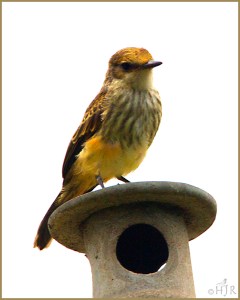
- Vermillion Flycatchers (Female)
-
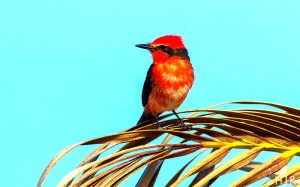
- Vermillion Flycatchers (Male)
The Vermilion Flycatcher (Pyrocephalus obscurus) is a small passerine bird in the tyrant flycatcher family found throughout South America and southern North America. It is a striking exception among the generally drab Tyrannidae due to its vermilion-red coloration. The males have bright red crowns, chests, and underparts, with brownish wings and tails. Females lack the vivid red coloration and can be hard to identify—they may be confused for the Say’s phoebe. The vermilion flycatcher’s song is a pit pit pit pidddrrrreeedrr, which is variable and important in establishing a territory. Riparian habitats and semi-open environments are preferred. As aerial insectivores, they catch their prey while flying. Their several months-long molt begins in summer.
© HJ Ruiz – Avian101
Share this:

Photography of Birds – Set # 203
Set # 203
Anhinga
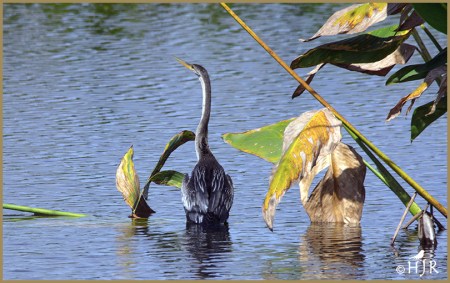
Anhinga
The Anhinga (/ænˈhɪŋɡə/; (Anhinga anhinga), sometimes called snakebird, darter, American darter, or water turkey, is a water bird of the warmer parts of the Americas. The word anhinga comes from the Brazilian Tupi language and means “devil bird” or “snake bird”. The origin of the name is apparent when swimming: only the neck appears above water so the bird looks like a snake ready to strike. They do not have external nares (nostrils) and breathe solely through their epiglottis.
Double-crested Cormorant
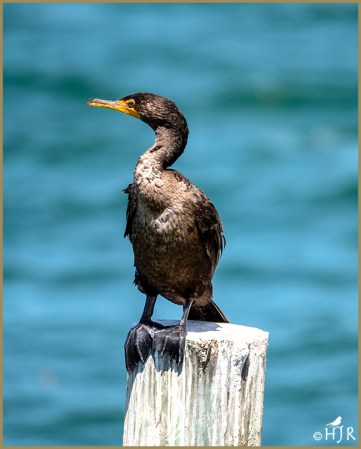
Double-crested Cormorant
The Double-crested Cormorant (Phalacrocorax auritus) is a member of the cormorant family of seabirds. Its habitat is near rivers and lakes as well as in coastal areas, and is widely distributed across North America, from the Aleutian Islands in Alaska down to Florida and Mexico. Measuring 70–90 cm (28–35 in) in length, it is an all-black bird which gains a small double crest of black and white feathers in breeding season. It has a bare patch of orange-yellow facial skin. Five subspecies are recognized. It mainly eats fish and hunts by swimming and diving. Its feathers, like those of all cormorants, are not waterproof and it must spend time drying them out after spending time in the water. Once threatened by the use of DDT, the numbers of this bird have increased markedly in recent years.
© HJ Ruiz – Avian101
Share this:

Photography of Birds – Set # 202
Set # 202
Amazilia Hummingbird
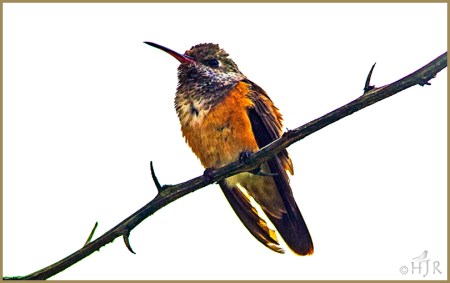
Amazilia Hummingbird
The Amazilia Hummingbird (Amazilis amazilia) is a species of hummingbird, a family of small near passerine birds. The Loja hummingbird (A. amazilia alticola), with less rufous to the underparts, is sometimes considered a subspecies of the amazilia hummingbird.
The amazilia hummingbird occurs in western Peru and south-western Ecuador. It is generally common, and can regularly be seen even in major cities such as Lima and Guayaquil. It prefers dry, open or semi-open habitats, but also occurs in forest. In its range it is easily recognized by the combination of a black-tipped red bill and mainly rufous underparts. It is a territorial species.
Ruby-throated Hummingbird

Ruby-throated Hummingbird
The Ruby-throated Hummingbird (Archilochus colubris) is a species of hummingbird that generally spends the winter in Central America, Mexico, and Florida, and migrates to Canada and other parts of Eastern North America for the summer to breed. It is by far the most common hummingbird seen east of the Mississippi River in North America.
© HJ Ruiz – Avian101
Share this:

Red Art Gallery – Northern Cardinal # 8
Red Art Gallery
-
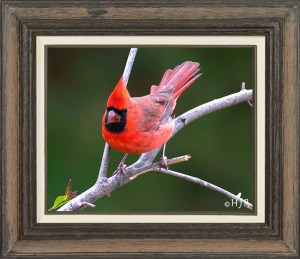
- Male
-
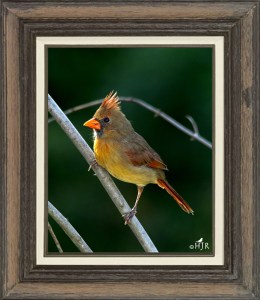
- Female
© HJ Ruiz – Avian101
Share this:

Read Past Reviews

Book # 69
Quote from the Author
“A good chuckle is healthy, it helps you break the monotony of a serious life.” ~ H.J. Ruiz
 H.J. Ruiz - Avian101
You must be logged in to post a comment.