
Framed Memories # 29
Photo Gallery

© HJ Ruiz – Avian101
Share this:

Photography of Birds – Set # 209
Set # 209
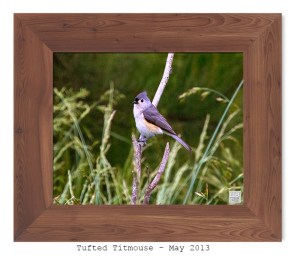
Tufted Titmouse

Tufted Titmouse
The lifespan of the Tufted Titmouse is approximately 2.1 years, although it can live for more than ten years. On average, these birds will have a clutch size of five to seven eggs. Unlike many birds, the offspring of tufted titmice will often stay with their parents during the winter, and even after the first year of their life. Sometimes, a bird born the year before will help its parents raise the next year’s young.
Carolina Chickadee
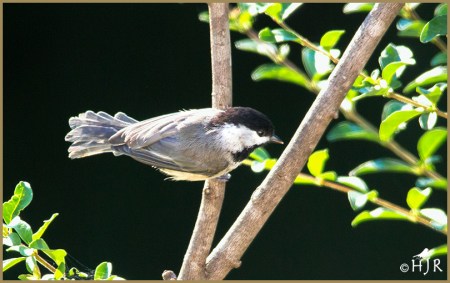
Carolina Chickadee
Their breeding habitat is mixed or deciduous woods in the United States from New Jersey west to southern Kansas and south to Florida and Texas; there is a gap in the range at high altitudes in the Appalachian Mountains where they are replaced by their otherwise more northern relative, the black-capped chickadee. They nest in a hole in a tree; the pair excavates the nest, using a natural cavity or sometimes an old woodpecker nest. They may interbreed with black-capped chickadees where the ranges overlap, which can make identification difficult. They are permanent residents, not usually moving south even in severe winter weather.
© HJ Ruiz – Avian101
Share this:

Photography of Birds – Set # 208
Set # 208
Reddish Egret

Reddish Egret
The Reddish Egret (Egretta rufescens) is a medium-sized heron. It is a resident breeder in Central America, The Bahamas, the Caribbean, the Gulf Coast of the United States, and Mexico. There is post-breeding dispersal to well north of the nesting range. In the past, this bird was a victim of the plume trade.
According to the Texas Parks and Wildlife Department, there are only 1,500 to 2,000 nesting pairs of reddish egrets in the United States — and most of these are in Texas. They are classified as “threatened” in Texas and receive special protection.
Great Egret

Great Egret
Like all egrets, it is a member of the heron family, Ardeidae. Traditionally classified with the storks in the Ciconiiformes, the Ardeidae are closer relatives of pelicans and belong in the Pelecaniformes, instead. The great egret—unlike the typical egrets—does not belong to the genus Egretta, but together with the great herons is today placed in Ardea. In the past, however, it was sometimes placed in Egretta or separated in a monotypic genus Casmerodius. The Old World population is often referred to as the “great white egret”. This species is sometimes confused with the great white heron of the Caribbean, which is a white morph of the closely related great blue heron. The scientific name comes from Latin ardea, “heron”, and alba, “white”.
© HJ Ruiz – Avian101
Share this:

Photography of Birds – Set # 207
Set # 207
Tropical Kingbirds
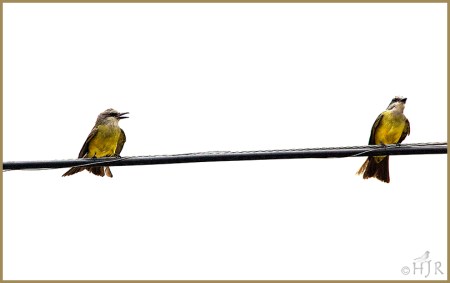
Tropical Kingbirds
The Tropical Kingbird (Tyrannus melancholicus) is a large tyrant flycatcher. This bird breeds from southern Arizona and the lower Rio Grande Valley of Texas in the United States through Central America, South America as far as south as central Argentina and Peru, and on Trinidad and Tobago. Birds from the northernmost and southern breeding areas migrate to warmer parts of the range after breeding.
Saffron Finch
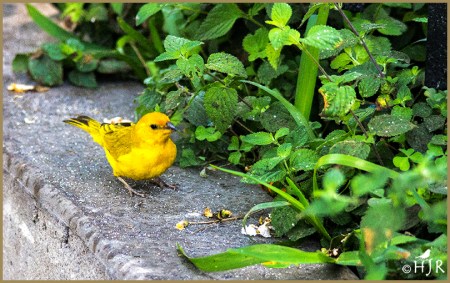
Saffron Finch
The Saffron Finch (Sicalis flaveola) is a tanager from South America that is common in open and semi-open areas in lowlands outside the Amazon Basin. They have a wide distribution in Colombia, northern Venezuela (where it is called “canario de tejado” or “roof canary”), western Ecuador, western Peru, eastern and southern Brazil (where it is called “canário-da-terra” or “native canary”), Bolivia, Paraguay, Uruguay, northern Argentina, and Trinidad and Tobago. It has also been introduced to Hawaii, Puerto Rico and elsewhere. Although commonly regarded as a canary, it is not related to the Atlantic canary. Formerly, it was placed in the Emberizidae but it is close to the seedeaters.
© HJ Ruiz – Avian101
Share this:


Read Past Reviews

Book # 69

Quote from the Author
“A good chuckle is healthy, it helps you break the monotony of a serious life.” ~ H.J. Ruiz
 H.J. Ruiz - Avian101
You must be logged in to post a comment.