Special Places – # 1 – NEW
Note from HJ:
This is a new post will be published EVERY SUNDAY, the rest of the week continues as always for birds! It will consist of photos of different places I visited during past years. Also will post photos that I consider artistic type. Keep in mind that some are scans of printed photos and film cameras. Digital Photography is much simpler now! I’m hoping you like my idea and enjoy my photographs.
Please do not think I’d leave the birds, this new post is one day a week, the bird’s post will continue for 6 days a week.
Monument Valley National Park (Utah)
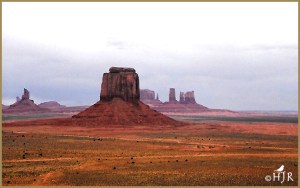

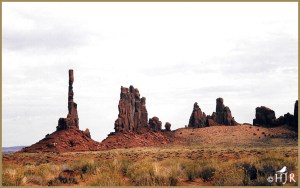
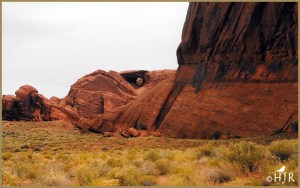
Monument Valley is a region of the Colorado Plateau characterized by a cluster of vast sandstone buttes, the largest reaching 1,000 ft (300 m) above the valley floor. It is located on the Arizona–Utah state line (around 36°59′N 110°6′W), near the Four Corners area. The valley lies within the territory of the Navajo Nation Reservation and is accessible from U.S. Highway 163.
Monument Valley has been featured in many forms of media since the 1930s. Director John Ford used the location for a number of his best-known films and thus, in the words of critic Keith Phipps, “its five square miles [13 square kilometers] have defined what decades of moviegoers think of when they imagine the American West
The area is part of the Colorado Plateau. The elevation of the valley floor ranges from 5,000 to 6,000 feet (1,500 to 1,800 m) above sea level. The floor is largely siltstone of the Cutler Group, or sand derived from it, deposited by the meandering rivers that carved the valley. The valley’s vivid red color comes from iron oxide exposed in the weathered siltstone. The darker, blue-gray rocks in the valley get their color from manganese oxide.
The buttes are clearly stratified, with three principal layers. The lowest layer is the Organ Rock Shale, the middle is de Chelly Sandstone, and the top layer is the Moenkopi Formation capped by Shinarump Conglomerate. The valley includes large stone structures including the famed “Eye of the Sun”.
Between 1945 and 1967, the southern extent of the Monument Upwarp was mined for uranium, which occurs in scattered areas of the Shinarump Conglomerate; vanadium and copper are associated with uranium in some deposits.
© HJ Ruiz – Avian101
Share this:

Red Art Gallery – Northern Cardinal # 10
Red Art Gallery
-
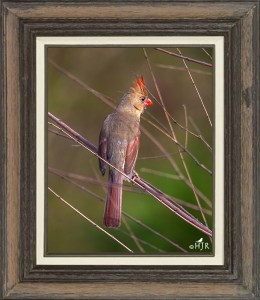
- Female
-
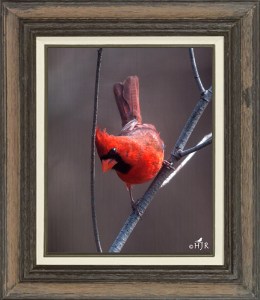
- Male
© HJ Ruiz – Avian101
Share this:

Photography of Birds – Set # 211
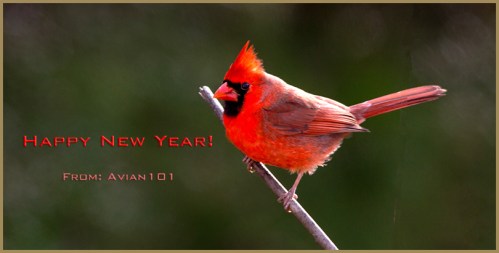
Set # 211
Vermillion Flycatcher (M)
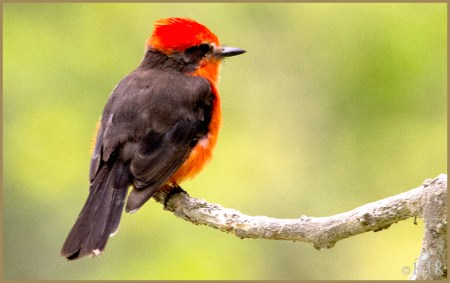
Vermillion Flycatcher (M)
Their range includes almost all of Mexico, extending north into the southwestern United States, and south to scattered portions of Central America, and parts of northwestern and central South America. It has ranged as far north as Canada. North American populations are generally resident, migrating only at the edge of the range. South American populations, especially those further south, may make long migrations to the northernmost parts of the Brazilian Amazon. This reflects a tendency to overwinter in areas where the temperature does not go below −1 °C (30 °F). Migrations may extend up to 4,000 km (2,500 mi). North American populations generally migrate by late August and return between February and April. Their ability to migrate likely aided their wide colonization of the Americas.
House Finch (M)
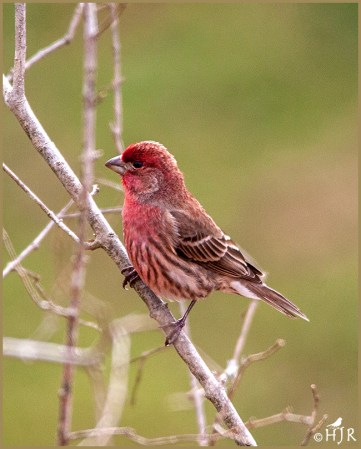
House Finch (M)
These birds are mainly permanent residents throughout their range; some northern and eastern birds migrate south. Their breeding habitat is urban and suburban areas across North America, as well as various semi-open areas in the west from southern Canada to the Mexican state of Oaxaca; the population in central Chiapas may be descended from escaped cagebirds. Analyses of nest records from House Finches in California spanning more than a century found that egg‐laying occurred significantly earlier in warmer springs.
Originally only a resident of Mexico and the southwestern United States, they were introduced to eastern North America in the 1940s. The birds were sold illegally in New York City as “Hollywood Finches”, a marketing artifice. To avoid prosecution under the Migratory Bird Treaty Act of 1918, vendors and owners released the birds. They have since become naturalized; in largely unforested land across the eastern U.S., they have displaced the native purple finch and even the non-native house sparrow. In 1870, or before, they were introduced to Hawaii and are now abundant on all its major islands. There are estimated to be anywhere from 267 million to 1.7 billion individuals across North America.
© HJ Ruiz – Avian101
Share this:

Photography of Birds – Set # 210
Set # 210
Great Blue Heron
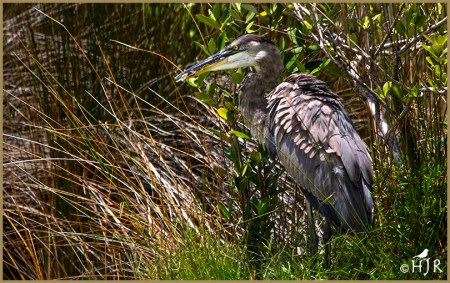
Great Blue Heron
The Great Blue Heron was one of the many species originally described by Carl Linnaeus in his 18th-century work, Systema Naturae. The scientific name comes from Latin ardea, and Ancient Greek ἐρῳδιός (erōdios), both meaning “heron”. The great blue heron is replaced in the Old World by the very similar grey heron (Ardea cinerea), which differs in being somewhat smaller (90–98 cm (35–39 in)), with a pale gray neck and legs, lacking the browner colors that the great blue heron has there. It forms a super-species with this and also with the cocoi heron from South America, which differs in having more extensive black on the head and a white breast and neck.
Anhinga
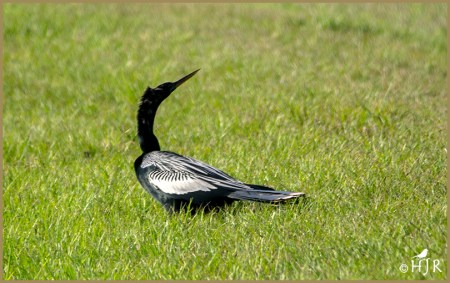
Anhinga
Anhingas swim with their webbed feet and pursue their prey, fish, under water and spear their prey by rapidly stretching out their neck. They come up to handle and swallow fish. Unlike ducks, ospreys and pelicans which coat their feathers with oil from their uropygial gland, the anhinga does not have waterproof feathers. Their feathers get soaked upon immersion in water. Therefore, they cannot stay floating on water for long periods of time. Their dense bones, wetted plumage and neutral buoyancy in water, allows them to fully submerge and search for underwater prey.
© HJ Ruiz – Avian101
Share this:

Read Past Reviews

Book # 69
Quote from the Author
“A good chuckle is healthy, it helps you break the monotony of a serious life.” ~ H.J. Ruiz
 H.J. Ruiz - Avian101
You must be logged in to post a comment.