Photography of Birds – Set # 214
Set # 214
Stilt Sandpipers

Stilt Sandpipers
The Stilt Sandpiper breeds in the open arctic tundra of North America. It is a long-distance migrant, wintering mainly in northern South America. It occurs as a rare vagrant in western Europe, Japan and northern Australia.
Roseate Spoonbill

Roseate Spoonbill
The Roseate Spoonbill is sometimes placed in its own genus – Ajaja. A 2010 study of mitochondrial DNA of the spoonbills by Chesser and colleagues found that the roseate and yellow-billed spoonbills were each other’s closest relatives, and the two were descended from an early offshoot from the ancestors of the other four spoonbill species. They felt the genetic evidence meant it was equally valid to consider all six to be classified within the genus Platalea or alternatively the two placed in the monotypic genera Platibis and Ajaja, respectively. However, as the six species were so similar morphologically, keeping them within the one genus made more sense.
© HJ Ruiz – Avian101
Share this:

Framed Memories – # 30
Photo Gallery
© HJ Ruiz – Avian101
Share this:

Photography of Birds – Set # 213
Set # 213
Mourning Dove

Mourning Dove
The Mourning Dove’s plumage is generally light gray-brown and lighter and pinkish below. The wings have black spotting, and the outer tail feathers are white, contrasting with the black inners. Below the eye is a distinctive crescent-shaped area of dark feathers. The eyes are dark, with light skin surrounding them. The adult male has bright purple-pink patches on the neck sides, with light pink coloring reaching the breast. The crown of the adult male is a distinctly bluish-grey color. Females are similar in appearance, but with more brown coloring overall and a little smaller than the male. The iridescent feather patches on the neck above the shoulders are nearly absent, but can be quite vivid on males. Juvenile birds have a scaly appearance, and are generally darker.
American Crow

American Crow
The American Crow is omnivorous. It will feed on invertebrates of all types, carrion, scraps of human food, seeds, eggs and nestlings, stranded fish on the shore and various grains. American crows are active hunters and will prey on mice, frogs, and other small animals. In winter and autumn, the diet of American crows is more dependent on nuts and acorns. Occasionally, they will visit bird feeders. The American crow is one of only a few species of bird that has been observed modifying and using tools to obtain food.
© HJ Ruiz – Avian101
Share this:

Photography of Birds – Set # 212
Set # 212
Northern Mockingbird (Juv.)
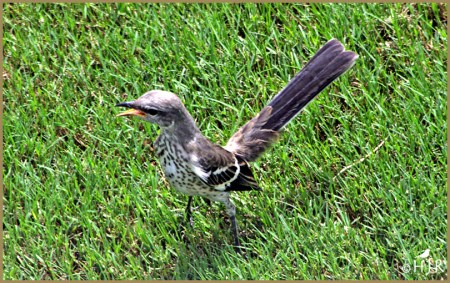
Northern Mockingbird (Juv.)
The Northern Mockingbirds aggressively defend their nests and surrounding areas against other birds and animals. When a predator is persistent, mockingbirds from neighboring territories may be summoned by distinct calls to join the defense. Other birds may gather to watch as the mockingbirds drive away the intruder. In addition to harassing domestic cats and dogs that they consider a threat, mockingbirds will at times target humans. The birds are bold, and will attack much larger birds, even hawks. One incident in Tulsa, Oklahoma involving a postal carrier resulted in the distribution of a warning letter to residents.
Eastern Towhee (Juv.)
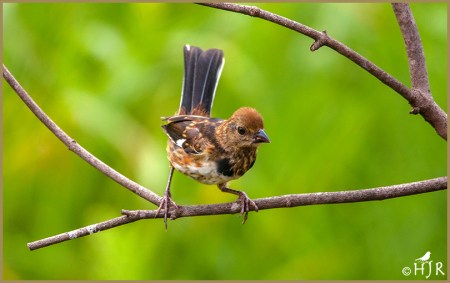
Eastern Towhee (Juv.)
Eastern Towhees primarily eat on the ground, although they also glean from vegetation. In a southeastern Massachusetts pitch pine barren, 73.5% of male and 80.4% of female foraging observations were on the ground. When foraging on the ground eastern towhees use a scratching technique where both feet kick back simultaneously. In a laboratory study 4 eastern towhees used this method to successfully obtain seed buried almost 1 inch (2.5 cm) deep. When foraging above ground the majority of time is spent gleaning foliage.
© HJ Ruiz – Avian101
Share this:

Read Past Reviews

Book # 69
Quote from the Author
“A good chuckle is healthy, it helps you break the monotony of a serious life.” ~ H.J. Ruiz
 H.J. Ruiz - Avian101
You must be logged in to post a comment.