
Special Places # 7
Sunsets
Photo Gallery
-

- Jamaica Golden Hour
-

- Panama Beach
-

- Mancora Beach, Peru
-

- Santa Maria Beach, Peru
-

- West Coast Florida
-

- Georgia, Home
© HJ Ruiz – Avian101
Share this:

Red Art Gallery – Northern Cardinal # 16
Red Art Gallery
-

- Female
-

- Male
© HJ Ruiz – Avian101
Share this:

Photography of Birds – Set # 235
Set # 235
Ruddy Turnstone
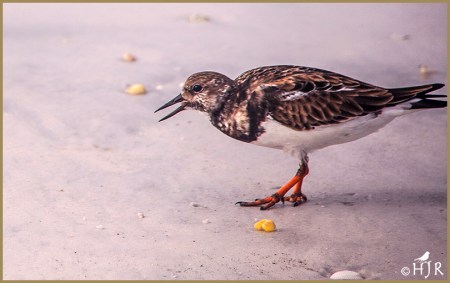
Ruddy Turnstone
In all seasons, the plumage is dominated by a harlequin-like pattern of black and white. Breeding birds have reddish-brown upper parts with black markings. The head is mainly white with black streaks on the crown and a black pattern on the face. The breast is mainly black apart from a white patch on the sides. The rest of the underparts are white. In flight it reveals a white wingbar, white patch near the base of the wing and white lower back, rump and tail with dark bands on the uppertail-coverts and near the tip of the tail. The female is slightly duller than the male and has a browner head with more streaking.
Sanderling

Sanderling
The Sanderling breeds in the High Arctic areas of North America, Europe and Asia. In North America, it breeds in the Canadian Arctic Archipelago, Nunavut, Greenland (and to a lesser extent Alaska). In Eurasia, it breeds in Spitsbergen and areas of northern Russia from the Taymyr Peninsula to the New Siberian Islands. In the northern winter, it has a nearly cosmopolitan distribution across the world’s marine coasts. It is a complete migrant, travelling between 3,000 to 10,000 km (1,900 to 6,200 mi) from its breeding grounds to its wintering sites. Birds that travel further also arrive later and leave sooner. Most adults leave the breeding grounds in July and early August, whereas juvenile birds leave in late August and early September. The northward migration begins in March at the southern end of their winter distribution.
© HJ Ruiz – Avian101
Share this:

Photography of Birds – Set # 234
Set # 234
Carolina Wren
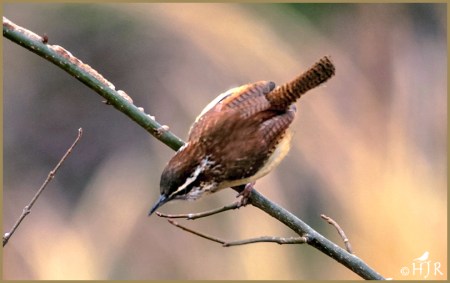
Carolina Wren
At 12.5 to 14 cm (4.9 to 5.5 in) long, with a 29 cm (11 in) wingspan and a weight of about 18 to 23 g (0.63 to 0.81 oz), the Carolina Wren is a fairly large wren; the second largest in the United States species after the cactus wren. Among standard measurements, the wing chord is 5.4 to 6.4 cm (2.1 to 2.5 in), the tail is 4.5 to 5.6 cm (1.8 to 2.2 in), the culmen is 1.4 to 1.8 cm (0.55 to 0.71 in) and the tarsus is 2 to 2.3 cm (0.79 to 0.91 in). Sexual dimorphism is slight with males being larger than their mates. A study indicated that of 42 mated pairs, every male but one was larger than the female of the pair. The males were on average 11 percent heavier along with having longer wing chords.
Vermillion Flycatcher
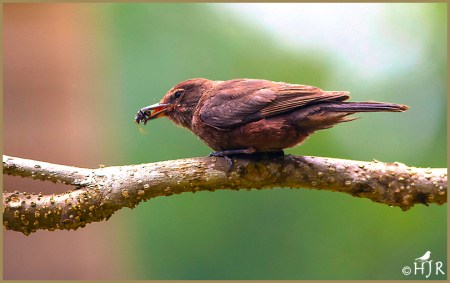
Vermillion Flycatcher
Despite being socially monogamous, vermilion flycatchers will engage in extra-pair copulation. They also practice within-species brood parasitism, whereby females lay their eggs in the nest of another individual. Females build shallow open cup nests and incubate the brown-speckled whitish eggs. The male feeds the female during incubation. Two broods of two or three eggs are laid in a season lasting from March through June. Once hatched, both males and females feed the chicks, which are ready to fledge after 15 days.
© HJ Ruiz – Avian101
Share this:

Read Past Reviews

Book # 69

Quote from the Author
“A good chuckle is healthy, it helps you break the monotony of a serious life.” ~ H.J. Ruiz
 H.J. Ruiz - Avian101
You must be logged in to post a comment.