Photography of Birds – Set # 238
Set # 238
European Starling
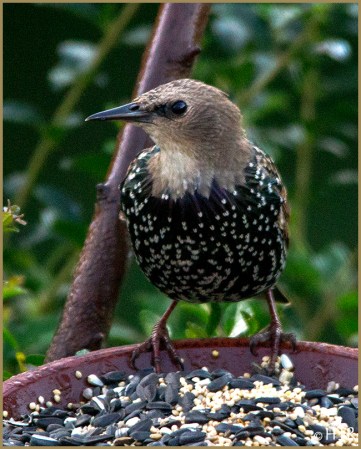
European Starling
Large flocks of European Starlings, typical of this species can be beneficial to agriculture by controlling invertebrate pests; however, starlings can also be pests themselves when they feed on fruit and sprouting crops. Common starlings may also be a nuisance through the noise and mess caused by their large urban roosts. Introduced populations in particular have been subjected to a range of controls, including culling, but these have had limited success, except in preventing the colonisation of Western Australia.
Brown Thrasher

Brown Thrasher
The Brown Thrasher is omnivorous, which has a diet that includes insects, berries, nuts and seeds, as well as earthworms, snails, and sometimes lizards and frogs. Across seasons and its breeding range, it was found 63% of stomach contents were made of animal matter, the remaining 37% being plant material. During the breeding season, the diet consists primarily of beetles, grasshoppers, and other arthropods, and fruits, nuts and seeds. More than 80% of the diet of brown thrasher from Illinois is made of animal matter, about 50% being beetles. In Iowa, about 20% of the summer diet was found to consist of grasshoppers. By the late summer, it begins to shift towards more of a herbivore diet, focusing on fruits, nuts, seeds, and grains, 60% of the food in Illinois being fruits and seeds. By winter, the customary diet of the brown thrasher is fruit and acorns.
© HJ Ruiz – Avian101
Share this:

Framed Memories # 36
Photo Gallery


© HJ Ruiz – Avian101
Share this:

Photography of Birds – Set # 237
Set # 237
Limpkin
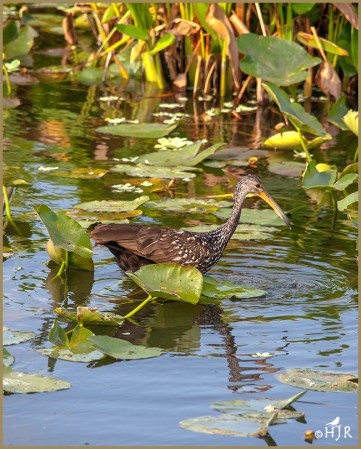
Limpkin
Limpkins forage primarily in shallow water and on floating vegetation such as water hyacinth and water lettuce. When wading, they seldom go deeper than having half the body underwater, and never are submerged up to the back. They walk slowly with a gait described as “slightly undulating” and “giving the impression of lameness or limping”, “high-stepping”, or “strolling”, looking for food if the water is clear or probing with the bill. They do not associate with other birds in mixed-species feeding flocks, as do some other wading birds, but may forage in small groups with others of their species.
Tricolored Heron
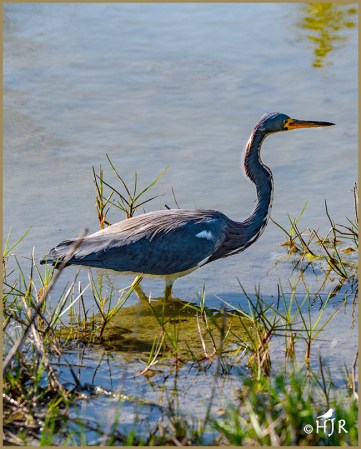
Tricolored Heron
The Tricolored Heron (Egretta tricolor), formerly known as the Louisiana heron, is a small species of heron native to coastal parts of the Americas; in the Atlantic region, it ranges from the northeastern United States, south along the coast, through the Gulf of Mexico and the Caribbean, to northern South America as far south as Brazil. In the Pacific region, it ranges from Peru to California, but it is only a nonbreeding visitor to the far north.
© HJ Ruiz – Avian101
Share this:

Photography of Birds – Set # 236
Set # 236
Downy Woodpecker
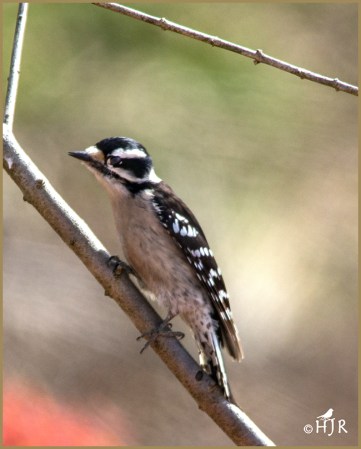
Downy Woodpecker
Downy Woodpeckers nest in a tree cavity excavated by the nesting pair in a dead tree or limb. In the winter, they roost in tree cavities. Downy Woodpeckers forage on trees, picking the bark surface in summer and digging deeper in winter. They mainly eat insects, also seeds and berries. They are a natural predator of the European corn borer, a moth that costs the US agriculture industry more than $1 billion annually in crop losses and population control.
Red-bellied Woodpecker
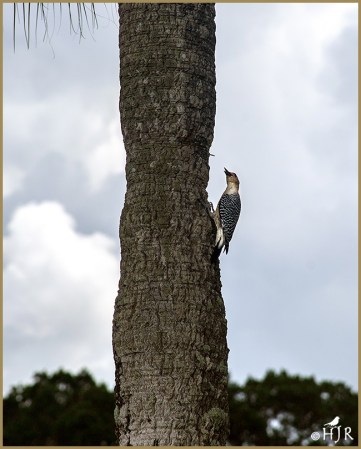
Red-bellied Woodpecker
As with all animals, foraging becomes an important role in an animal’s ability to survive and reproduce. The Red-bellied Woodpecker expresses foraging behavior by catching or storing food. The woodpecker uses its bill for foraging as a chisel drilling into bark or probing cracks on trunk of trees. In this manner, the red-bellied woodpecker is able to pull out beetles and other insects from the tree with the help of its long tongue. This behavior is also seen for storing food from other animals by hiding food behind bark or deep in cracks of a tree.
© HJ Ruiz – Avian101
Share this:

Read Past Reviews

Book # 69
Quote from the Author
“A good chuckle is healthy, it helps you break the monotony of a serious life.” ~ H.J. Ruiz
 H.J. Ruiz - Avian101
You must be logged in to post a comment.