Photography of Birds – Set # 243
Set # 243
Boat-tailed Grackle (F&M)
-
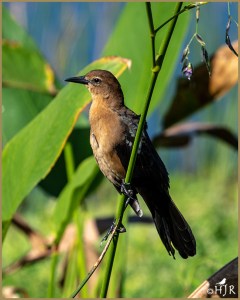
- Boat-tailed Grackle (F)
-
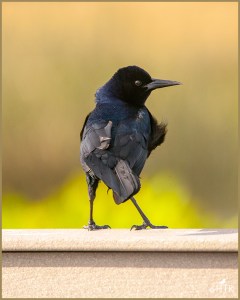
- Boat-tailed Grackle (M)
Boat-tailed Grackles forage on the ground, in shallow water, or in shrubs; they will steal food from other birds. They are omnivorous, eating insects, minnows, frogs, eggs, berries, seeds, grain, and even small birds.
Boat-tailed grackles have established significant populations in several United States Gulf Coast cities and towns, where they can be found foraging in trash bins, dumpsters, and parking lots.
This bird’s song is a harsh jeeb, and it has a variety of typically grackle-like chatters and squeaks.
© HJ Ruiz – Avian101
Share this:

Photography of Birds – Set # 242
Set # 242
Eastern Phoebe

Eastern Phoebe
The Eastern Phoebe is a tyrant flycatcher that breeds in eastern North America, although its normal range does not include the southeastern coastal United States.
The breeding habitat of the eastern phoebe is open woodland, farmland and suburbs, often near water. This phoebe is insectivorous, and often perches conspicuously when seeking food items. It also eats fruits and berries in cooler weather.
Tufted Titmouse
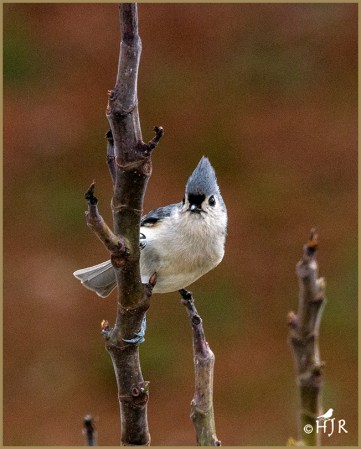
Tufted Titmouse
The song of the Tufted Titmouse is usually described as a whistled peter-peter-peter, although this song can vary in approximately 20 notable ways. Its habitat is deciduous and mixed woods as well as gardens, parks, and shrublands. Although the tufted titmouse is non-migratory and originally native to Ohio and Mississippi, factors such as bird feeders have caused these birds to occupy a larger amount of territory across the United States and stretching into Ontario, Canada. From 1966 – 2015 the tufted titmouse population has increased by more than 1.5% per year throughout the northeastern U.S., Michigan, and Wisconsin.
© HJ Ruiz – Avian101
Share this:

Framed Memories # 37
Photo Gallery


© HJ Ruiz – Avian101
Share this:

Photography of Birds – Set # 241
Set # 241
Pied-billed Grebe

Pied-billed Grebe
Pied-billed grebes rarely fly. They make a slow dive frequently, especially when in danger, diving to about 20 ft (6.1 m) or less. They dive for about 30 seconds and may move to a more secluded area of the water, allowing only the head to be visible to watch the danger dissipate. This frequency in diving has earned them the description of being reclusive or shy in nature. It has also earned them nicknames like “hell-diver.” They rarely spend time in flocks. Their courtship include calling and sometimes duets. Males will show territorial behaviour if another male is at the edge of his territory. They face each other and then turn their heads and bills up. Then they turn away and start calling. Then they turn back around to look at one another.
American Coot
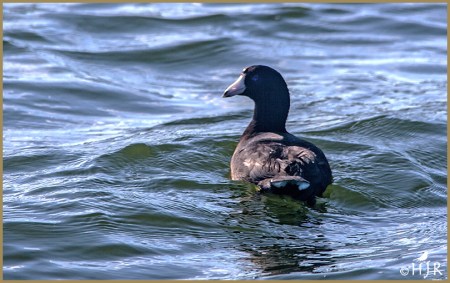
American Coot
Much research has been done on the breeding habits of American Coots. Studies have found that mothers will preferentially feed offspring with the brightest plume feathers, a characteristic known as chick ornaments. American coots are also susceptible to conspecific brood parasitism and have evolved mechanisms to identify which offspring are theirs and which are from parasitic females.
© HJ Ruiz – Avian101
Share this:

Read Past Reviews

Book # 69
Quote from the Author
“A good chuckle is healthy, it helps you break the monotony of a serious life.” ~ H.J. Ruiz
 H.J. Ruiz - Avian101
You must be logged in to post a comment.