
Red Art Gallery – Northern Cardinal # 19
Red Art Gallery
Photo Gallery
-

- Male
-
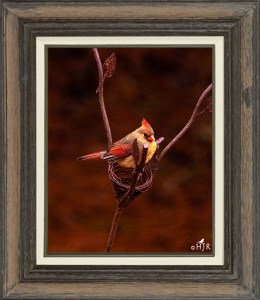
- Female
© HJ Ruiz – Avian101
Share this:

Photography of Birds – Set # 246
Set # 246
Magnificent Frigatebirds
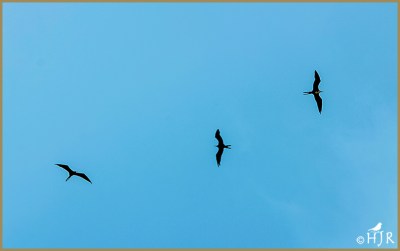
Magnificent Frigatebirds
The Magnificent Frigatebird (Fregata magnificens) or man o’ war is a seabird of the frigatebird family Fregatidae. With a length of 89–114 centimetres (35–45 in) and wingspan of 2.17–2.44 m (7.1–8.0 ft) it is the largest species of frigatebird. It occurs over tropical and subtropical waters off America, between northern Mexico and Perú on the Pacific coast and between Florida and southern Brazil along the Atlantic coast. There are also populations on the Galápagos Islands in the Pacific and the Cape Verde islands in the Atlantic.
The magnificent frigatebird is a large, lightly built seabird with brownish-black plumage, long narrow wings and a deeply forked tail. The male has a striking red gular sac which he inflates to attract a mate. The female is slightly larger than the male and has a white breast and belly. Frigatebirds feed on fish taken in flight from the ocean’s surface (often flying fish), and sometimes indulge in kleptoparasitism, harassing other birds to force them to regurgitate their food.
Double-crested Cormorants

Double-crested Cormorants
The Double-crested Cormorant (Phalacrocorax auritus) is a member of the cormorant family of water birds. Its habitat is near rivers and lakes as well as in coastal areas, and is widely distributed across North America, from the Aleutian Islands in Alaska down to Florida and Mexico. Measuring 70–90 cm (28–35 in) in length, it is an all-black bird which gains a small double crest of black and white feathers in breeding season. It has a bare patch of orange-yellow facial skin. Five subspecies are recognized. It mainly eats fish and hunts by swimming and diving. Its feathers, like those of all cormorants, are not waterproof and it must spend time drying them out after spending time in the water. Once threatened by the use of DDT, the numbers of this bird have increased markedly in recent years.
© HJ Ruiz – Avian101
Share this:

Photography of Birds – Set # 245
Set # 245
House Finches

House Finches
Originally House Finches were only resident of Mexico and the southwestern United States, they were introduced to eastern North America in the 1940s. The birds were sold illegally in New York City as “Hollywood Finches”, a marketing artifice. To avoid prosecution under the Migratory Bird Treaty Act of 1918, vendors and owners released the birds. They have since become naturalized; in largely non-forest land across the eastern U.S., they have displaced the native purple finch and even the non-native house sparrow. In 1870, or before, they were introduced to Hawaii and are now abundant on all its major islands.There are estimated to be anywhere from 267 million to 1.7 billion individuals across North America.
Field Sparrows
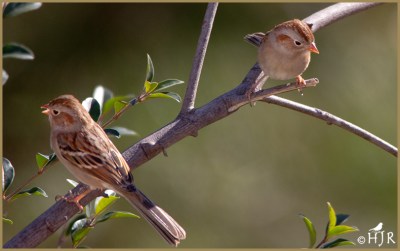
Field Sparrows
The Field Sparrow is distributed across eastern Canada and the eastern United States, with northern populations migrating southwards to southern United States and Mexico in the fall. The typical habitat of this bird is bushy country with shrubs and grassland. The nest is a cup-shaped construction built on the ground and hidden beneath a bush or clump of grass. The birds forage on the ground or in low vegetation, feeding mainly on seeds and insects. The population is thought to be in slow decline, but it is a common species with a wide range, and the International Union for Conservation of Nature has assessed its conservation status as being of “least concern”.
© HJ Ruiz – Avian101
Share this:

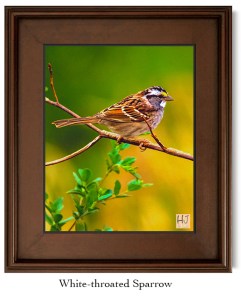
Framed Memories # 38
Photo Gallery
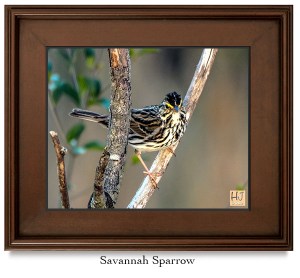
© HJ Ruiz – Avian101
Share this:

Read Past Reviews

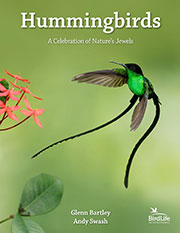
Book # 69
Quote from the Author
“A good chuckle is healthy, it helps you break the monotony of a serious life.” ~ H.J. Ruiz
 H.J. Ruiz - Avian101
You must be logged in to post a comment.