
Photography of Birds – Set # 256
Set # 256
Eastern Bluebirds
-

- Eastern Bluebird (F)
-

- Eastern Bluebird (Fledgling)
Mating occurs in the spring and summer. A mature female typically raises two broods each season. Nests are constructed in trees within abandoned woodpecker holes or other cavities that provide adequate protection (usually several feet above ground). Construction of the nest is done primarily by the female and takes around 10 days to complete. These nests are small, cup-like structures lined with grass, feathers, stems, and hairs. Each female lays three to seven light-blue or, rarely, white eggs. The female incubates the eggs, which hatch after 13 to 16 days. The young cannot care for themselves upon hatching. The female broods the chicks for up to seven days after hatching. Fledglings then leave the nest 15 to 20 days after hatching.
© HJ Ruiz – Avian101
Share this:

Framed Memories # 41
Photo Gallery
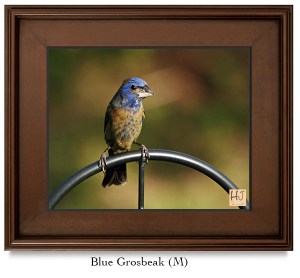

© HJ Ruiz – Avian101
Share this:

Photography of Birds – Set # 255
Set # 255
White-throated Sparrow
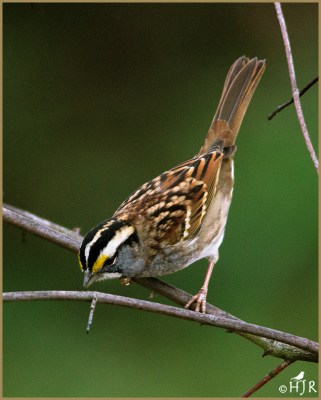
White-throated Sparrow
In winter, the White-throated Sparrow migrates to the southern and eastern United States. They are differential migrants with females migrating farther, increasing the proportion of females at lower latitudes in the Atlantic flyway. Females are smaller so they would not perform as optimally at colder, higher latitudes, and females avoid competition with the dominant males of the winter hierarchies by migrating farther. There is also no benefit for females to be among the first to return after winter, so migrating farther allows the males to return and establish territory a few weeks before their arrival. It stays year round in the Atlantic provinces of Canada. This bird is a rare vagrant to western Europe. Alongside some other species such as the cardinal, dark-eyed junco, song sparrow and chickadees, this species ranks among the most abundant native birds during winter in eastern North America.
Song Sparrow
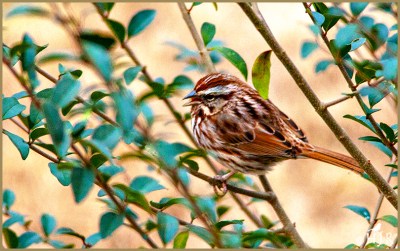
Song Sparrow
The Song Sparrow has been the subject of several studies detailing the physiological reactions of bird species to conditions such as daylight length and differing climatic conditions. Most birds gain mass in their reproductive organs in response to some signal, either internal or external as the breeding season approaches. The exact source of this signal varies from species to species – for some, it is an endogenous process separate from environmental cues, while other species require extensive external signals of changing daylight length and temperature before beginning to increase the mass of their reproductive organs. Male specimens of M. melodia gain significant testicular mass in response both to changes in the daily photoperiod and as a result of endogenous chemical signals. Females also undergo significant ovarian growth in response to both photo-period and endogenous signals. Hormone levels in both males and females fluctuate throughout the breeding season, having very high levels in March and late April and then declining until May. These studies suggest that there are multiple factors at work that influence when and how the song sparrow breeds other than just increasing day length.
© HJ Ruiz – Avian101
Share this:

Photography of Birds – Set # 254
Set # 254
Common Moorhen

Common Moorhen
The Common Moorhen is a distinctive species, with dark plumage apart from the white undertail, yellow legs and a red frontal shield. The young are browner and lack the red shield. The frontal shield of the adult has a rounded top and fairly parallel sides; the tailward margin of the red unfeathered area is a smooth waving line. In the related common gallinule of the Americas, the frontal shield has a fairly straight top and is less wide towards the bill, giving a marked indentation to the back margin of the red area.
White-breasted Nuthatch
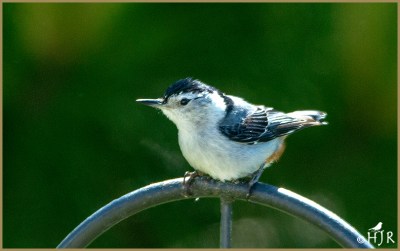
White-breasted Nuthatch
The White-breasted Nuthatch has nine subspecies, although the differences are small and change gradually across the range. The subspecies are sometimes treated as three groups based on close similarities in morphology, habitat usage, and vocalizations. These groups cover eastern North America, the Great Basin and central Mexico, and the Pacific coastal regions. The subspecies of the western interior have the darkest upperparts, and eastern S. c. carolinensis has the palest back. The eastern form also has a thicker bill and broader dark cap stripe than the interior and Pacific races. The calls of the three groups differ, as described above. The Great Basin and Eastern forms have been observed in secondary contact on the Great Plains, where they do not seem to mix.
© HJ Ruiz – Avian101
Share this:

Read Past Reviews

Book # 69

Quote from the Author
“A good chuckle is healthy, it helps you break the monotony of a serious life.” ~ H.J. Ruiz
 H.J. Ruiz - Avian101
You must be logged in to post a comment.