
Photography of Birds – Set # 260
Set # 260
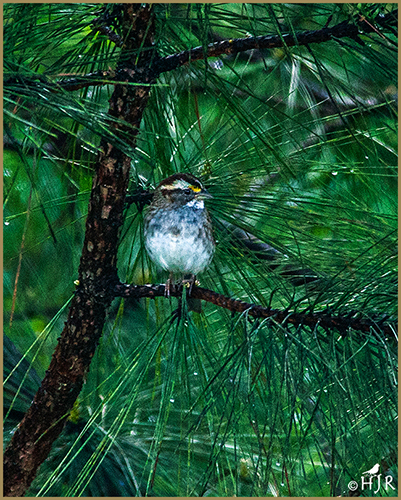
White-throated Sparrow
The tan and white morphs of White-throated Sparrows use different reproductive strategies. Tan males invest in parental care and guard their mates from others searching for extra pair copulations (EPCs). White males invest in securing additional mates and EPCs through song advertisement and intruding into neighboring territory. Female morphs have similar differences, where tan females invest in parental care and white females solicit EPCs and engage in brood parasitism, leaving their eggs in another’s nest to be raised and fed. Mating with the opposite morphs and using alternative reproductive strategies helps maintain competitive equilibrium.
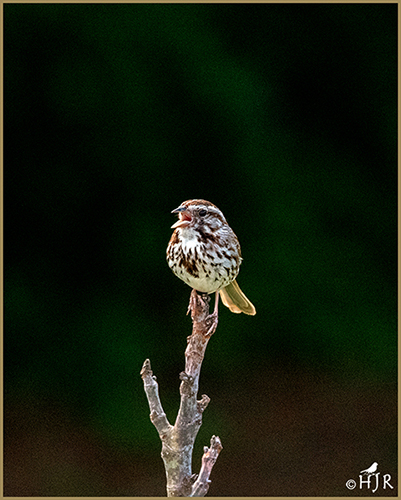
Song Sparrow
Song Sparrows forage on the ground, in shrubs or in very shallow water. They mainly eat insects and seeds. Birds in salt marshes may also eat small crustaceans. They nest either in a sheltered location on the ground or in trees or shrubs. Song sparrows with areas of shrub cover in their territory, away from the intertidal coastline, have greater over-winter survival, as well higher reproductive success.
© HJ Ruiz – Avian101
Share this:

Framed Memories # 42
Photo Gallery

© HJ Ruiz – Avian101
Share this:

Book Review # 63 – Birds of Chile
Birds of Chile
Field Guide
Author:
Daniel E. Martinez Pina & Gonzalo E. Gonzalez Cifuentes
Publisher:
Princeton University Press – SBN:9780691221052
Brief Review:

I was very pleased to know that we Princeton Press was going to publish a new Field Guide to the Birds of Chile, which will bring many advantages to our friends birders. Myself, being one birder that usually visits places with a guide in my backpack and immediately try to ID the bird in front of me, it does make a great difference.
This guide is a product of two ingenious and qualified persons involved with bird knowledge, writing and illustration. They are Daniel E. Martinez Pina and Gonzalo E. Gonzalez Cifuentes.
The guide, 224 pages, size 5.25 x 8.5 inches is perfect to carry in a pocket of backpack while fielding for birds. It covers 468 species recorded in Chile included vagrants.
The guide describes each species in a comprehensive way to make an easy identification, adding their location, region, their range, habitat and voice. All these illustrated in color in 89 plates. They present in a concise manner how the species are distributed all throughout Chile.
I believe that this important field guide will help many birders to accomplish their work or hobby with ease and without confusion.
Reviewed by:
H.J. Ruiz -Avian101.Wordpress.com – March 30th, 2021
© HJ Ruiz – Avian101
Share this:

Photography of Birds – Set # 259
Set # 259
Great Egret
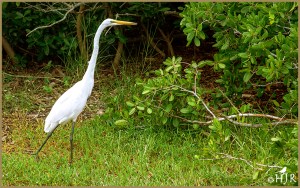
Great Egret
The Great Egret is generally a very successful species with a large and expanding range, occurring worldwide in temperate and tropical habitats. It is ubiquitous across the Sun Belt of the United States and in the Neotropics. In North America, large numbers of great egrets were killed around the end of the 19th century so that their plumes could be used to decorate hats. Numbers have since recovered as a result of conservation measures. Its range has expanded as far north as southern Canada. However, in some parts of the southern United States, its numbers have declined due to habitat loss, particularly wetland degradation through drainage, grazing, clearing, burning, increased salinity, groundwater extraction and invasion by exotic plants. Nevertheless, the species adapts well to human habitation and can be readily seen near wetlands and bodies of water in urban and suburban areas.
Mute Swan
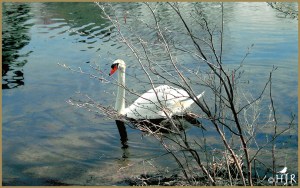
Mute Swan
Mute Swans nest on large mounds that they build with waterside vegetation in shallow water on islands in the middle or at the very edge of a lake. They are monogamous and often reuse the same nest each year, restoring or rebuilding it as needed. Male and female swans share the care of the nest, and once the cygnets are fledged it is not uncommon to see whole families looking for food. They feed on a wide range of vegetation, both submerged aquatic plants which they reach with their long necks, and by grazing on land. The food commonly includes agricultural crop plants such as oilseed rape and wheat, and feeding flocks in the winter may cause significant crop damage, often as much through trampling with their large webbed feet, as through direct consumption.
© HJ Ruiz – Avian101
Share this:

Read Past Reviews

Book # 69
Quote from the Author
“A good chuckle is healthy, it helps you break the monotony of a serious life.” ~ H.J. Ruiz
 H.J. Ruiz - Avian101
You must be logged in to post a comment.