
Photography of Birds – Set # 269
Set # 269
House Sparrow

The House Sparrow is a very social bird. It is gregarious during all seasons when feeding, often forming flocks with other species of birds. It roosts communally and while breeding nests are usually grouped together in clumps. House sparrows also engage in social activities such as dust or water bathing and “social singing”, in which birds call together in bushes. The house sparrow feeds mostly on the ground, but it flocks in trees and bushes. At feeding stations and nests, female house sparrows are dominant despite their smaller size, and they can fight over males in the breeding season.
Field Sparrow

Adults have brown upperparts, a buffy breast, a white belly, two whitish wing bars and a dark-brown forked tail. They have a grey face, a rusty crown, a white eye ring and a pink bill. They have rusty markings behind the eye. There are grey and rufous colour variants. Males are females have a similar appearance with males being slightly larger than females.
© HJ Ruiz – Avian101
Share this:

Photography of Birds – Set # 268
Set # 268
Carolina Wren
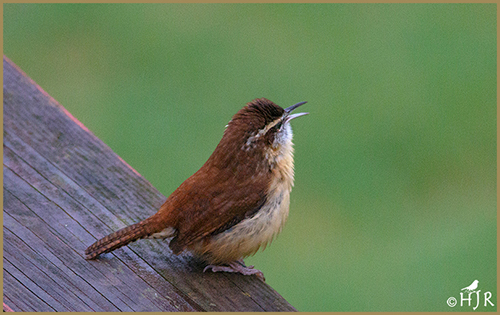
There are seven recognized subspecies across the range of these wrens and they differ slightly in song and appearance. The birds are generally inconspicuous, avoiding the open for extended periods of time. When out in the open, they investigate their surroundings and are rarely stationary. After finding a mate, pairs maintain a territory and stay together for several years. Both males and females give out alarm calls, but only males sing to advertise territory. Carolina wrens raise multiple broods during the summer breeding season, but can fall victim to brood parasitism by brown-headed cowbirds, among other species. Some populations have been affected by mercury contamination.
Palm Warbler
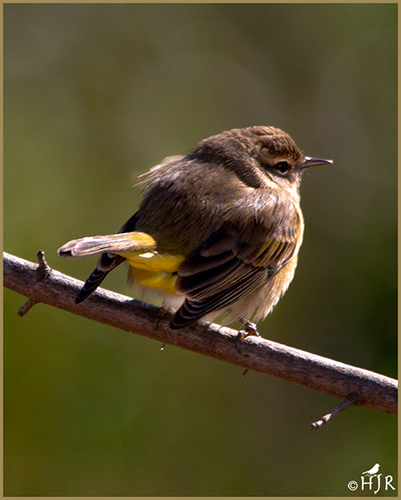
Palm warblers breed in open coniferous bogs and edge east of the Continental Divide, across Canada and the northeastern United States.
These birds migrate to the southeastern United States, the Yucatán Peninsula, islands of the Caribbean, and eastern Nicaragua south to Panama to winter. They are one of the earlier migrants to return to their breeding grounds in the spring, often completing their migration almost two months before most other warblers. Unlike most Setophaga species, the Palm warbler’s winter range includes much of the Atlantic coast of North America, extending as far north as southern Nova Scotia.
© HJ Ruiz – Avian101
Share this:

Framed Memories # 44
Photo Gallery

© HJ Ruiz – Avian101
Share this:

Photography of Birds – Set # 267
Set # 267
Indigo Bunting
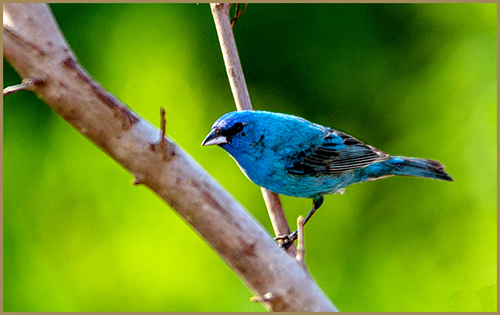
The indigo bunting is a smallish songbird, around the size of a small sparrow. It measures 11.5–15 cm (4.5–5.9 in) long, with a wingspan of 18–23 cm (7.1–9.1 in). Body mass averages 14.5 g (0.51 oz), with a reported range of 11.2–21.4 g (0.40–0.75 oz). During the breeding season, the adult male appears mostly a vibrant cerulean blue. Only the head is indigo. The wings and tail are black with cerulean blue edges. In fall and winter plumage, the male has brown edges to the blue body and head feathers, which overlap to make the bird appear mostly brown. The adult female is brown on the upperparts and lighter brown on the underparts. It has indistinct wing bars and is faintly streaked with darker markings underneath.
Eastern Bluebird
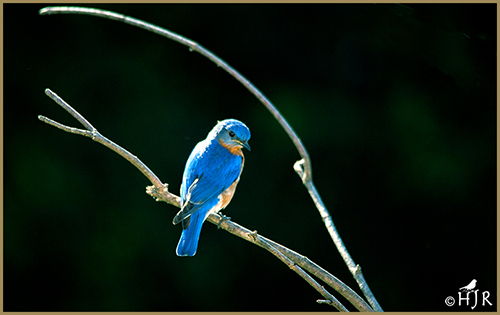
About two thirds of an adult bluebird’s diet consists of insects and other invertebrates. The remainder is made up of wild fruits or berries. It has a preference for grasshoppers, crickets, katydids, and beetles; and will also eat earthworms, spiders, millipedes, centipedes, sowbugs, and snails.
Bluebirds feed by perching on a high point, such as a branch or fence post, and swooping down to catch insects on or near the ground. The availability of a winter food source will often determine whether or not a bird will migrate. If bluebirds do remain in a region for the winter, they group and seek cover in heavy thickets, orchards, or other areas in which adequate food and cover resources are available.
© HJ Ruiz – Avian101
Share this:

Read Past Reviews

Book # 69
Quote from the Author
“A good chuckle is healthy, it helps you break the monotony of a serious life.” ~ H.J. Ruiz
 H.J. Ruiz - Avian101
You must be logged in to post a comment.