
Eastern Phoebe
Yesterday was an exciting day for me, the two feeders we have were almost full and hardly any birds came in, on the ground I some a couple of mourning doves and then a song sparrow showed up, running around pecking here and there. They sky was gray and we had some rain, it was a little breeze also, I didn’t think much of the day, Halloween is going to be wet. Of a sudden I see this bird that showed up perched high and posed calmly grooming himself. I realized that I have never seen this bird before. I shot a whole bunch of pictures. I wish it was a little more light, it was getting dark already. Despite the lack of light, I was very happy to add the 30th species of bird that have visited my backyard. Here it is:
Eastern Phoebe Sp. Name: Sayornis Phoebe
Description:
Medium size gnatcatcher with gray back with black-capped large head, white breast and underparts, wings dark gray almost black, black eyes with a white eye liner, legs and feet are black.
Feeds mostly insects.
-
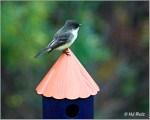
- Eastern Phoebe
-
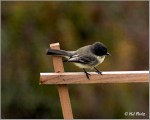
- Eastern Phoebe
-
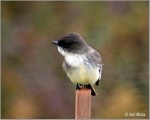
- Eastern Phoebe
-
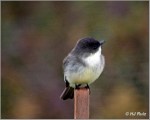
- Eastern Phoebe
Share this:

Guest Gallery – Wendy Lubbers
My good friend and neighbor Wendy Lubbers has been tremendously nice to share some of her photos for my blog, Among her activities is birding and all kinds of photography not only birds but also flowers, butterflies etc.
-
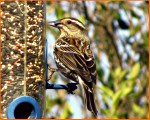
- Tree Sparrow
-
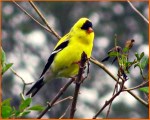
- American Goldfinch
-
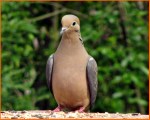
- Mourning Dove
-
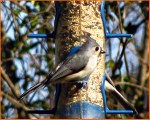
- Tufted Titmouse
-
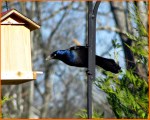
- Grackle
-
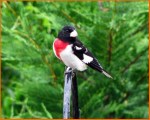
- Rose-Breasted Grosbeak
Share this:

Gallery # 9
Here are some more shots taken from my backyard.
-
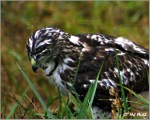
- Red-Shouldered Hawk
-
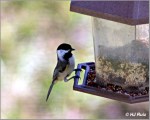
- Carolina Chickadee
-

- Shiny Cowbird
-
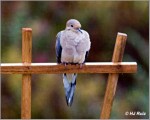
- Mourning Dove
Share this:

Ancient Birds- What do we know Part ll
Gastornithiformes are an order of prehistoric birds. The birds from this group lived from the Paleocene to the Eocene and were spread out across Asia, Europe, and North America. All the birds were very large birds that were flightless, similar to an ostrich but more heavily built and with a huge beak. They are generally assumed to be predators, but this is conjectural. It is likely though that they included a considerable amount of meat in their diet, although they may have been scavengers rather than active hunters.
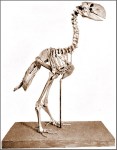
Gastornithifomes
There is no agreement on the relationships of the Gastornithiformes. They were long and still are sometimes placed with the Gruiformes as a family Gastornithidae. The Gruiformes seem paraphyletic though, with some lineages that are exclusively Gondwanan but apparently not closely related to cranes, rails and allies which are common in Eurasia and Africa but far less so in the Americas. Some others, probably unrelated to either group, were very diverse in the Americas but prehistorically also occurred in Europe. Nothing is known of the ancestry of the Gastornithiformes; judging from biogeography, a relationship with either the true Gruiformes or the “Americas” lineage (which might include the seriemas and the phorusrhacids) is possible.
However, the early occurrence of the Gastornithiformes in the fossil record poses problems. These animals were highly apomorphic and thus the lineage must have evolved for significant time after diverging from their closest known relatives. Most purported relatives are not known nor suspected to have been so highly distinct at the time when the Gastornithiformes lived.
Share this:


Read Past Reviews

Book # 69

Quote from the Author
“A good chuckle is healthy, it helps you break the monotony of a serious life.” ~ H.J. Ruiz


You must be logged in to post a comment.