
Photography of Birds – Set # 130
Set # 130
Cooper’s Hawk
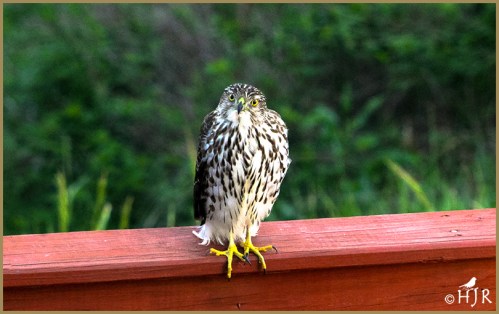
Cooper’s Hawk
Cooper’s hawks are fairly variable in size. There is usually minimal to no overlap in dimensions between the sexes, with females being considerably larger than males. On average, she may be about 20% larger linearly and around 40% heavier (though can be up to 125% more massive). More westerly Cooper’s hawks (roughly west of the Rocky mountains) show slightly less pronounced sexual dimorphism than hawks of the species elsewhere. Sexual dimorphism in Cooper’s hawks is most reliably measured by wing size, talon size, then body mass. Although there is some margin of error, within a given region dimensions of the two sexes never overlap in these regards (but may overlap marginally in tarsal and tail lengths). In general terms, Accipiter species are among the most sexually dimorphic in size of all raptorial birds.
Red-shouldered Hawk
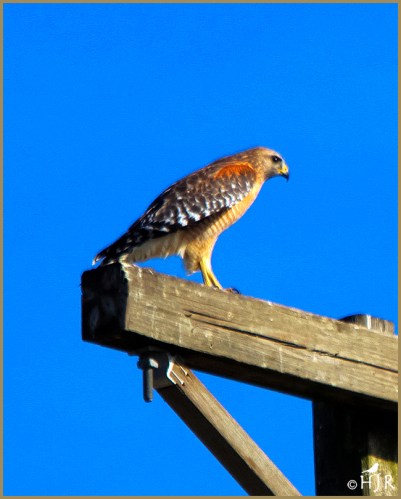
Red-shouldered Hawk


 H.J. Ruiz - Avian101
I enjoyed both these raptor photos and the accompanying info, HJ. You caught a fun and quirky look in the Cooper’s Hawk.
He’s watching me! Birds use both eyes when it’s figuring out the distance between their position to the subject they are looking at; doing that makes the quirky look possible.Thank you, my friend. 🙂
The Cooper’s Hawk is really giving you the eye. And the highlights on the Red-shouldered Hawk show why it is named so. Nice photos!
Thanks so much, Jane. 🙂
Beautiful HJ. That Cooper’s hawk is stunning!
Thank you, Chris. 🙂