Bird’s ID – Cooper’s Hawk
Cooper’s Hawk
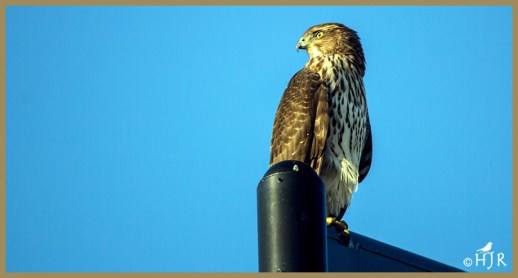
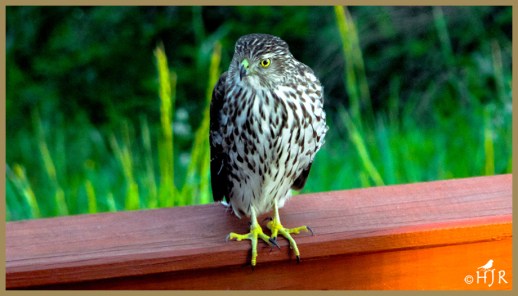
Cooper’s Hawk (Accipiter cooperii) is a medium-sized hawk native to the North American continent and found from Southern Canada to Northern Mexico. As in many birds of prey, the male is smaller than the female. The birds found east of the Mississippi River tend to be larger on average than the birds found to the west.
The average mass of an adult male ranges from 220 to 440 g (7.8 to 15.5 oz) with a length between 35 and 46 cm (14 and 18 in). The adult male is significantly smaller than the average female, which weighs 330 to 700 g (12 to 25 oz) and measures 42 to 50 cm (17 to 20 in) long. Its wingspan ranges from 62 to 94 cm (24 to 37 in). Individuals living in the eastern regions, where the sexes average 349 g (12.3 oz) and 566 g (20.0 oz), tend to be larger and heavier than those in the western regions, where the respective sexes average 280 g (9.9 oz) and 440 g (16 oz).
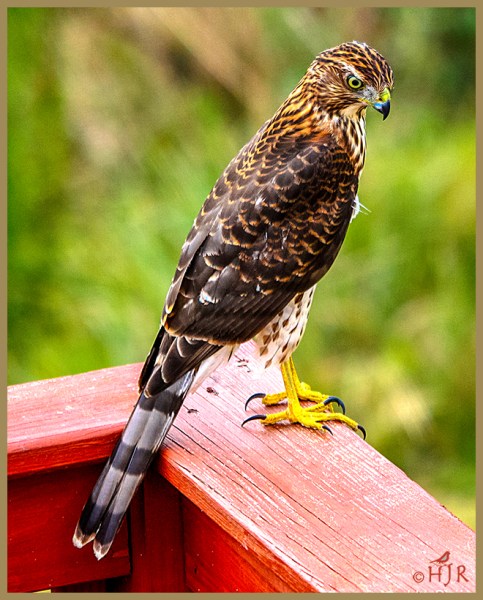
Cooper’s hawks have short rounded wings, the wing chord measuring 21.4–27.8 cm (8.4–10.9 in) long, and a relatively long tail, 17–20.5 cm (6.7–8.1 in) long, with dark bands, round-ended at the tip. As in most accipiters, the tarsus is relatively long, measuring 5.6–7.6 cm (2.2–3.0 in) long, and the bill is relatively small, with the culmen from the cere measuring only 1.5–2.1 cm (0.59–0.83 in). Adults have red eyes and have a black cap, with blue-gray upper parts and white underparts with fine, thin, reddish bars. Their tail is blue-gray on top and pale underneath, barred with black bands.
Immatures have yellow eyes and have a brown cap, with brown upper parts and pale underparts with thin black streaks mostly ending at the belly. Their tail is brown on top and pale underneath, barred with dark bands. The eyes of this hawk, as in most predatory birds, face forward, enabling good depth perception for hunting and catching prey while flying at top speeds. They have hooked bills that are well adapted for tearing flesh of prey. The crow-like size of Cooper’s hawks is sometimes distinctive from the sharp-shinned, but this can be less reliable in large female sharp-shinneds. Goshawks are usually more distinctive in their larger size and differing plumage markings, with the juvenile goshawk having broader, darker streaking below with more irregular patterns than the immature Cooper’s. The Cooper’s hawk appears long-necked in flight and has been described by birdwatchers as looking like a “flying cross”. The Cooper’s hawk is seen mostly flying with quick, consecutive wing beats and a short glide, though they may also soar.
These birds capture prey from cover or while flying quickly through dense vegetation, relying almost totally on surprise. One study showed that this is a quite dangerous hunting style. More than 300 Cooper’s hawk skeletons were investigated and 23% revealed healed fractures in the bones of the chest. Cooper’s hawks prey almost exclusively on small to mid-sized birds. Typical prey species include American robins, other thrushes, jays, woodpeckers, European starlings, quail, icterids, cuckoos, pigeons and doves.
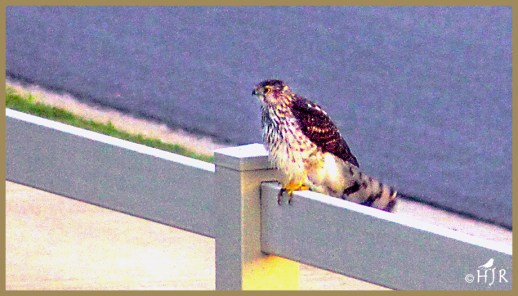
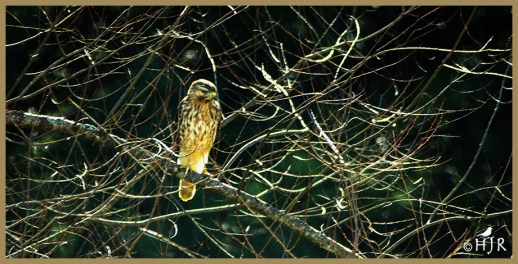
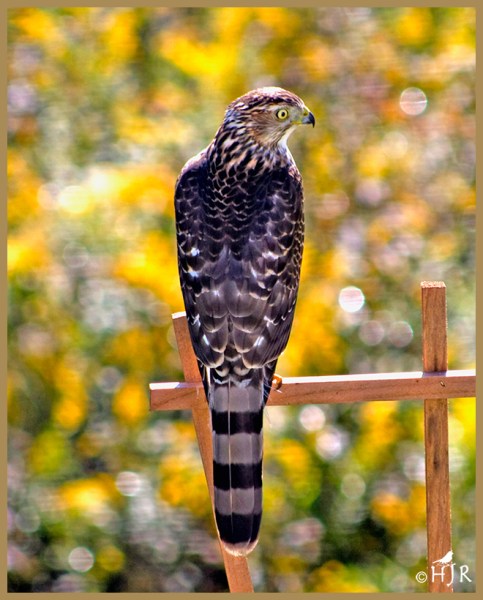


 H.J. Ruiz - Avian101
Make sure you heed warning to these beautiful hawks to not visit your backyard! Period!! 😊
There’s not a thing I can do, I just wish they never show up in my backyard. I’ve seen the mockingbird save some birds by distracting the hawk several times. They also sound the alarm when one is around. 🙂
Love the last picture!
Thank you Indira. 🙂
The last picture is a real winner HJ.
Thanks Tom! 🙂
I wonder if your Cooper’s Hawks are a different subspecies or maybe just more brightly colored than the northern population. That last picture is a stunner. 🙂
It might have to be related to what they eat, subspecies have more radical changes. Thank you Lisa. 🙂