Bird’s ID – Red-breasted Nuthatch
Red-breasted Nuthatch
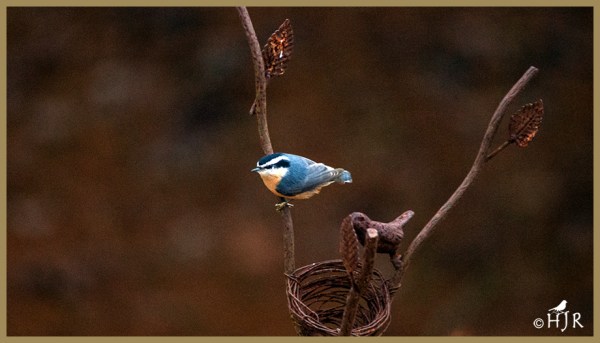
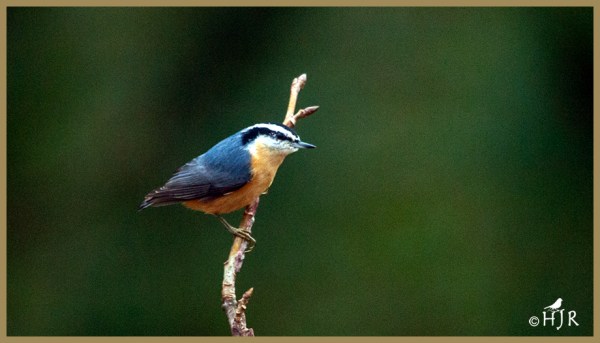
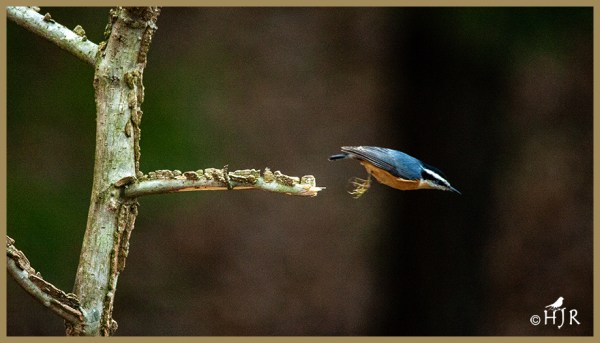
The Red-breasted Nuthatch (Sitta canadensis) is a small songbird. The adult has blue-grey upper parts with cinnamon underparts, a white throat and face with a black stripe through the eyes, a straight grey bill and a black crown. Its call, which has been likened to a tin trumpet, is high-pitched and nasal. It breeds in coniferous forests across Canada, Alaska and the northeastern and western United States. Though often a permanent resident, it regularly irrupts further south if its food supply fails. There are records of vagrants occurring as far south as the Gulf Coast and northern Mexico. It forages on the trunks and large branches of trees, often descending head first, sometimes catching insects in flight. It eats mainly insects and seeds, especially from conifers. It excavates its nest in dead wood, often close to the ground, smearing the entrance with pitch.
The red-breasted nuthatch is a small passerine, measuring 4.5 in (11 cm) in length, with a wingspan of 8.5 in (22 cm) and a weight of 9.9 g (0.35 oz). Its back and upper tail are bluish, and its underparts rust-colored. It has a black cap and eye line and a white supercilium (eyebrow). Sexes are similarly plumaged, though females and youngsters have duller heads and paler underparts.
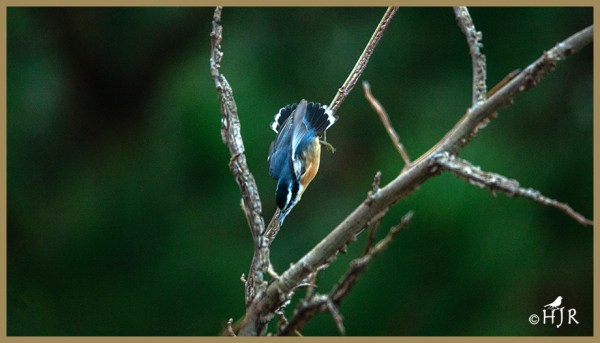
Like all nuthatches, the red-breasted nuthatch is an acrobatic species, hitching itself up and down tree trunks and branches to look for food. It goes headfirst when climbing down. It can “walk” on the underside of branches. Unlike woodpeckers and creepers, it does not use its tail as a prop while climbing. It tends to forage singly or in pairs.
The red-breasted nuthatch’s diet changes depending on the season. In the summer, it eats mostly insects, occasionally even fly catching, while in the winter, it switches to conifer seeds. At feeders it will take sunflower seeds, peanut butter, and suet. It often wedges food pieces in bark crevices in order to break them up with the bill (as opposed to holding the food in their feet, like the black-capped chickadee does).
Important Note:
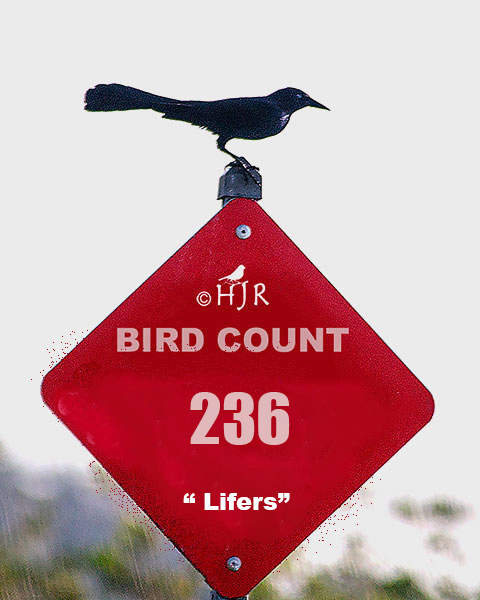
The Red-breasted Nuthatch adds the Avian101 “Lifer” list count to # 216



 H.J. Ruiz - Avian101
Beautiful bird!!
Indeed! Thank you Indira. 🙂
I saw the only one of these ever to reach England, in Norfolk, in 1990. None since!
You’re a lucky guy John! 🙂
Beautiful birds. Our nuthatches here are among my favourites.
Yes, they are. I like them a lot. 🙂
Nice work, there certainly seems to be an abundance of them this winter. Well done H.J.
Thanks so much Miguel. 🙂
Beautiful colors and an amazing acrobat!