Great Grebe
During my trip to Peru, I was fortunate enough to capture some photos of the Great Grebe which I had not seen before and now I’m happy to add their name to my All time Bird List. as Bird # 206.
The following information about this species is from © Wikipedia:
The Great Grebe (Podiceps major) is the largest species of grebe in the world. A disjunct population exists in northwestern Peru, while the main distribution is from extreme southeastern Brazil to Patagonia and central Chile. The population from southern Chile is considered a separate subspecies, P. m. navasi.
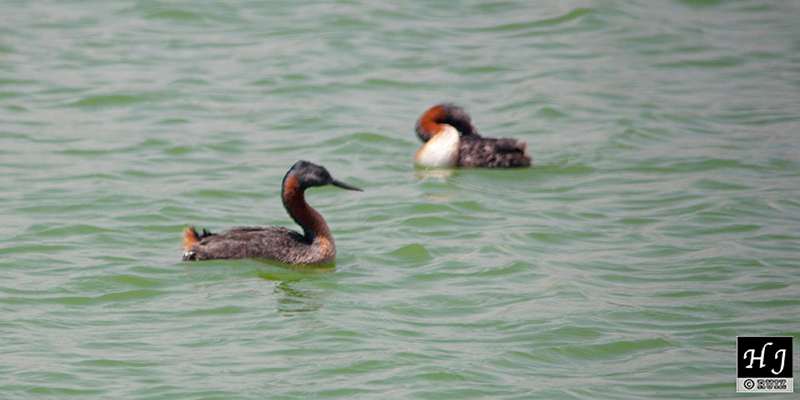
Great Grebes (Male and female)
This species occurs mainly in open waterways. Most birds are seen on low altitude lakes and sluggish rivers (often surrounded by forests), as well as estuarine marshes. While breeding, it frequents the heavily vegetated inlets off of large lakes. Outside of the breeding season, most birds will move to estuaries and bays, usually heavy with kelp (occasionally, they even are seen on the open sea). Non-breeding birds may live along the coasts all year.
They are buffy-rufous on the neck and chest, blackish on the back and have a whitish belly. The head is sooty gray with a reddish brown eye. Due to its size and unique coloration, the great grebe is unlikely to be confused with any other bird, including other grebes.
The great grebe lives on a diet mostly of fish, sometimes over 11 cm (4.3 inches) long, but usually smaller. Prey competition can occasionally occur with the neotropic cormorant over fish, but that species (in spite of smaller body size) usually takes larger fish. Also insects, crustaceans and mollusks are taken. The diet can switch to almost half crabs during the wintertime along the coasts, and these birds can also take the young of other waterbirds, especially coots.
Photo Gallery


© HJ Ruiz – Avian101


 H.J. Ruiz - Avian101
You must be pleased to add another bird to your list, I enjoyed the photographs.
Of course! I love it that my list gets longer. Thanks Susan! 🙂
How exciting to see this Grebe! It looks like it was doing some mating/courtship rituals too. Very cool!
You got it all figured out, didn’t you? Cool! Thanks Deborah! 🙂
🙂 I was photographing some Common Golden Eyes, and Hooded Mergansers and the males were doing some neck motions very similar to that Grebe when another male was nearby. Love is in the air! 🙂
I wish that I could still bend my neck like that! Good pictures.
Thanks Tom! 🙂
Congrats on your 206th bird, H.J.! Great photos 🙂 I miss my salt marsh…greetings from Geneva.
Thank you so much Tiny! Have a great time my dear! 🙂
Congratulations on adding another bird to your list HJ!
Thank you very much Clare! 🙂
Excellent gallery… You were very lucky to find them, swimming in such a situation…
Sending love and best wishes, dear HJ- Aquileana 😀
Thanks my dear Aquileana! My very best wishes to you! 🙂
Great photos and congrats on lifer, HJ!
Thanks Donna! 🙂