
Additional New Birds – Part Two
Bird # 194
The Forster’s Tern – Latin name: Sterna forsteri
This a member of the tern family Sternidae. It breeds inland in North America and winters south to the Caribbean and northern South America.

Foster Tern
This species is rare but annual in western Europe, and has wintered in Ireland and Great Britain on a number of occasions. No European tern winters so far north.
This species breeds in colonies in marshes. It nests in a ground scrape and lays three or more eggs. Like all white terns, it is fiercely defensive of its nest and young.
The Forster’s Tern feeds by plunge-diving for fish, but will also hawk for insects in its breeding marshes. It usually feeds from saline environments in winter, like most Sterna terns. It usually dives directly, and not from the “stepped-hover” favored by the Arctic Tern. The offering of fish by the male to the female is part of the courtship display.
This is a small tern, 33–36 cm long with a 64–70 cm wingspan. It is most similar to the Common Tern. It has pale grey upper-parts and white underparts. Its legs are red and its bill is red, tipped with black. In winter, the forehead becomes white and a characteristic black eyemask remains. Juvenile Forster’s Terns are similar to the winter adult. The call is a harsh noise like a Black-headed Gull.
This species is unlikely to be confused with the Common Tern in winter because of the black eye-mask, but is much more similar in breeding plumage. Forster’s has a grey centre to its white tail, and the upper-wings are pure white, without the darker primary wedge of Common.
——–
Bird # 195
The Mottled Duck – latin name: Anas fulvigula
It is intermediate in appearance between the female Mallard and the American Black Duck. It is closely related to those species, and is sometimes considered a subspecies of the former, but this is inappropriate.

Mottled Duck
There are two distinct populations of Mottled Ducks. One population, A. fulvigula maculosa (Mottled Duck), lives on the Gulf of Mexico coast between Alabama and Tamaulipas (Mexico); outside the breeding season individual birds may venture as far south as to Veracruz. The other, A. fulvigula fulvigula (Florida Duck), is resident in central and south Florida and occasionally strays north to Georgia. The same disjunct distribution pattern was also historically found in the local Sandhill Cranes.
Along the Gulf of Mexico coast, the Mottled Duck is one of the most frequently banded waterfowl. This is due in part to the fact that it is mostly non-migratory. Approximately one out of every twenty mottled ducks is banded, making it an extremely prized and sought after bird among hunters.
——–
Bird # 196
The Black-crested Titmouse – Latin name: Baeolophus atricristatus
This is a small songbird, a passerine bird in the tit family Paridae. Once considered a subspecies of the Tufted Titmouse (B. bicolor), it was recognized as a separate species in 2002. It is native to southern Texas, Oklahoma, and east-central Mexico. Vagrants have been seen as far north and east as St. Louis, Missouri.
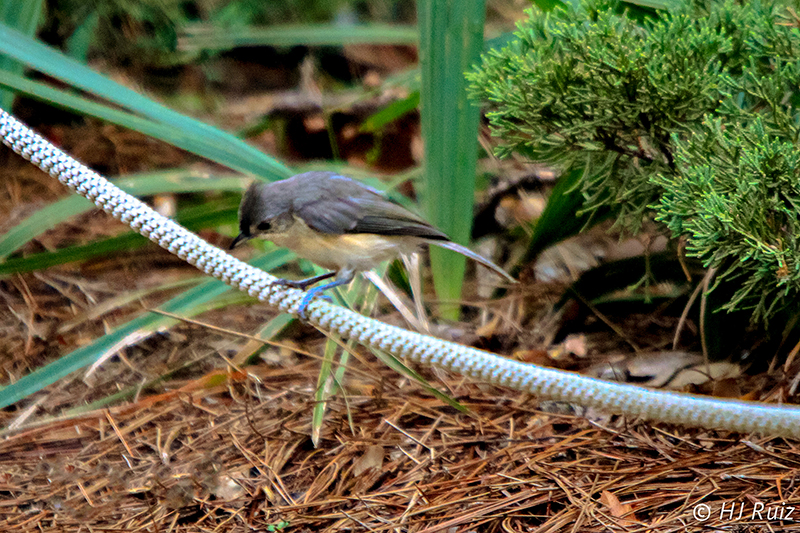
Black-crested Titmouse
The bird is 5.5 to 6 inches (14 to 15 cm) long, with rusty flanks, gray upper-parts, and a whitish belly. The male has a long, dark black crest that is usually erect, while the female’s crest is not as dark. It is common wherever trees grow, whether they are deciduous, heavy timber, or urban shade trees. Its call peter, peter, peter is similar to that of the Tufted Titmouse, but shorter. Its diet consists of berries, nuts, spiders, insects, and insect eggs.
The Black-crested Titmouse nests in tree cavities, telephone poles, fence posts, and bird boxes. The eggs, four to seven of which are laid in March or April, are white with reddish-brown spots.
Text excerpts © Wikipedia – All photographs © HJ Ruiz – Avian101




 H.J. Ruiz - Avian101
You must be logged in to post a comment.