My Job is Done!
You read on my post that I had contacted Atlanta Audubon Society via email, today’s post will show the way of how this issue transpired… You get your own opinion!
– I wrote an email reporting the presence of a Red-crested Cardinal in my backyard in Hiram, Ga. described a few things and attached a nice photograph which showed clearly the red band on the bird’s leg. Please read the Audubon reply next:
Hi HJ,
Thank you for the report. We have received similar notes regarding Red-crested Cardinals. In most cases they are released pets, which may explain the band as well. I’ve copied the GA IBA coordinator who may be able to speak to the color band.
Atlanta Audubon does not process bird reports itself. We encourage people to suit sightings to http://www.ebird.org.
Thank you,
Nikki
– Soon after I received an email from the GA IBA coordinator, read next:
Hi,
I am actually concerned about the number of reports of these guys. As neat as they are, I hope they do not become established. The band was used to ID the individual when it was captive.
Charlie
– I replied his email with a few pertinent questions, read next:
Hi Charlie,
Thank you very much for the information about the Red-crested Cardinal that I photographed in my backyard. Why is it that you hope they don’t become established in the mainland.however, they were introduced to Puerto Rico and Hawaii?
What make you think that have been banded locally and not in some other Country? Were all the reports you mention of birds with the same color band? Or were not banded at all.
I’m sorry to be so inquisitive about this matter, I’d like to get to the bottom of this rare occurrence. Who would release a bunch of banded precious birds?
I’d appreciate it very much if you could answer my questions.
Sincerely,
H.J. Ruiz
Avian101.wordpress.com
– Read what his response was next:
Hi Henry,
Anytime exotic species become established, it is always to the detriment of native species. While this is a really cool bird, it is more important that our natives are able to survive.
Banders do not typically apply just plastic bands without numbered metal bands to wild birds. That is typically done for captive birds. Most likely, an aviary was damaged, allowing several birds to escape.
Cheers,
Charlie
– I wasn’t very impressed with his reply or the way they all handled this matter. My disappointment with these societies has grown considerably.
As a person that gives a lot of his time to the welfare of birds I felt that I had to make a report and I did. My job is done!
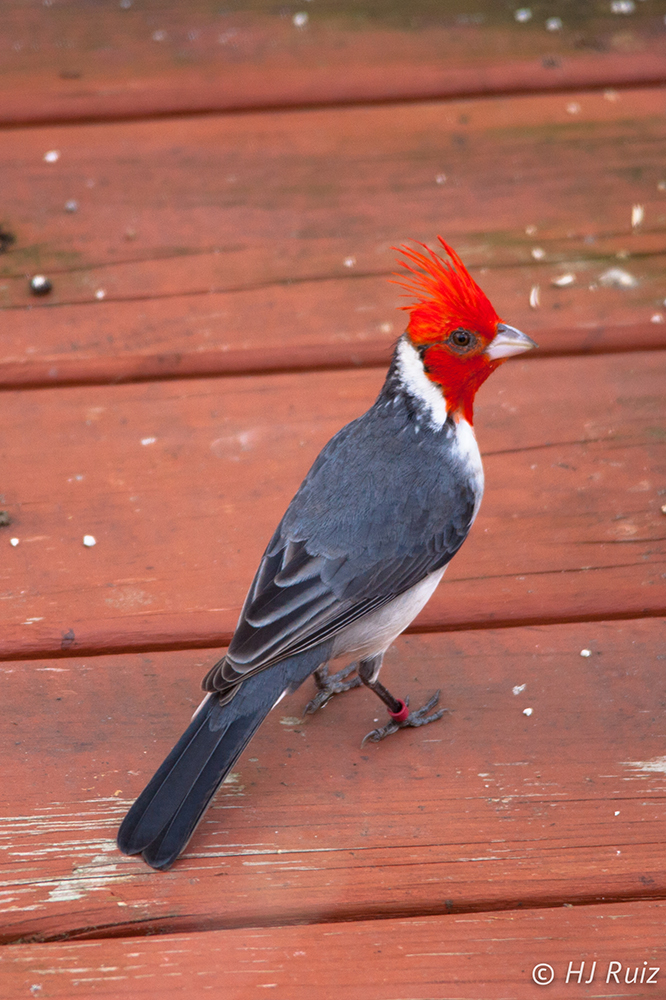
Red-crested Cardinal


 H.J. Ruiz - Avian101
It’s good that you reported it to your local Audubon Society, although ebird is the “official” place where people are keeping track of these things. Not to mention you’d have to answer to the “ebird police” there too. As for released birds becoming established outside of their native range argument, there are at least two sides to this quagmire. There are those who wish everything could be put back the way it was originally and they try to restore habitats and euthanize threats to endangered species. Then there are those who admit that the ecology of virtually everywhere has been changed by humans forever in some way and while we should try to mitigate the damages or prevent further occurrences, we can’t put the genie back in the bottle. There are Nutmeg Manakins, for instance, established in Southern California somewhere, and they’re an escaped caged bird originating in Southeast Asia/Australia. I’m not sure whether they have displaced any native species. Then there are those of us who sit on both sides of the fence…and basically end up enjoying the experience of seeing an unusual bird. Heavens, look at Monk Parakeets – they’re probably viewed as less destructive here than they are in their native habitat. And now that they’re established, they’ve been added to the list of species that can be seen in this country, where they reside.
I agree with you Lisa 100%, I just wanted to find out why these birds were introduced to Hawaii and Puerto Rico but would not like them to establish in mainland USA. What was the result of their experiment at the States they were introduced? I know, we have more examples like the House Sparrows and European Starlings that have proliferated into the millions! All that is becoming too complicated for us but Mother Nature will figure out the way to do what’s necessary whether we like it or not! Thanks for sharing my dear! 🙂
I agree that their responses were very tepid! But kudos to you for doing your part and reporting the rare sighting of this magnificent bird. I also liked Lisa’s comments above. Very well put!
Thank you very much NW! My dear friend Lisa is quite versed in Bird matters and Classic Music! You’re also a great comment writer! I wish I knew at least your first name. I’m H.J. by the way! 🙂
My name is Amy. 🙂 Sorry, I forget that my gravitar has just the novelwriter on there. I keep thinking I need to change it so it matches with my blog. My blog is Amy A. Corron, author. 🙂 I love your posts and pictures! Great to meet you, H.J!
I’ve seen first hand the damage invasive non-native species of birds (and other wildlife …. even plants) have had on our native populations. English (House) Sparrows and Starlings had a terrible effect on our lovely Bluebirds. And American gray squirrels are doing a lot of damage to the red squirrel population in England. Yes, with people being so mobile these days, many insects, plants, animals cross boarders that it would be better had they not.
It’s good you made your report. At least you got some information. I guess these guys just don’t like to write a lot.
I’m well aware of the effects of non-native species invade other territories, it creates all kinds of misbalances for the habitat of the native ones. It has happened in every Country of the world and I’m not referring only to birds!
I reported it and they gave me and answer. Am I happy? No. But that’s how far I will go! Thank you Annie! 🙂