
Glossy Ibis
Glossy Ibis – Latin name: Plegadis falcinellus
This is a wading bird in the ibis family Threskiornithidae.The most widespread ibis species, breeding in scattered sites in warm regions of Europe, Asia, Africa, Australia, and the Atlantic and Caribbean region of the Americas. It is thought to have originated in the Old World and spread naturally from Africa to northern South America in the 19th century, from where it spread to North America. This species is migratory; most European birds winter in Africa, and in North America birds from north of the Carolinas winter farther south. Birds from other populations may disperse widely outside the breeding season. While generally declining in Europe it has recently established a breeding colony in Southern Spain, and there appears to be a growing trend for the Spanish birds to winter in Britiain and Ireland, with at least 22 records in 2010.
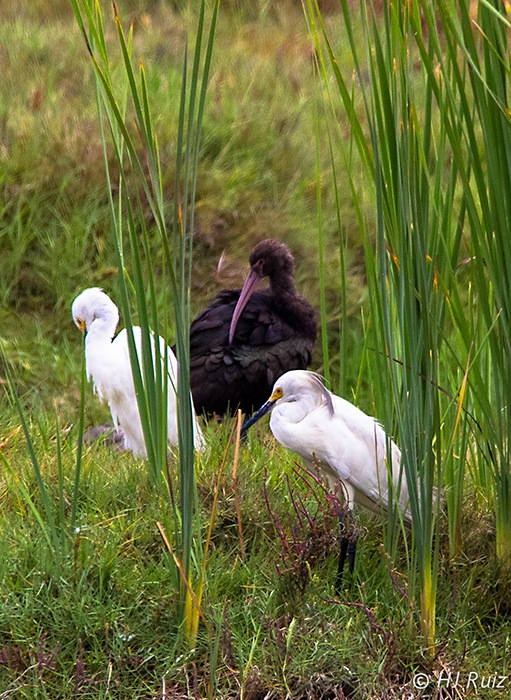
Glossy Ibis
Glossy Ibises undertake dispersal movements after breeding and are very nomadic. The more northerly populations are fully migratory and travel on a broad front, for example across the Sahara Desert. Populations in temperate regions breed during the local spring, while tropical populations nest to coincide with the rainy season. Nesting is often in mixed-species colonies. When not nesting flocks of over 100 individuals may occur on migration, and during the winter or dry seasons the species is usually found foraging in small flocks. Glossy Ibis often roosts communally at night in large flocks, with other species, occasionally in trees which can be some distance from wetland feeding areas.
Glossy Ibis feed in very shallow water and nest in freshwater or brackish wetlands with tall dense stands of emergent vegetation such as reeds, papyrus or rushes) and low trees or bushes. They show a preference for marshes at the margins of lakes and rivers but can also be found at lagoons, flood-plains, wet meadows, swamps, reservoirs, sewage ponds, paddies and irrigated farmland. It is less commonly found in coastal locations such as estuaries, deltas, salt marshes and coastal lagoons. Preferred roosting sites are normally in large trees which may distant from the feeding areas.
The nests are usually a platform of twigs and vegetation positioned at least 1m above water, sometimes up to 7 m in tall, dense stands of emergent vegetation, low trees or bushes.
NOTE: The Glossy Ibis is a new addition to my Bird List as: # 184


Text © Wikipedia – All photographs © H.J. Ruiz – Avian 101


 H.J. Ruiz - Avian101
It’s such a beautiful color. Nice habitat too. Thanks for posting and congrats on #184!
Thank you so much Lisa! I almost missed this bird because it was hidden behind the reeds and from far it looked like a shadow. I could take only a few crummy shots!
wow, great sighting HJ! congrats on 184!
Thanks Donna! 🙂