
House Wren
House Wren – Latin name: Troglodytes aedon
This is a very small songbird of the wren family, Troglodytidae. It occurs from Canada to southernmost South America, and is thus the most widely distributed bird in the Americas. It occurs in most suburban areas in its range and it is the single most common wren. Its taxonomy is highly complex and some subspecies groups are often considered separate species.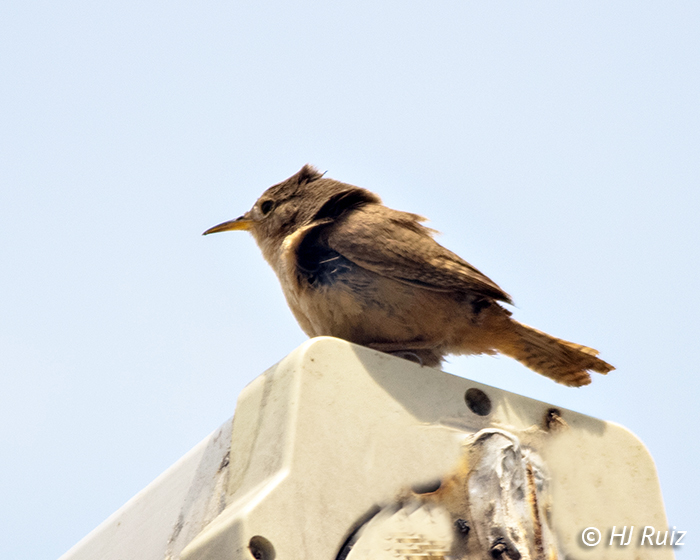
Adults are 11 to 13 cm (4.3 to 5.1 in) long, with a 15 cm (5.9 in) wingspan and weigh about 10 to 12 g (0.35 to 0.42 oz). Among standard measurements, the wing chord is 4.7 to 5.3 cm (1.9 to 2.1 in), the tail is 3.9 to 4.4 cm (1.5 to 1.7 in), the culmen is 1.1 to 1.3 cm (0.43 to 0.51 in) and the tarsus is 1.6 to 1.8 cm (0.63 to 0.71 in). The subspecies vary greatly, with upperparts ranging from dull greyish-brown to rich rufescent-brown, and the underparts ranging from brown, over buff and pale grey, to pure white. All subspecies have blackish barring to the wings and tail, and some also to the flanks. All subspecies show a faint eye-ring and eyebrow and have a long, thin bill with a blackish upper mandible, and a black-tipped yellowish or pale grey lower mandible. The legs are pinkish or grey. The short tail is typically held cocked.
This bird’s rich bubbly song is commonly heard during the nesting season but rarely afterwards. There is marked geographical variation in its song, though somewhat more gradual than in the birds’ outward appearance which can strikingly differ e.g. on neighboring islands in the Caribbean. Birds from far north and south of the species’ range nonetheless have songs that differ markedly.
NOTE: The House Wren is a new addition to my Bird List as: # 179


Text © Wikipedia – All photographs © H.J. Ruiz – Avian 101




 H.J. Ruiz - Avian101
You must be logged in to post a comment.