
Kelp Gull
Kelp Gull – Latin name: Larus dominicanus
Also known as the Dominican Gull, is a gull which breeds on coasts and islands through much of the southern hemisphere. The nominate L. d. dominicanus is the subspecies found around South America, parts of Australia (where it overlaps with the Pacific Gull), and New Zealand (where it is known as the Southern Black-backed Gull or by its Māori name Karoro). L. d. vetula (known as the Cape Gull) is a subspecies occurring around southern Africa.
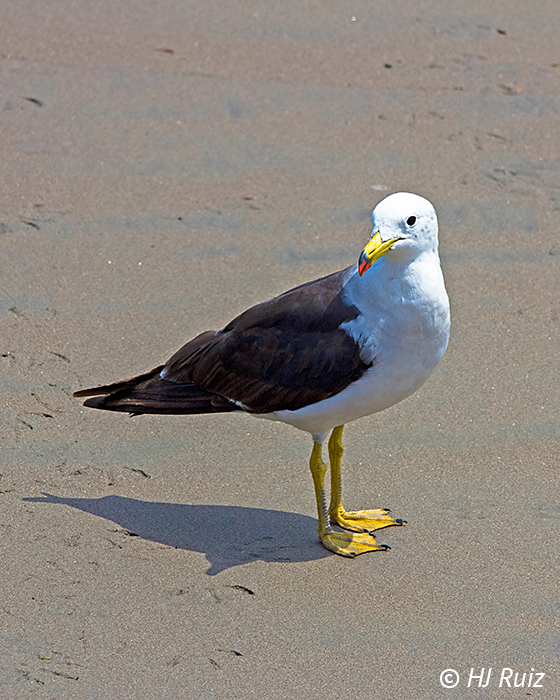
Kelp Gull
The specific name comes from the Dominican Order of friars, who wore black and white habits.
The Kelp Gull superficially resembles two gulls from further north in the Atlantic Ocean the Lesser Black-backed Gull and the Great Black-backed Gull. The Kelp is intermediate in size between these two species. This species ranges from 54 to 65 cm (21 to 26 in) in total length, from 128 to 142 cm (50 to 56 in) in wingspan and from 540 to 1,390 g (1.2 to 3.1 lb) in weight. Adult males and females weigh on average 1,000 g (2.2 lb) and 900 g (2.0 lb) respectively. Among standard measurements, the wing chord is 37.3 to 44.8 cm (14.7 to 17.6 in), the bill is 4.4 to 5.9 cm (1.7 to 2.3 in) and the tarsus is 5.3 to 7.5 cm (2.1 to 3.0 in). The adult Kelp Gull has black upperparts and wings. The head, underparts, tail and the small “mirrors” at the wing tips are white. The bill is yellow with a red spot, and the legs are greenish-yellow (brighter and yellower when breeding, duller and greener when not breeding). The call is a strident ki-och. Juveniles have dull legs, a black bill, a dark band in the tail, and an overall grey-brown plumage densely edged whitish, but they rapidly get a pale base to the bill and largely white head and underparts. They take three or four years to reach maturity.
The African subspecies L. d. vetula is sometimes split as the Cape Gull, L. vetula. It has a more angular head and a smaller shorter bill. The adult has a dark eye, whereas the nominate Kelp Gull usually has a pale eye. Young Cape Gulls have almost identical plumage to similarly aged Kelp Gulls.
NOTE: The Kelp Gull is a new addition to my Bird List as: # 177


Text © Wikipedia – All photographs © H.J. Ruiz – Avian 101


 H.J. Ruiz - Avian101
Very cool. I am jealous. This is the one and only gull I could have seen in Brazil and it eluded my camera. Great shots, especially the one with the fish! 🙂
Don’t worry Lisa, you’ll get it the next time! Thank you my dear! 🙂
Reblogged this on Wolf's Birding and Bonsai Blog.