House Finch
The House Finches have been visiting my backyard since the very first time a placed a feeder and still keep coming and nesting in our area.
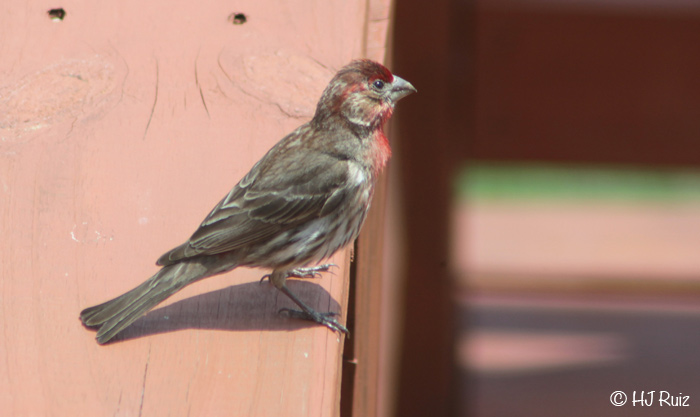
Adults have a long, square-tipped brown tail and are a brown or dull-brown color across the back with some shading into deep gray on the wing feathers. Breast and belly feathers may be streaked; the flanks usually are. In most cases, adult males’ heads, necks and shoulders are reddish. This color sometimes extends to the belly and down the back, between the wings. Male coloration varies in intensity with the seasons and is derived from the berries and fruits in its diet. Adult females have brown upper-parts and streaked under-parts.
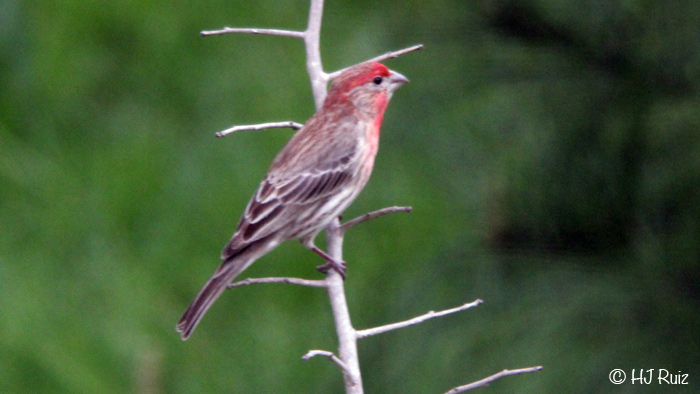
House Finch (M)
These birds are mainly permanent residents throughout their range; some northern and eastern birds migrate south. Their breeding habitat is urban and suburban areas in eastern North America as well as various semi-open areas in the west from southern Canada to northern Florida.
Interesting note:
Originally only a resident of Mexico and the , they were introduced to eastern North America in the 1940s. The birds were sold illegally in New York City as “Hollywood Finches”, a marketing artifice. To avoid prosecution under the Migratory Bird Treaty Act of 1918, vendors and owners released the birds. They have become naturalized; in some unforested areas, they have displaced the native Purple Finch and non-native House Sparrow. We extend the “welcome” matt to them any time!
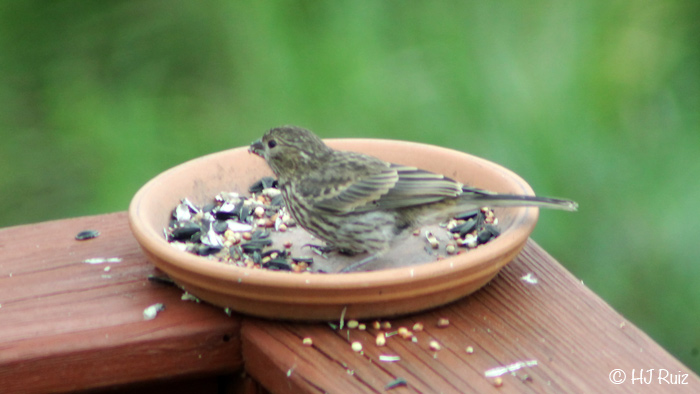
House Finch (F)
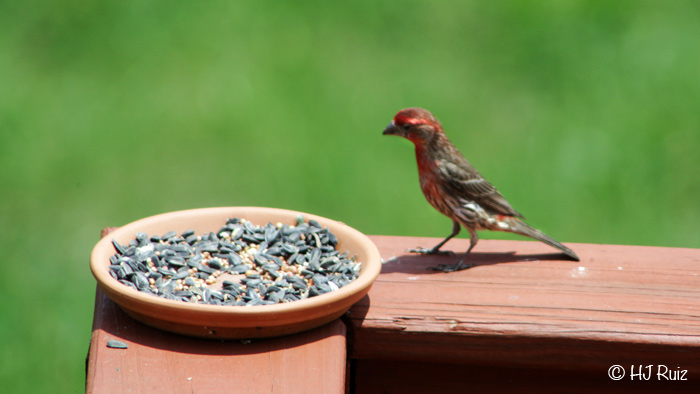
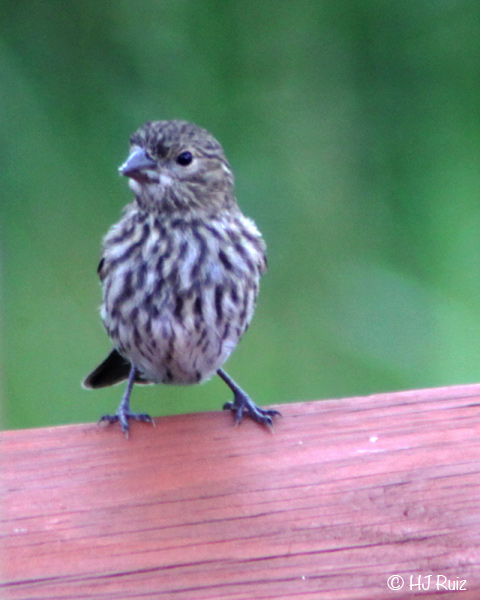
House Finch (I)
Click on images to see enlargements
Text and photographs © H.J. Ruiz – Avian 101


 H.J. Ruiz - Avian101
Oh My Gosh I love this House Finch! I was able to shoot my first house finch yesterday as I was walking around the bay. Along with another shot of a bird that I had never seen. I was so excited, as I always am over birds.
That’s great, now you can compare the images!
P.S. The one I shot had the ‘red’ markings. I see not all of them do. So they are different colors? The house finch?
If you look at my photos it tells you (F)= female, (M) =Male or (I) = Immature
These birds are dimorphic ( Differ in size, shape or color) Thanks for your comments BD! 🙂
Excuse my ignorance H.J. I had no idea was the M, F and I were. LOL. I do now. ;0)
I don’t think we have them over here. They’re delightful – what wonderful photos – you can see their personalities!
Thank you for your comment Julie! 🙂
House finches are one of my back yard species. They don’t seem to get along with the mourning doves, but when the doves are on vacation, the finches, waxwings, and bluebirds visit.
The Mourning Doves are gluttons, they eat and eat! They bunch up and block the feeder and don’t move until it’s empty!
I do have some fat ones here. lol