Endangered Bird Produces a Chick on U.S. Soil for 2nd Time in History
For the second time ever recorded, an endangered Short-tailed Albatross has nested in the United States and produced a chick. The recent discovery of the nest and chick on Midway Atoll in the Northwestern Hawaiian Islands follows the fledging of the first U.S.-born chick last year at the same site by the same parents.
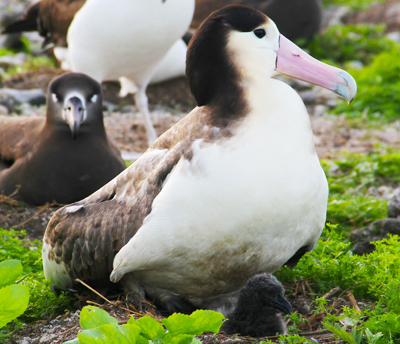
Short-tailed Albatross and chick; USFWS
“This is great news because it suggests that the first chick hatched last year was not an isolated incident. We may be seeing the early stages of the formation of a new population of this very rare bird,” said Dr. George Wallace, Director of Oceans and Islands at American Bird Conservancy, the nation’s leading bird conservation organization. “This would be a significant conservation development because it would reduce the likelihood that a catastrophic event on its main breeding island, Torishima, Japan, would wipe the species out.”
The Short-tailed Albatross was once the most abundant of the North Pacific albatross species, numbering more than a million birds. It was decimated by feather hunting at the turn of the 20th Century, and by the late 1940s was thought to be extinct. In the early 1950s, ten pairs were discovered breeding on the volcanic island of Torishima, Japan. The population has now reached 3,000 individuals, with most on Torishima, but conservationists fear an eruption there could spell disaster. For the last five years, the Short-tailed Albatross Recovery Team, an international group of collaborators, has been working on establishing a new colony on Mukojima Island, also in Japan, which is safe from volcanic activity.
Midway Atoll is located more than 1,300 miles northwest of Honolulu, and consists of a circular barrier reef and several sand islets managed as Midway Atoll National Wildlife Refuge. It is home to the world’s largest colonies of Laysan and Black-footed albatrosses, as well as millions of other seabirds.
American Bird Conservancy (ABC) is a 501(c)(3) not-for-profit membership organization whose mission is to conserve native birds and their habitats throughout the Americas.


 H.J. Ruiz - Avian101
Wow! Fantastic.
🙂
lovely!
Thanks! 🙂