
Sunbittern
Sunbittern – Spec. Name: Eurypyga helias
This is a bittern-like bird of tropical regions of the Americas, and the sole member of the family Eurypygidae (sometimes spelled Eurypigidae) and genus Eurypyga.
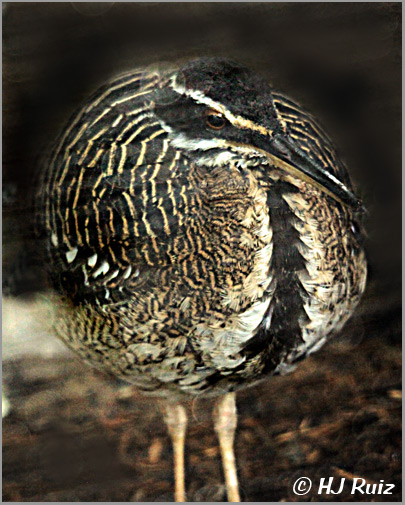
Sunbittern
The bird has a generally subdued coloration, with fine linear patterns of black, grey and brown. Its remiges however have vividly-colored middle webs, which with wings fully spread show bright eyespots in red, yellow, and black. These are shown to other sunbitterns in courtship and threat displays, or used to startle potential predators. Like some other birds, the Sunbittern has powder down.
They build open nests in trees, and lay two eggs with blotched markings. The young are precocial, but remain in the nest for several weeks after hatching
The Sunbittern’s range extends from Guatemala to Brazil. The species may also be present in southern Mexico: it has been traditionally reported from the Atlantic slope of Chiapas, but no specimens are known and there have been no recent records.
The Sunbittern is normally found foraging on the ground and scratching for insects.
The Sunbittern is usually placed in the Gruiformes, but this was always considered preliminary. Altogether, the bird is most similar to another enigmatic bird that was provisionally placed in the Gruiformes, the Kagu (Rhynochetos jubatus).[4] Molecular studies seem to confirm that the Kagu and Sunbittern are each other’s closest living relatives.] They are probably not Gruiformes (though the proposed Metaves are just as weakly supported). Altogether, the two species seem to form a minor Gondwanan lineage which could also include the extinct adzebills and/or the mesites, and is of unclear relation to the Gruiformes proper. Notably, the Kagu and mesites also have powder down.
A DNA study by Hackett et al. (2008) concluded strongly, as well as Fain & Houde (2004) and other researchers, that the Sunbittern and the Kagu form a clade, but puts these two as a sister group of the swifts, nightjars and hummingbirds.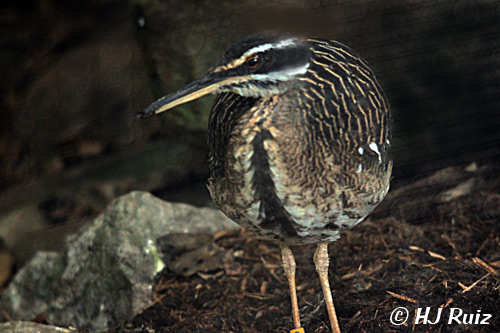
All photos are © H.J. Ruiz – Avian101
Text is available under the Creative Commons Attribution-ShareAlike License; additional terms may apply. See Terms of use for details.


 H.J. Ruiz - Avian101
You must be logged in to post a comment.