Canada Goose
Canada Goose – Spec. Name: Branta canadensis
This is a wild goose belonging to the genus Branta, which is native to arctic and temperate regions of North America, having a black head and neck, white patches on the face, and a brownish-gray body.
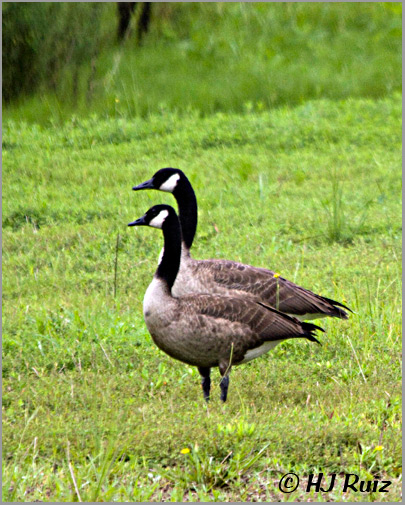
Canada Geese
The black head and neck with white “chinstrap” distinguish the Canada Goose from all other goose species, with the exception of the Barnacle Goose, but the latter has a black breast, and also grey, rather than brownish, body plumage. There are seven subspecies of this bird, of varying sizes and plumage details, but all are recognizable as Canada Geese. Some of the smaller races can be hard to distinguish from the newly-separated Cackling Goose.
This species is 76–110 centimetres (30–43 in) long with a 127–180 centimetres (50–71 in) wingspan. The male usually weighs 3.2–6.5 kilograms (7.1–14 lb), and can be very aggressive in defending territory. The female looks virtually identical but is slightly lighter at 2.5–5.5 kilograms (5.5–12 lb), generally 10% smaller than its male counterpart, and has a different honk. An exceptionally large male of the race B. c. maxima, the “giant Canada goose” (which rarely exceed 8 kilograms (18 lb)), weighed 10.9 kilograms (24 lb) and had a wingspan of 2.24 metres (7.3 ft). This specimen is the largest wild goose ever recorded of any species. The life span in the wild of geese that survive to adulthood ranges 10–24 years.
Like most geese, the Canada Goose is naturally migratory with the wintering range being most of the United States. The calls overhead from large groups of Canada Geese flying in V-shaped formation signal the transitions into spring and autumn. In some areas, migration routes have changed due to changes in habitat and food sources. In mild climates from California to the Great Lakes, some of the population has become non-migratory due to adequate winter food supply and a lack of former predators.
Canada Geese are primarily herbivores, although they sometimes eat small insects and fish. Their diet includes green vegetation and grains. The Canada Goose eats a variety of grasses when on land. It feeds by grasping a blade of grass with the bill, then tearing it with a jerk of the head. The Canada Goose also eats grains such as wheat, beans, rice, and corn when they are available. In the water, it feeds from silt at the bottom of the body of water. It also feeds on aquatic plants, such as seaweeds. In urban cities, they are also known to pick food out of garbage bins.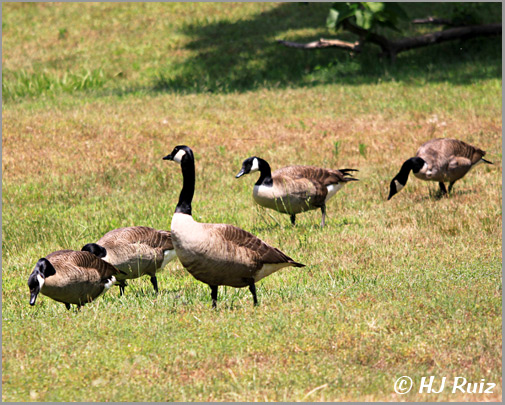
All photographs are © H.J. Ruiz – Avian101
Text is available under the Creative Commons Attribution-ShareAlike License; additional terms may apply. See Terms of use for details.


 H.J. Ruiz - Avian101
You must be logged in to post a comment.