King Vulture
King Vulture – Spec. Name: Sarcoramphus papa
This is a large bird found in Central and South America. It is a member of the New World vulture family Cathartidae. This vulture lives predominantly in tropical lowland forests stretching from southern Mexico to northern Argentina, though some believe that William Bartram’s Painted Vulture of Florida may be of this species. It is the only surviving member of the genus Sarcoramphus, although fossil members are known.
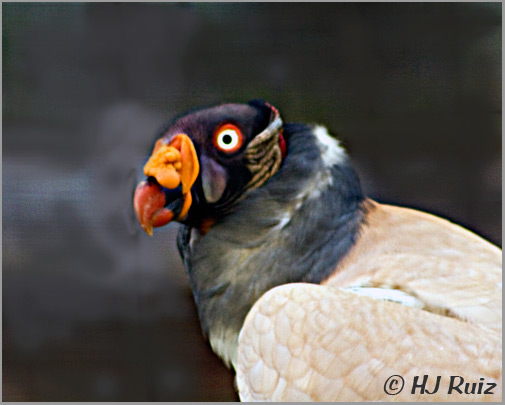
Large and predominantly white, the King Vulture has gray to black ruff, flight, and tail feathers. The head and neck are bald, with the skin color varying, including yellow, orange, blue, purple, and red. The King Vulture has a very noticeable yellow fleshy caruncle on its beak. This vulture is a scavenger and it often makes the initial cut into a fresh carcass. It also displaces smaller New World vulture species from a carcass. King Vultures have been known to live for up to 30 years in captivity.
King Vulture
King Vultures were popular figures in the Mayan codices as well as in local folklore and medicine.
Although currently listed as Least Concern by the IUCN, they are decreasing in number, due primarily to habitat loss.
Excluding the two species of condors, the King Vulture is the largest of the New World vultures. Its overall length ranges from 67–81 centimeters (27–32 in) and its wingspan is 1.2–2 meters (4–6.6 ft). Its weight ranges from 2.7–4.5 kilograms (6–10 lb). An imposing bird, the adult King Vulture has predominantly white plumage, which has a slight rose-yellow tinge to it. In stark contrast, the wing coverts, flight feathers and tail are dark grey to black, as is the prominent thick neck ruff. The head and neck are devoid of feathers, the skin shades of red and purple on the head, vivid orange on the neck and yellow on the throat. On the head, the skin is wrinkled and folded, and there is a highly noticeable irregular golden crest attached on the cere above its orange and black bill; this caruncle does not fully form until the bird’s fourth year.
The King Vulture has the largest skull and braincase, and strongest bill of the New World vultures. This bill has a hooked tip and a sharp cutting edge. The bird has broad wings and a short, broad, and square tail. The irises of its eyes are white and bordered by bright red sclera. Unlike some New World vultures, the King Vulture lacks eyelashes. It also has gray legs and long, thick claws.
The vulture is minimally sexually dimorphic, with no difference in plumage and little in size between males and females. The juvenile vulture has a dark bill and eyes, and a downy, gray neck that soon begins to turn the orange of an adult. Younger vultures are a slate gray overall, and, while they look similar to the adult by the third year, they do not completely molt into adult plumage until they are around five or six years of age. Jack Eitniear of the Center for the Study of Tropical Birds in San Antonio, Texas reviewed the plumage of birds in captivity of various ages and found that ventral feathers were the first to begin turning white from two years of age onwards, followed by wing feathers, until the full adult plumage was achieved. The final immature stages being a scattered black feathers in the otherwise white lesser wing coverts.
The vulture’s head and neck are featherless as an adaptation for hygiene, though there are black bristles on parts of the head; this lack of feathers prevents bacteria from the carrion it eats from ruining its feathers and exposes the skin to the sterilizing effects of the sun.
Dark-plumaged immature birds may be confused with Turkey Vultures, but soar with flat wings, while the pale plumaged adults could feasibly be confused with the Wood Stork, although the latter’s long neck and legs allow for easy recognition from afar.
Photograph is © H.J. Ruiz – Avian101
Text is available under the Creative Commons Attribution-ShareAlike License; additional terms may apply. See Terms of use for details.


 H.J. Ruiz - Avian101
Interesting. More colorful than the ones we have here in west Texas.
You’re right Bob, this is the king of vultures because its size and colorful features.
Thanks!