Golden-breasted Starling
Golden-breasted Starling a.k.a. Royal Starling – Spec. Name: Cosmopsarus regius
This is a medium-sized, up to 35cm long, passerine in the starling family. The adult has a metallic green head and upperback, bright golden-yellow breast and belly, dark bill and legs, white irisand metallic violet-blue on wings, back, neck and its long tail feathers. Both sexes are similar. The young is duller than adult.
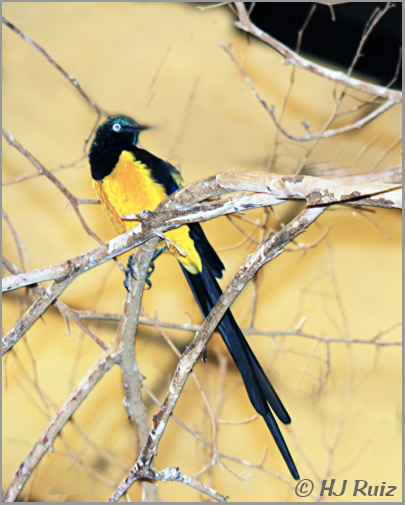
Golden-breasted Starling
The Golden-breasted Starling is distributed to the grassland, savanna and shrubland of East Africa, from Somalia, Ethiopia, Kenya and northern Tanzania.
The Golden-breasted Starling is a social animal, living in groups of three to twelve individuals. Its diet consists mainly of insects and termites. The Golden-breasted Starling molts once a year, after the breeding season.
The female usually lays between three to five pale green eggs with red speckles. It nests in tree holes. The nest is made from leaves, roots and other vegetation matters.
Widespread throughout its habitat range, the Golden-breasted Starling is evaluated as Least Concern on the IUCN Red List of Threatened Species.
Unlike most starlings which feed on a combination of insects and fruits, the Golden-breasted starling lives almost entirely on insects. Termites are caught by opening their ground tunnels with rapid flicks of its bill and other insects are caught in flight. Literature also suggests it eats snails, crabs, spiders and small vertebrates. In zoos, such as the Lincoln Park Zoo in Chicago, starlings are fed fruit, dog and/or cat chow, meat and insects. (According to Honolulu Zoo information.)
All photographs are © H.J. Ruiz – Avian101
Text is in part available under the Creative Commons Attribution-ShareAlike License; additional terms may apply. See Terms of use for details.


 H.J. Ruiz - Avian101
You must be logged in to post a comment.