Sulphur-crested Cockatoo
Sulphur-crested Cockatoo – Spec, Name: Cacatua galerita
This is a relatively large white cockatoo found in wooded habitats in Australia and New Guinea. They can be locally very numerous, leading to them sometimes being considered pests. They are well known in aviculture, although they can be demanding pets.
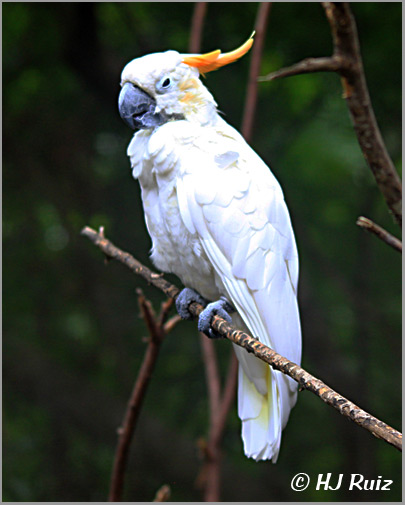
Sulphur-crested Cockatoo
It has a total length of 45–55 cm (18–22 in), with the Australian subspecies larger than subspecies from New Guinea and nearby islands. The plumage is overall white, while the underwing and -tail are tinged yellow. The expressive crest is yellow. The bill is black, the legs are grey, and the eye-ring is whitish. Males typically have almost black eyes, whereas the females have a more red or brown eye, but this require optimum viewing conditions to be seen. The differences between the subspecies are subtle. C. g. fitzroyi is similar to the nominate race but lacks the yellow on the ear tufts and slightly blueish skin around the eye. C. g. eleonora is similar to C. g. fitzroyi but is smaller and has broader feathers in the crest, and C. g. triton is similar to C. g. eleonora except it has a smaller bill.
It is similar in appearance to the three species of corellas found in Australia. However, corellas are smaller, lack the prominent yellow crest and have pale bills. In captivity, the Sulphur-crested Cockatoo is easily confused with the smaller Yellow-crested Cockatoo or the Blue-eyed Cockatoo with a differently shaped crest and a darker blue eye-ring.
Their distinctive raucous call can be very loud; it is adapted to travel through the forest environments in which they live, including tropical and subtropical rainforests. These birds are naturally curious, as well as very intelligent. They have adapted very well to European settlement in Australia and live in many urban areas.
These birds are very long-lived, and can live upwards of 70 years in captivity, although they only live to about 20–40 years in the wild. They have been known to engage ingeophagy, the process of eating clay to detoxify their food. These birds produce a very fine powder to waterproof themselves instead of oil as many other creatures do.
The Sulphur-crested Cockatoo is a seasonal breeder in Australia, little is known about its breeding behaviour in New Guinea. In southern Australia the breeding season is from August to January, whereas in northern Australia the season is from May to September. The nest is a bed of wood chips in a hollow in a tree. Like many other parrots it competes with others of its species and with other species on nesting sites. Two to three eggs are laid and incubation lasts between 25–27 days. Both parents incubate the eggs and raise the nestlings. The nestling period is between 9 to 12 weeks, and the young fledgelings remain with their parents for a number of months after fledging.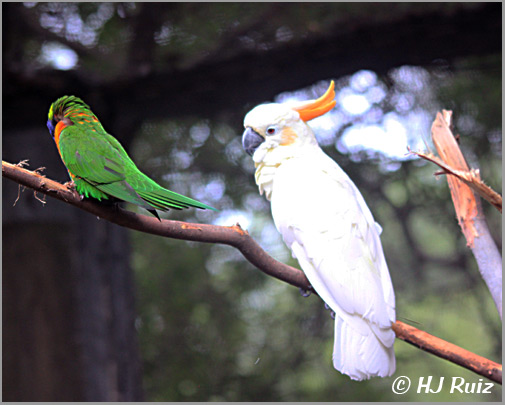
All photographs are © H.J. Ruiz – Avian101
Text is available under the Creative Commons Attribution-ShareAlike License; additional terms may apply. See Terms of use for details.


 H.J. Ruiz - Avian101
You must be logged in to post a comment.