Nene
Nene,a.k.a. Nēnē and Hawaiian Goose – Spec. Name:, Branta sandvicensis
This is a species of goose endemic to the Hawaiian Islands. The official bird of the state of Hawaiʻi, the Nene is exclusively found in the wild on the islands of Maui, Kauaʻi and Hawaiʻi. The Hawaiian nameNēnēcomes from its soft call.

Nene
The Nene evolved from the Canada Goose (Branta canadensis), which most likely migrated to the Hawaiian islands 500,000 years ago, shortly after the island of Hawaiʻi was formed. This ancestor is the progenitor of the Nene as well as the prehistoric Giant Hawaiʻi Goose and Nēnē-nui (Branta hylobadistes). The Nēnē-nui was larger than the Nene, varied from flightless to flighted depending on the individual, and inhabited the island of Maui. Similar fossil geese found on Oʻahu and Kauaʻi may be of the same species. The Giant Hawaiʻi Goose was restricted to the island of Hawaiʻi and measured 1.2 metres (3.9 ft) in length with a mass of 8.6 kilograms (19 lb), making it more than four times larger than the Nene. It is believed that the herbivorous Giant Hawaiʻi Goose occupied the same ecological niche as the goose-like ducks known as moa-nalo, which were not present on the Big Island. Based on mitochondrial DNA found in fossils, all Hawaiian geese, living and dead, are closely related to the Giant Canada Goose (B. c. maxima) and Dusky Canada Goose (B. c. occidentalis).
The Nene is a medium-sized goose at 41 centimetres (16 in) tall. They are said to be able to fly because their wingspan is long and strong. Females have a mass of 1.525–2.56 kilograms (3.36–5.6 lb), while males average 1.695–3.05 kilograms (3.74–6.7 lb), 11% larger than females. Adult males have a black head and hindneck, buff cheeks and heavily furrowed neck. The neck has black and white diagonal stripes. Aside from being smaller, the female Nene is similar to the male in colouration. The adult’s bill, legs and feet are black. It has soft feathers under its chin. Goslings resemble the male, but are a duller brown and with less demarcation between the colours of the head and neck, and striping and barring effects are much reduced. The bill, legs and feet are the same as for the adult. Its strong toes are padded and have reduced webbing, an adaptation that allows it to swiftly traverse rough terrain such as lava plains.
The breeding season of the Nene, from August to April, is longer than that of any other goose; most eggs are laid between November and January. Unlike most other waterfowl, the Nene mates on land. Nests are built by females on a site of their choosing, in which one to five eggs are laid (average is three on Maui and Hawaiʻi, four on Kauaʻi). Females incubate the eggs for 29 to 32 days, while the male acts as a sentry. Goslings are precocial, able to feed on their own; they remain with their parents until the following breeding season.
The Nene is an herbivore that will either graze or browse, depending on the availability of vegetation. Food items include the leaves, seeds, fruit, and flowers of grasses and shrubs.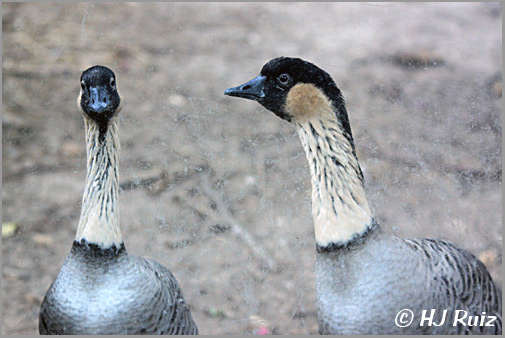
All photographs are © H.J. Ruiz
Text is available under the Creative Commons Attribution-ShareAlike License; additional terms may apply. See Terms of use for details.


 H.J. Ruiz - Avian101
You must be logged in to post a comment.