
Introducing Rainbow Lorikeets to my Grandson
Not very long ago I introduced my grandson Tyler to his first contact with birds. It happened at the Birmingham Zoo in Alabama. We let Tyler touch and play with the multicolor Lorikeets. Tyler is familiar with birds when he see them at my backyard but from afar, however, this time at the Zoo he was intrigued when he saw them close and with a chance for a touch. At first he hesitated of the contact but a minute later he was familiarized and wanted more.
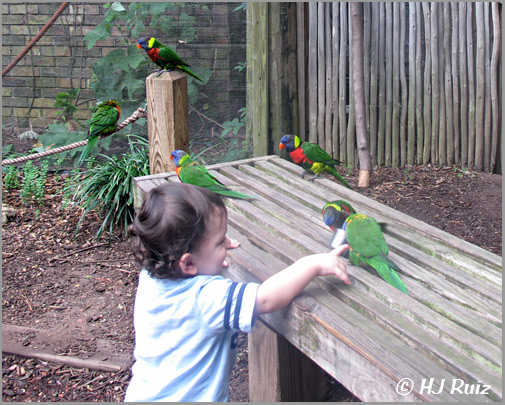
Tyler touching the Lorikeet
Lorikeets are extremely friendly I may say, because while I was shooting pictures of Tyler and the Lorikeets, one of them landed on my shoulder and began to nibble on my ear, it was funny and made me laugh because I did not expect it and it tickled me. He wouldn’t let go.of my ear! 🙂
My wife enjoyed this moment very much, so did Tyler being only 16 months old.
We planned this trip as a trial to see if Tyler would be ok to have long drives without getting bored or too uncomfortable. He did the trip with no problem at all. I’ll be making plans to travel to further points, until he gets used to. We always like to travel by road to visit new places and do photography. Tyler lives with us now.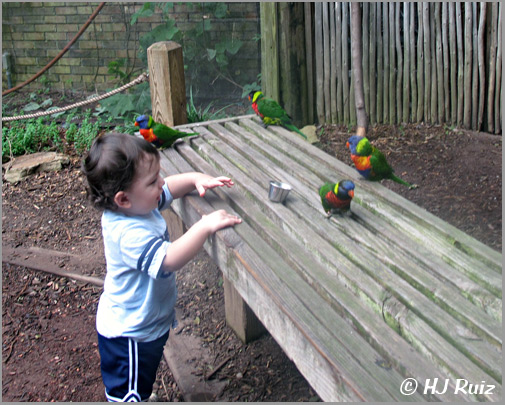
That day Tyler had a great deal of fun looking at all the animals and seeing other children walking the grounds with their relatives. I saw several large groups of school children and their teachers and chaperons. I’m not sure if is mandatory for all School Curriculums but it would be a great benefit for all kids to visit a Zoo. It would be an unforgettable experience for them, to be aware of the existence of many kinds of animals in Nature. Later in life, when kids grow up, I’m sure they will remember the experience and have more respect for animals and care for them. (I lived that experience!)
We certainly had a great day in Alabama, my wife and I were very happy that the trip was a success, we returned home with a smile on our faces and Tyler was happy camper! Hurray! 🙂
Now I have more about Rainbow Lorikeets:
Rainbow Lorikeet – Spec. Name: Trichoglossus haematodus
This is a species of Australasian parrot found in Australia, eastern Indonesia(Maluku and Western New Guinea), Papua New Guinea, New Caledonia, Solomon Islands and Vanuatu. In Australia, it is common along the eastern seaboard, from Queensland to South Australia and northwest Tasmania. Its habitat is rainforest, coastal bush and woodland areas. Several taxa traditionally listed as subspecies of the Rainbow Lorikeet are increasingly treated as separate species (see Taxonomy).
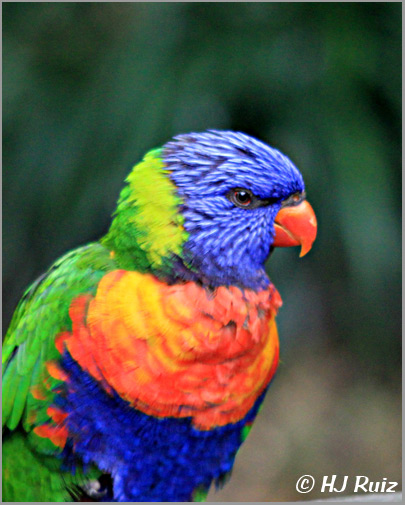
Rainbow Lorikeet
Rainbow Lorikeets have been introduced to Perth – Western Australia, Auckland – New Zealand and Hong Kong – China
The Rainbow Lorikeet is a medium sized parrot, with the length ranging from 25–30 cm (9.8-11.8 in) in size, and has a wingspan of about 17 cm (6.7 in). The weight varies from 75–157 g (2.6–5.5 oz). The plumage of the nominate race, as with all subspecies, is very bright. The head is deep blue with a greenish-yellow nuchal collar, and the rest of the upperparts (wings, back and tail) are deep green. The chest is red with blue-black barring. The belly is deep green, and the thighs and rump are yellow with deep green barring. In flight a yellow wing-bar contrasts clearly with the red underwing coverts. There is little to visually distinguish between the sexes. Juveniles have a black beak which gradually brightens to orange in the adults. The markings of the best known subspecies T. h. moluccanus resemble those of the nominate race, but with a blue belly and a more orange breast with little or no blue-black barring. 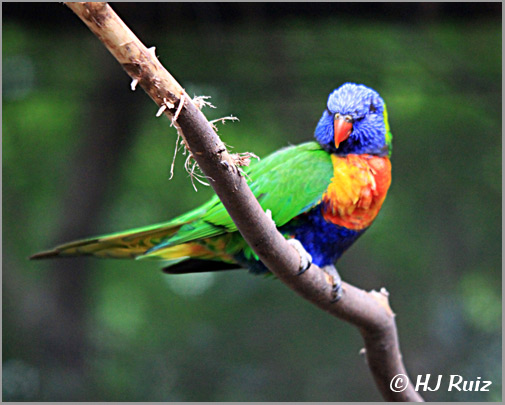 Other subspecies largely resemble either the nominate race or T. h. moluccanus, or are intermediate between them. Two exceptions are T. h. flavicans and T. h. rosenbergii. In the rather variable T. h. flavicans the green of some individuals is dull, almost olivaceous, but in others the green hue approaches that typical of the Rainbow Lorikeet. T. h. rosenbergii is highly distinctive and several features separates it from all other subspecies: Its wing-bars are deep orange (not contrasting clearly with the red underwing coverts in flight), the entire nape is yellow bordered by a narrow red band and the dark blue barring to the red chest is very broad.
Rainbow Lorikeets feed mainly on fruit, pollen and nectar, and possess a tongue adapted especially for their particular diet. The end of the tongue is equipped with a papillate appendage adapted to collecting nectar from flowers.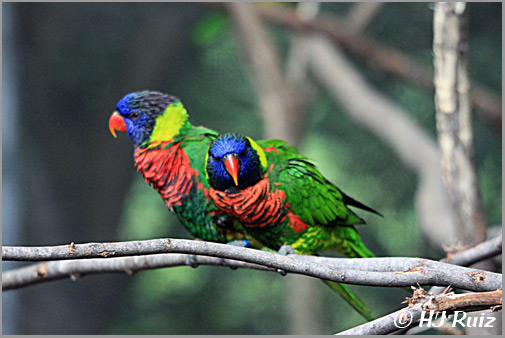
All photographs are © H.J. Ruiz – Avian101
Text is available under the Creative Commons Attribution-ShareAlike License; additional terms may apply. See Terms of use for details.


 H.J. Ruiz - Avian101
You must be logged in to post a comment.