Secretary Bird
Secretary Bird – Spec. Name: Sagittarius serpentarius
This is a large, mostly terrestrial bird of prey. Endemic to Africa, it is usually found in the open grasslands and savannah of the sub-Sahara. Although a member of the order Accipitriformes, which also includes many other diurnal raptors such as kites, buzzards, vultures, and harriers, it is given its own family, Sagittariidae. It appears on the coats of arms of Sudan and South Africa.

Secretary Bird
The Secretary Bird is instantly recognizable as having an eagle-like body on crane-like legs which increases the bird’s height to around 1.3 m (4 ft) tall. This 140 cm (4.5 ft) long bird has an eagle-like head with a hooked bill, but has rounded wings. Body weight averages at about 3.3 kg (7.3 lbs) and the wingspan is over 2 m (6.6 ft). Due to its long legs and long tail, it is both longer and taller than any other diurnal raptor. The neck is not especially long, and can only be lowered down to the inter-tarsal joint, so birds reaching down to the ground or drinking must stoop to do so.
From a distance or in flight it resembles a crane more than a bird of prey. The tail has two elongated central feathers that extend beyond the feet during flight, as well as long flat plumage creating a posterior crest. Secretary Bird flight feathers and thighs are black, while most of the coverts are grey with some being white. Sexes look similar to one another as the species exhibits very little sexual dimorphism, although the male has longer head plumes and tail feathers. Adults have a featherless red face as opposed to the yellow facial skin of the young.
Secretary Birds are endemic to Sub-Saharan Africa and are non-migratory, though they may follow food sources. Their range extends from Senegal to Somalia and south to the Cape of Good Hope. These birds are also found at a variety of elevations, from the coastal plains to the highlands. Secretary Birds prefer open grasslands and savannas rather than forests and dense shrubbery which may impede their cursorial existence. While the birds roost on the local Acacia trees at night, they spend much of the day on the ground, returning to roosting sites just before dark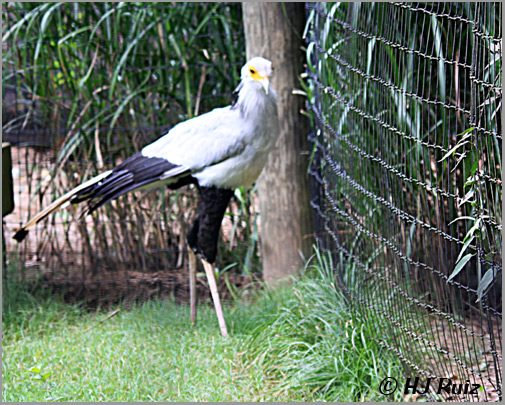
The Secretary Bird is largely terrestrial, hunting its prey on foot, and other than the caracara (such as Caracara plancus), is the only bird of prey to do so habitually. Adults hunt in pairs and sometimes as loose familial flocks, stalking through the habitat with long strides. Prey consists of insects, small mammals, lizards, snakes, young birds, bird eggs, and sometimes dead animals killed in grass or bush fires. It also waits near fires, eating anything it can that is trying to escape. Larger herbivores are not hunted, although there are some reports of Secretary Birds killing young gazelles.
Young are fed liquefied and regurgitated insects directly by the male or female parent and are eventually weaned to small mammals and reptile fragments regurgitated onto the nest itself. The above foodstuffs are originally stored in the crop of the adults.
Secretary Birds have two distinct feeding strategies that are both executed on land. They can either catch their prey by chasing it and striking with the bill, or stamping on the prey until it is rendered stunned or unconscious enough to swallow. Studies of this latter strategy have helped reconstruct the possible feeding mechanisms employed by the dinosaur-like ‘terror birds’ that lived between sixty and five million years ago.
In hunting and feeding on small animals and arthropods on the ground and in tall grass or scrub, Secretary Birds occupy an ecological niche similar to that occupied by peafowl in South and Southeast Asia, roadrunners in North and Central America and seriemas in South America.
All photographs are © H.J. Ruiz – Avian101
Text is available under the Creative Commons Attribution-ShareAlike License; additional terms may apply. See Terms of use for details.


 H.J. Ruiz - Avian101
You must be logged in to post a comment.