
Bird Anatomy – Part 2
Today I bring you Part 2 of the series Bird Anatomy, I hope that will help you satisfy some of the curiosity that you had about some anatomic names of birds.
PART 2
Skeleton
The bird skeleton is highly adapted for flight. It is extremely lightweight but strong enough to withstand the stresses of taking off, flying, and landing. One key adaptation is the fusing of bones into single ossifications, such as the pygostyle. Because of this, birds usually have a smaller number of bones than other terrestrial vertebrates. Birds also lack teeth or even a true jaw, instead having evolved a beak, which is far more lightweight. The beaks of many baby birds have a projection called an egg tooth, which facilitates their exit from the amniotic egg.
Birds have many bones that are hollow (pneumatized) with criss-crossing struts or trusses for structural strength. The number of hollow bones varies among species, though large gliding and soaring birds tend to have the most. Respiratory air sacs often form air pockets within the semi-hollow bones of the bird’s skeleton. Some flightless birds like penguins and ostriches have only solid bones, further evidencing the link between flight and the adaptation of hollow bones.
Birds also have more cervical (neck) vertebrae than many other animals; most have a highly flexible neck consisting of 13-25 vertebrae. Birds are the only vertebrate animals to have a fused collarbone (the furcula or wishbone) or a keeled sternum or breastbone. The keel of the sternum serves as an attachment site for the muscles used for flight, or similarly for swimming in penguins. Again, flightless birds, such as ostriches, which do not have highly developed pectoral muscles, lack a pronounced keel on the sternum. It is noted that swimming birds have a wide sternum, while walking birds had a long or high sternum while flying birds have the width and height nearly equal.
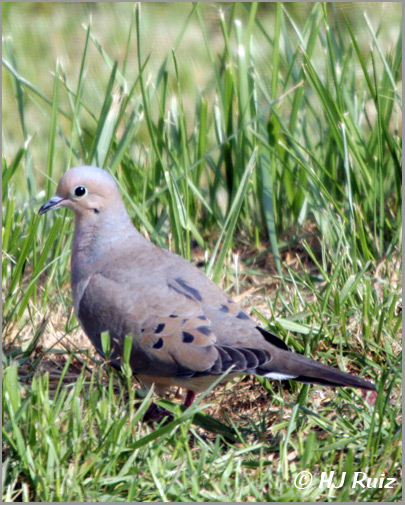
Mourning Dove
Birds have uncinate processes on the ribs. These are hooked extensions of bone which help to strengthen the rib cage by overlapping with the rib behind them. This feature is also found in the tuatara Sphenodon. They also have a greatly elongate tetradiate pelvis as in some reptiles. The hindlimb has an intra-tarsal joint found also in some reptiles. There is extensive fusion of the trunk vertebrae as well as fusion with the pectoral girdle. They have a diapsid skull as in reptiles with a pre-lachrymal fossa (present in some reptiles). The skull has a single occipital condyle.
The skull consists of five major bones: the frontal (top of head), parietal (back of head), premaxillary and nasal (top beak), and the mandible (bottom beak). The skull of a normal bird usually weighs about 1% of the birds total body weight.
The vertebral column consists of vertebrae, and is divided into three sections: cervical (11-25) (neck), Synsacrum (fused vertebrae of the back, also fused to the hips (pelvis)), and pygostyle (tail).
The chest consists of the furcula (wishbone) and coracoid (collar bone), which two bones, together with the scapula (see below), form the pectoral girdle. The side of the chest is formed by the ribs, which meet at the sternum (mid-line of the chest).
The shoulder consists of the scapula (shoulder blade), coracoid (see The Chest), and humerus (upper arm). The humerus joins the radius and ulna (forearm) to form the elbow. The carpus and metacarpus form the “wrist” and “hand” of the bird, and the digits (fingers) are fused together. The bones in the wing are extremely light so that the bird can fly more easily.
The hips consist of the pelvis which includes three major bones: Illium (top of the hip), Ischium (sides of hip), and Pubis (front of the hip). These are fused into one (the innominate bone). Innominate bones are evolutionary significant in that they allow birds to lay eggs. They meet at the acetabulum (the hip socket) and articulate with the femur, which is the first bone of the hind limb.
The upper leg consists of the femur. At the knee-joint, the femur connects to the tibia-tarsus (shin) and fibula (side of lower leg). The tarsus-metatarsus forms the upper part of the foot, digits make up the toes. The leg bones of birds are the heaviest, contributing to a low center of gravity. This aids in flight. A bird’s skeleton comprises only about 5% of its total body weight. Birds feet are classified as anisodactyl, zygodactyl, pterodactyl, syndactyl or pamprodactyl.
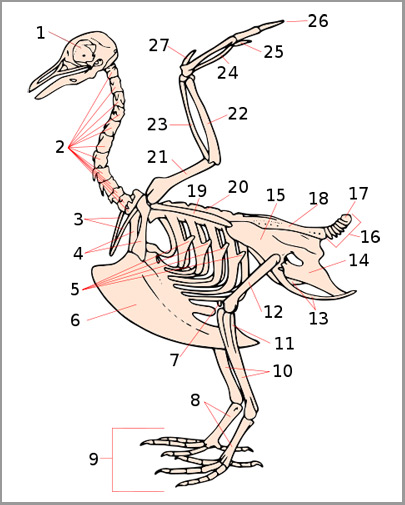
Skeleton drawing based on a dove © Biodidac
1. Skull
2. Cervical vertebrae
3. Furcula
4. Coracoid
5. Uncinate processes of ribs
6. Keel
7. Patella
8. Tarsus-metatarsus
9. Digits
10. Tibia
11. Fibula
12. Femur
13. Ischium
14. Pubis
15. Illium
16. Caudal vertebrae
17. Pygostyle
18. Synsacrum
19. Scapula
20. Lumbar vertebrae
21. Humerus
22. Ulna
23. Radius
24. Carpus
25. Metacarpus
26. Digits
27. Alula
Photograph © H.J. Ruiz – Avian 101
Text is available under the Creative Commons Attribution-ShareAlike License; additional terms may apply. See Terms of use for details.


 H.J. Ruiz - Avian101
You must be logged in to post a comment.