
White Stork
White Stork – Spec. Name: Ciconia ciconia
This is a large bird in the stork family Ciconiidae. Its plumage is mainly white, with black on its wings. Adults have long red legs and long pointed red beaks, and measure on average 100–115 cm (39–45 in) from beak tip to end of tail, with a 195–215 cm (77–85 in) wingspan. The two subspecies, which differ slightly in size, breed in Europe (north to Estonia), northwestern Africa, southwestern Asia (east to southern Kazakhstan), and southern Africa. The White Stork is a long-distance migrant, wintering in Africa from tropical Sub-Saharan Africa to as far south as South Africa, or on the Indian subcontinent. When migrating between Europe and Africa, it avoids crossing the Mediterranean Sea and detours via the Levant in the east or the Strait of Gibraltar in the west, because the air thermals on which it depends do not form over water.
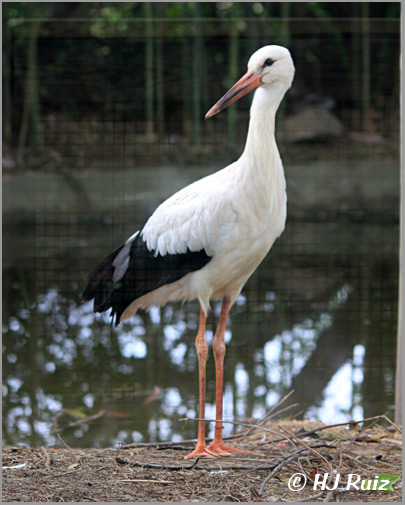
White Stork
A carnivore, the White Stork eats a wide range of animal prey, including insects, fish, amphibians, reptiles, small mammals, and small birds. It takes most of its food from the ground, among low vegetation, and from shallow water. It is a monogamous breeder, but does not pair for life. Both members of the pair build a large stick nest, which may be used for several years. Each year the female can lay one clutch of usually four eggs, which hatch asynchronously 33–34 days after being laid. Both parents take turns incubating the eggs and both feed the young. The young leave the nest 58–64 days after hatching, and continue to be fed by the parents for a further 7–20 days.
The White Stork has been rated as Least Concern by the International Union for Conservation of Nature (IUCN). It benefited from human activities during the Middle Ages as woodland was cleared, but changes in farming methods and industrialisation saw it decline and disappear from parts of Europe in the 19th and early 20th centuries. Conservation and reintroduction programs across Europe have resulted in the White Stork resuming breeding in the Netherlands, Switzerland, and Sweden. It has few natural predators, but may harbour several types of parasite; the plumage is home to chewing lice and feather mites, while the large nests maintain a diverse range of mesostigmatic mites. This conspicuous bird has given rise to many legends across its range, of which the best-known is the story of babies being brought by storks.
The White Stork is a large bird. It has a length from the tip of its beak to the tip of its tail of 100–115 cm (39–45 in), a wingspan of 195–215 cm (77–85 in), and a weight of 2.3–4.4 kg (5.1–9.7 lb). Like all storks, it has long legs, a long neck, and a long, straight, pointed beak. The sexes are identical in appearance, except that males are larger than females on average. The plumage is mainly white with black flight feathers and wing coverts; the black is caused by the pigment melanin. The breast feathers are long and shaggy forming a ruff which is used in some courtship displays. The irises are dull brown or grey, and the peri-orbital skin is black. The adult has a bright red beak and red legs, the coloration of which is derived from carotenoids in the diet. In parts of Spain, studies have shown that the pigment is based on astaxanthin obtained from an introduced species of crayfish (Procambarus clarkii) and the bright red beak colours show up even in nestlings, in contrast to the duller beaks of young White Storks elsewhere.
As with other storks, the wings are long and broad enabling the bird to soar. In flapping flight its wingbeats are slow and regular. It flies with its neck stretched forward and with its long legs extended well beyond the end of its short tail. It walks at a slow and steady pace with its neck upstretched. In contrast, it often hunches its head between its shoulders when resting. Molting has not been extensively studied, but appears to take place throughout the year, with the primary flight feathers replaced over the breeding season.
Upon hatching, the young White Stork is partly covered with short, sparse, whitish down feathers. This early down is replaced about a week later with a denser coat of woolly white down. By three weeks, the young bird acquires black scapulars and flight feathers. On hatching the chick has pinkish legs, which turn to greyish-black as it ages. Its beak is black with a brownish tip. By the time it fledges, the juvenile bird’s plumage is similar to that of the adult, though its black feathers are often tinged with brown, and its beak and legs are a duller brownish-red or orange. The beak is typically orange or red with a darker tip. The bills gain the adults’ red color the following summer, although the black tips persist in some individuals. Young storks adopt adult plumage by their second summer.
White Storks consume a wide variety of animal prey. They prefer to forage in meadows that are within roughly 5 km (3 mi) of their nest and sites where the vegetation is shorter so that their prey is more accessible. Their diet varies according to season, locality and prey availability. Common food items include insects (primarily beetles, grasshoppers, locusts and crickets), earthworms, reptiles, amphibians, particularly frog species such as the edible frog (Pelophylax kl. esculentus) and common frog (Rana temporaria) and small mammals such as voles, moles, and shrews. Less commonly, they also eat bird eggs and young birds, fish, molluscs, crustaceans and scorpions. They hunt mainly during the day, swallowing small prey whole, but killing and breaking apart larger prey before swallowing. Birds returning to Latvia during spring have been shown to locate their prey, moor frogs (Rana arvalis), by homing in on the mating calls produced by aggregations of male frogs.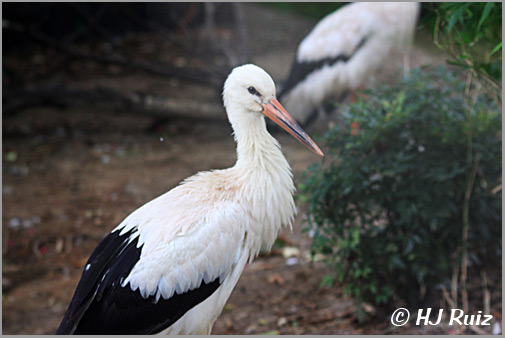
All photographs are © H.J. Ruiz – Avian101
Text is available under the Creative Commons Attribution-ShareAlike License; additional terms may apply. See Terms of use for details.


 H.J. Ruiz - Avian101
You must be logged in to post a comment.