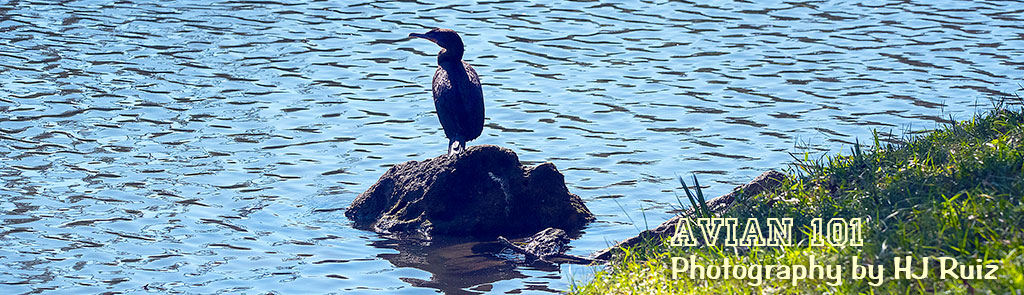
Bird Anatomy
This topic of Bird Anatomy is very interesting and will be uploaded in several parts then the articles will be added to GUIDE section (See top bar of blog)
Bird anatomy, or the physiological structure of birds’ bodies, shows many unique adaptations, mostly aiding flight. Birds have a light skeletal system and light but powerful musculature which, along with circulatory and respiratory systems capable of very high metabolic rates and oxygen supply, permit the bird to fly. The development of a beak has led to evolution of a specially adapted digestive system. These anatomical specializations have earned birds their own class in the vertebrate phylum.
Let’s start with:
PART 1
RESPIRATORY SYSTEM
Due to their high metabolic rate required for flight, birds have a high oxygen demand. Development of an efficient respiratory system enabled the evolution of flight in birds. Birds ventilate their lungs by means of air sacs.
These sacs do not play a direct role in gas exchange, but to store air and act like bellows, allowing the lungs to maintain a fixed volume with fresh air constantly flowing through them.
Three distinct sets of organs perform respiration—the anterior air sacs (interclavicular, cervicals, and anterior thoracics), the lungs, and the posterior air sacs (posterior thoracics and abdominals). The posterior and anterior air sacs, typically nine, expand during inhalation. Air enters the bird via the trachea. Half of the inhaled air enters the posterior air sacs, the other half passes through the lungs and into the anterior air sacs. Air from the anterior air sacs empties directly into the trachea and out the bird’s mouth or nares. The posterior air sacs empty their air into the lungs. Air passing through the lungs as the bird exhales is expelled via the trachea. Some taxonomic groups (Passeriformes) possess 7 air sacs, as the clavicular air sacs may interconnect or be fused with the cranial thoracic air sacs. Birds lungs obtain fresh air during both exhalation and inhalation.
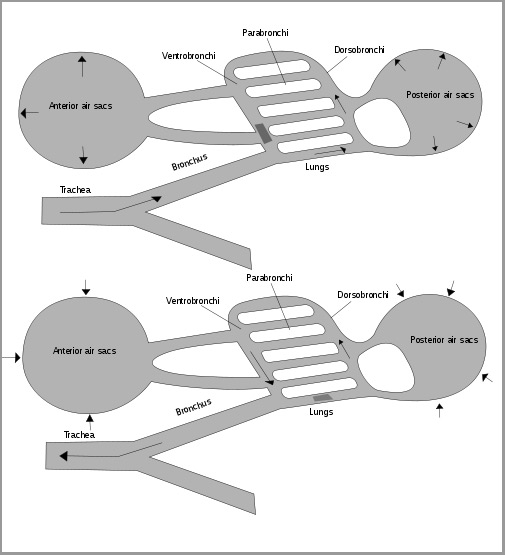
Bird respiratory system
As air flows through the air sac system and lungs, there is no mixing of oxygen-rich air and oxygen-poor, carbon dioxide-rich, air as in mammalian lungs. Thus, the partial pressure of oxygen in a bird’s lungs is the same as the environment, and so birds have more efficient gas-exchange of both oxygen and carbon dioxide than do mammals. In addition, air passes through the lungs in both exhalation and inspiration, with the air sacs functioning as a reservoir for the next breath of air.
Avian lungs do not have alveoli, as mammalian lungs do, but instead contain millions of tiny passages known as parabronchi, connected at either ends by the dorsobronchi and ventrobronchi. Air flows through the honeycombed walls of the parabronchi into air vesicles, called atria, which project radially from the parabronchi. These atria give rise to air capillaries, where oxygen and carbon dioxide are traded with cross-flowing blood capillaries by diffusion.
Birds also lack a diaphragm. The entire body cavity acts as a bellows to move air through the lungs. The active phase of respiration in birds is exhalation, requiring muscular contraction.
The syrinx is the sound-producing vocal organ of birds, located at the base of a bird’s trachea. As with the mammalian larynx, sound is produced by the vibration of air flowing through the organ. The syrinx enables some species of birds to produce extremely complex vocalizations, even mimicking human speech. In some songbirds, the syrinx can produce more than one sound at a time.
Text is available under the Creative Commons Attribution-ShareAlike License; additional terms may apply. See Terms of use for details.


 H.J. Ruiz - Avian101
You must be logged in to post a comment.