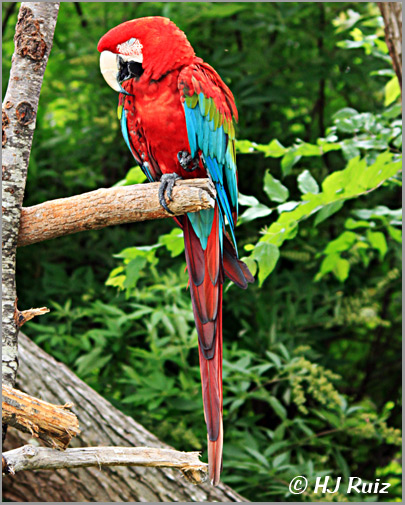
Red and Green Macaw
Red-and-green Macaw, a.k.a. Green-winged Macaw – Spec. Name: Ara chloropterus
This is the largest of the Aragenus, widespread in the forests and woodlands of northern and central South America. However, in common with other macaws, in recent years there has been a marked decline in its numbers due to habitat loss and illegal capture for the parrot trade.
Red and Green Macaw
The Red-and-green Macaw can be readily identified from the Scarlet Macaw as whilst the breast of both birds is bright red, the upper-wing covert feathers of the Red-and-green Macaw are green (as opposed to yellow, or yellow and green in the Scarlet Macaw). In addition, the Red-and-green Macaw has characteristic red lines around the eyes formed by rows of tiny feathers on the otherwise bare white skin patch; this is one of the biggest differences from a Scarlet Macaw to the casual viewer. Iridescent teal feathers are surrounded by red on the tail.
It is second only in size to the Hyacinth Macaw, the largest bird of the macaw family. The wingspan of the Red-and-green Macaw can be up to 49 inches (125 cm), with a total body length of 39 inches (100 cm). A healthy adult will weigh between 1,250 and 1,700 grams (2.7-3.7 lbs).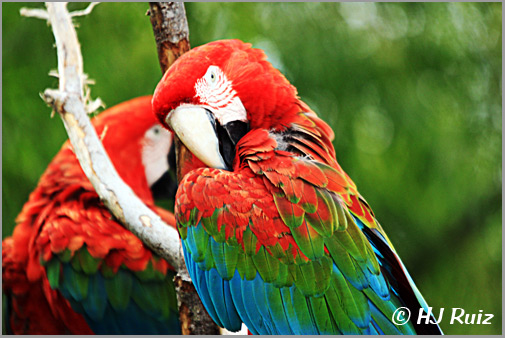
The Red-and-green Macaw has a very powerful beak which can generate a pressure of 2000 psi and can snap a broomstick in half. This powerful beak has evolved to crush or open even the hardest nuts and seeds.
The Red-and-green Macaw generally mates for life. The female typically lays two or three eggs in a nest made in a hole in a tree. The female incubates the eggs for about 28 days, and the chicks fledge from the nest about 90 days after hatching.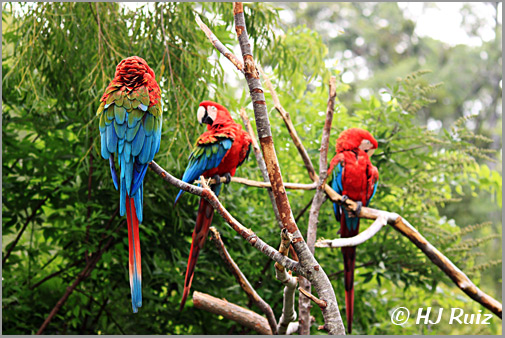
All photographs are © H.J. Ruiz – Avian101
Text is available under the Creative Commons Attribution-ShareAlike License; additional terms may apply. See Terms of use for details.


 H.J. Ruiz - Avian101
Beautiful photos as usual. Macaws are amazing birds.
Large birds with amazing colors are always impressive. Thank you for your comment!