
Humboldt Penguin
Humboldt Penguin, a.k.a. Peruvian Penguin, or Patranca – Spec. Name: Spheniscus Humboldti
This is a South American penguin, that breeds in coastal Peru and Chile. Its nearest relatives are the African Penguin, the Magellanic Penguin and the Galápagos Penguin. The penguin is named after the cold water current it swims in, which is itself named after Alexander von Humboldt, an explorer.
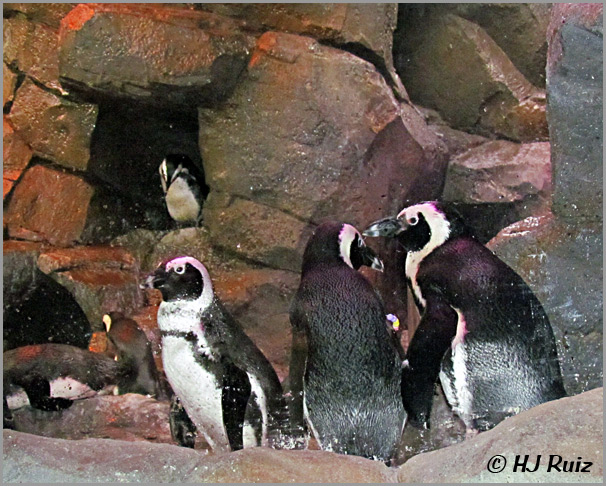
Humboldt Penguin
Humboldt Penguins are medium-sized penguins, growing to 65-70 cm (26-28 in) long and a weight of 3.6-5.9 kg (8-13 lbs). They have a black head with a white border that runs from behind the eye, around the black ear-coverts and chin, and joins at the throat. They have blackish-grey upperparts and whitish underparts, with a black breast-band that extends down the flanks to the thigh. They have a fleshy-pink base to the bill. Juveniles have dark heads and no breast-band. They have spines on their tongue which they use to hold their prey.
Humboldt Penguins nest on islands and rocky coasts, burrowing holes in guano and sometimes using scrapes or caves. In South America the Humboldt Penguin is found only along Pacific coast, and the range of the Humboldt Penguin overlaps that of the Magellanic Penguin on the central Chilean coast.
The current status of this penguin is threatened, due to a declining population caused in part by over-fishing, climate change, and ocean acidification. Historically it was the victim of guano over-exploitation. Penguins are also declining in numbers due to habitat destruction. The current population is estimated at between 3,300 and 12,000. In August 2010 the Humboldt penguin of Chile and Peru, was granted protection under the U.S. Endangered Species Act.
Photograph © H.J. Ruiz – “My Backyard Visitors”
Text is available under the Creative Commons Attribution-ShareAlike License; additional terms may apply. See Terms of use for details.



 H.J. Ruiz - Avian101
You must be logged in to post a comment.