
Greater Flamingo
Greater Flamingo – Spec. Name: Phoenicopterus Roseus
This is the most widespread species of the flamingo family. It is found in parts of Africa, southern Asia (coastal regions of Pakistan and India), and southern Europe (including Spain, Sardinia, Albania, Turkey,Greece,
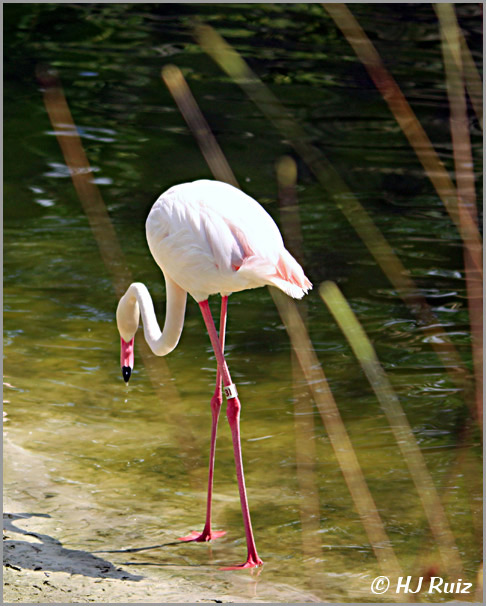
Greater Flamingo
Cyprus, Portugal, and the Camargue region of France). Some populations are short distance migrants, and records north of the breeding range are relatively frequent; however, given the species’ popularity in captivity whether these are truly wild individuals is a matter of some debate. A single bird was seen on North Keeling Island (Cocos (Keeling) Islands) in 1988. Greater Flamingo is the state bird of Gujarat, India.
This is the largest species of flamingo, averaging 110–150 cm (43–60 in) tall and weighing 2–4 kg (4.4–8.8 lbs). The largest male flamingoes have been recorded at up to 187 cm (74 in) tall and 4.5 kg (10 lbs). It is closely related to the American Flamingo and Chilean Flamingo, with which it has sometimes been considered conspecific, but that treatment is now widely seen (e.g., by the American and British Ornithologists’ Union) as incorrect and based on a lack of evidence. Like all flamingos, this species lays a single chalky-white egg on a mud mound. Most of the plumage is pinkish-white, but the wing coverts are red and the primary and secondary flight feathers are black. The bill is pink with a restricted black tip, and the legs are entirely pink. The call is a goose-like honking.
The first recorded zoo hatch was in 1959 at Zoo Basel. In Zoo Basel’s breeding program over 400 birds hatched with an average between 20 and 27 since the year 2000. Due to Basel’s breeding success, most hatched flamingos cannot be kept in the zoo and are given to zoos around the world. Given the history and the large number of birds hatched in Basel since 1959, it can be concluded that most Greater Flamingo zoo colonies around the world are related to the one at Zoo Basel. 
All photographs are © H.J. Ruiz – “My Backyard Visitors”
Text is available under the Creative Commons Attribution-ShareAlike License; additional terms may apply. See Terms of use for details.


 H.J. Ruiz - Avian101
You must be logged in to post a comment.