
Sandhill Crane
Sandhill Crane – Spec. Name: Grus Canadensis
This is a large crane of North America and extreme northeastern Siberia. The common name of this bird references habitat like that at the Platte River, on the edge of Nebraska’s Sandhills in the American Midwest.

Sandhill Crane
This is the most important stopover area for the Lesser Sandhill Crane (Grus canadensis canadensis), with up to 450,000 of these birds migrating through annually.
Adults are gray overall; during breeding, the plumage is usually much worn and stained, particularly in the migratory populations, and looks nearly ochre. The Sandhill Crane has a red forehead, white cheeks and a long dark pointed bill. Its long dark legs trail behind in flight, and the long neck is kept straight in flight. Immature birds have reddish brown upperparts and gray underparts. The sexes look alike. Size varies among the different subspecies. This crane frequently gives a loud trumpeting call that suggests a French-style “r” rolled in the throat, and they can be heard from a long distance.
Mated pairs of cranes engage in “unison calling.” The cranes stand close together, calling in a synchronized and complex duet. The female makes two calls for every single call of the male.
The only other large grayish-bodied bird of North America is the Great Blue Heron. This heron is of similar dimensions to the Sandhill Crane and is sometimes mistakenly called a crane, even though it is very different in plumage details and build. Like other herons, it flies with its neck tucked toward the body.
The sandhill crane’s large wingspan, which is 6–8 feet when fully grown, makes this a very skilled soaring bird similar in style to hawks and eagles. Utilizing thermals to obtain lift, they can stay aloft for many hours, requiring only occasional flapping of their wings and consequently expending little energy. With migratory flocks containing hundreds of birds, they can create clear outlines of the normally invisible rising columns of air (thermals) that they ride.
The Sandhill Crane flies south for the winter. In their wintering areas they form flocks of over 10,000 birds. One place to observe this is at Bosque del Apache National Wildlife Refuge, 100 miles south of Albuquerque, New Mexico. There is an annual Sandhill Crane Festival in November.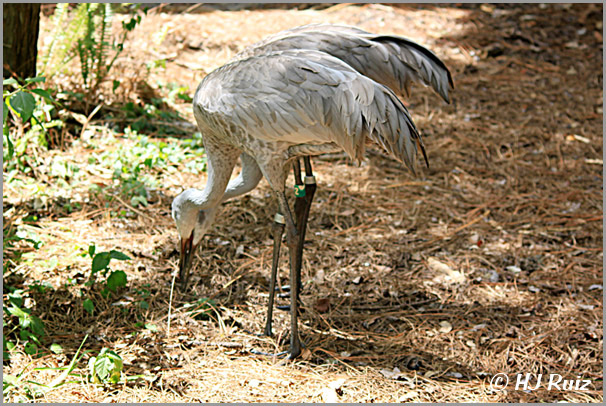
All Photographs are © H.J. Ruiz – “My Backyard Visitors”
Text is available under the Creative Commons Attribution-ShareAlike License; additional terms may apply. See Terms of use for details.


 H.J. Ruiz - Avian101
You must be logged in to post a comment.